FAQs
The full rollout of Claude will take place in the spring. Your school/department and OIT will provide additional updates and detailed guidance as it becomes available.
Your SMU Claude license is intended for university-related work - teaching, research, administrative tasks, and other job-related activities. Use must comply with SMU’s Acceptable Use Policy (8.1) and Information Security Policy (8.2), including guidance on what types of university data can be used with AI tools.
The Claude research offer is connected to a Principal Investigator (PI) personally and cannot be later migrated to a university-managed environment. It may become significantly more expensive after the initial promotional period. For both cost and compliance reasons, the guidance from our research office is that SMU PI's should not participate in this program.
If your personal account uses your @smu.edu email address, you can follow the guide Coming From a Personal Claude Account to migrate your content. You cannot keep both your personal account on @smu.edu and an enterprise workspace account.
No. SMU has negotiated service agreements to protect SMU data. Anthropic will use no inputs or outputs from the SMU-provided accounts to train models in any of their products.
On September 30, 2026, Anthropic began applying its EU AI Act text watermark to outputs from these three models. This is the same watermark Claude Fable 5.1, Claude Opus 5.5, and Claude Opus 5 already carry. The watermark is an imperceptible statistical pattern in word choice. It does not change the meaning, quality, or readability of responses, adds no characters or tokens, and has no effect on pricing, latency, or request/response formats. It contains no information about the user, their organization, or their conversations with Claude.
Anthropic retains your chats and coding sessions in the product to provide you with consistent product experience. You control your conversations and can delete your chats anytime from your dashboard. When you delete a conversation, it is:
- Removed from your chat history immediately
- Deleted from Anthropic's back-end storage systems within 30 days
You can find several resources in Claude Academy. Here are some to get you started:
- Claude 101
- AI capabilities and limitations
- What are Projects?
- How can I create and manage Projects?
- Project visibility and sharing
- What are Artifacts and how do I use them?
- Usage Limit Best Practices
- Create and edit files with Claude
- When should I use web search, extended thinking, and research?
- Claude Code 101
Under our enterprise license, Anthropic provides the models you see under the options.
This is a fair question given how AI is discussed in the news. Today's AI systems, including Claude, don't have the ability to act independently in the physical world, access systems they haven't been given permission to use, or make consequential decisions without a person involved. The more immediate risks with any AI tool are things like sharing the wrong type of data, over-relying on AI output without checking it, or using AI in ways that bypass university approval processes - which is why SMU's policies require human review for consequential decisions and restrict what data can be used with AI tools. If you have concerns about a specific use case, reach out to askaboutai@smu.edu.
Troubleshooting
Can't sign in via SSO?
There are a few things to note when attempting to access Claude through SSO:
- Members with @smu.edu accounts in organizations created before the SSO enablement will continue to be able to access these organizations, but with SSO only.
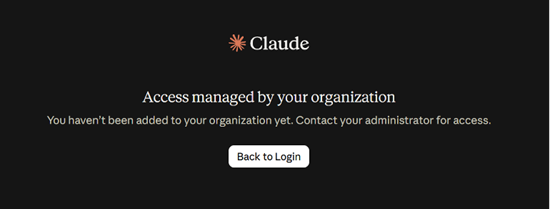
- New members who do not have a personal / separate organization already will see the following until assigned a seat in the SMU organization:
I’m experiencing some challenges in Claude. What do I do?
| Challenge | What's happening | Try this |
|---|---|---|
| Claude's response is too generic | Your prompt didn't include enough context about your specific situation | Add details about your audience, role, or constraints. Instead of "Write an email about the project delay," try "Write an email to our enterprise client explaining that the software integration will be delayed by two weeks. They've been patient so far but this is the second delay. Keep it professional but apologetic." |
| The response is too long (or too short) | Claude is guessing at appropriate length | Be explicit: "Give me a two-paragraph summary" or "Keep this under 100 words" or "I need a comprehensive analysis—length isn't a concern." |
| Claude didn't follow my format | Claude understood what you want but not how you want it presented | Show, don't just tell. Provide an example of the format, or describe the structure explicitly: "Use bullet points with bold headers for each section." |
| The tone isn't right | Claude defaults to helpful and professional, which may not match your needs | Describe the tone in plain language: "Make this more conversational" or "This should sound authoritative and formal." Provide an example of writing in the style you want. |
I have a question not answered here. Where can I go for help?
You can send an email to askaboutai@smu.edu and someone will be in touch.