All F-1 students who wish to gain practical experience off campus in a paid or unpaid position must have CPT Approval on pg. 2 of the I-20 from the International Office before starting any off-campus practicum training. Unauthorized employment is a serious violation of F-1 status.
Curricular Practical Training (CPT)
Don’t see the answers you’re looking for?
Here’s how to reach International Office (IO) for help:
☎️ 214-768-4475
📧 intloffice@smu.edu
🚶🏾 Blanton Student Services Building, Suite 101
Curricular Practical Training (CPT)
Under 8 CFR § 214.2(f)(10)(i), Curricular Practical Training (CPT) is defined as:
“alternative work/study, internship, cooperative education or any other type of required internship or practicum that is offered by sponsoring employers through cooperative agreements with the school.”
The regulations further require that CPT be “an integral part of an established curriculum” and directly related to the student's major area of study.
At SMU, CPT must be a required component of the student's established curriculum and necessary to complete the degree, meaning it must fulfill degree requirements. An elective internship or optional practical experience does not qualify for CPT authorization simply because it offers academic credit or relates to the student's field of study.
Eligible practical training must have clearly defined academic learning objectives, faculty oversight, and assessment of student learning.
Furthermore, CPT is temporary employment authorization available to eligible F-1 students who have completed at least one full academic year of study and whose academic program includes a CPT-eligible curricular requirement.
Exception to the one-academic-year requirement: Graduate students may qualify for CPT before completing one academic year only when their established graduate program requires immediate participation in practical training for all students in the program. At SMU, this requirement must be documented in the curriculum and apply to all students in the applicable program, regardless of citizenship or immigration status.
All CPT requests must be reviewed and authorized by the International Office before students begin their practical training experience.
Official regulatory reference: 8 CFR § 214.2(f)(10)(i).
Application:
-
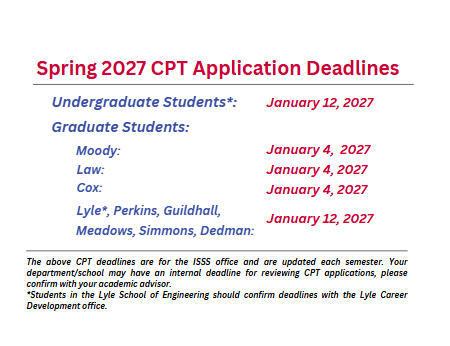
All CPT Applications must be submitted to the International Office by the deadlines listed below.
-
The CPT Application is submitted via DocuSign; which includes a job offer letter, specifics of the CPT-eligible course verified by an academic/faculty advisor, and a signed legal agreement between the employer and SMU.
Employment Start and End Dates:
Employment may begin before the first day of the academic session but must end no later than the official session end date.
CPT work authorization is approved on a semester basis, as the practical training must be required for a specific course.
Click here to view the SMU Academic Calendar.
Meadows performance students may submit a CPT application at any time during the semester, provided they are enrolled in the appropriate course that requires continuous
practicum experience to meet the course's learning objectives.
How to Apply for Curricular Practical Training (CPT)
Step-by-Step Application Process
Step 1: Confirm CPT Eligibility with Your Academic or Faculty Advisor
Meet with your academic or faculty advisor to determine whether your degree program includes a required internship or practicum that qualifies for CPT.
- CPT must be an integral and required part of your established curriculum and directly related to your major area of study.
- Not all SMU degree programs include courses or academic requirements that qualify for CPT.
- Elective internships, optional practical experiences, or courses that offer academic credit but are not required to complete your degree do not qualify for CPT authorization under SMU's current requirements.
Step 2: Enroll in the Required Course
Enroll in the course that requires the practical training experience. Work with your academic or faculty advisor to confirm that the proposed employment meets the course's academic requirements and learning objectives.
- The practical experience must be integral and required to fulfill degree requirements.
- The course must include appropriate faculty oversight and assessment of student learning.
- CPT authorization is approved on a semester basis and must align with the academic requirements and dates of the course.
Step 3: Secure an Employment Offer
Obtain an employment offer that meets the requirements of your academic program.
If you need assistance finding an employer, contact the Hegi Family Career Development Center at the Hughes-Trigg Student Center.
Step 4: Prepare Your CPT Application
Before submitting your CPT application, have the following information available:
- Academic/Faculty Advisor: Name and contact information of the faculty member responsible for verifying the academic requirements and overseeing the practical experience.
- Employer Representative: Name and contact information of the individual authorized to sign the CPT agreement on behalf of the employer. This may be your supervisor, a Human Resources representative, or another authorized company representative.
- Employment Offer: An offer letter that includes the employer's name, work location, position, employment dates, and a description of the work to be performed.
- Course Information: Details of the required course, including enrollment and how the employment fulfills its academic learning objectives.
Important: CPT based on thesis or dissertation work is only eligible when the practical training is a documented requirement of the established curriculum. An advisor's letter confirming that employment relates to a student's research or dissertation is not sufficient by itself to establish CPT eligibility.
Step 5: Submit Your CPT Application
Complete and submit your application through DocuSign.
What Happens After You Submit Your CPT Application?
- Academic/Faculty Advisor Review: Your academic or faculty advisor will receive a DocuSign request to verify your enrollment, confirm that the practical experience is required by your established curriculum, and verify that the employment meets the course's learning objectives.
- Employer Review: Once your academic or faculty advisor completes their portion, the employer representative will receive a DocuSign request to review and sign the CPT agreement.
- SMU Approval: Once the employer signs, the designated SMU representative will receive the agreement for institutional approval.
- International Office Review: The International Office will review the completed application, verify CPT eligibility, and determine whether the employment meets federal regulations and SMU's CPT requirements.
- CPT Authorization: If approved, the International Office will issue a new Form I-20 reflecting your CPT authorization on page 2. You will receive an email when your updated I-20 is ready.
- Begin Employment: Review your new I-20, sign page 1, and provide the appropriate documentation to your employer to complete the onboarding process. You may begin your off-campus practicum experience (employment) only AFTER receiving your CPT-authorized I-20 and no earlier than the approved CPT start date.
Important Reminders
- Do not begin any off-campus practicum experience/employment before receiving your CPT authorization. Any off-campus practicum experience including training performed without proper authorization may result in a violation of your F-1 status.
- CPT authorization is employer-specific and limited to the approved dates, location, and employment conditions listed on your I-20.
- Any changes to your employer, employment dates, or other authorized conditions must be reviewed by the International Office before the changes take effect.
- CPT authorization generally follows the academic semester and the requirements of the associated course. View the SMU Academic Calendar.
- If you do not have a Social Security Number, you will need to apply for one to complete employment-related requirements.
CPT Tutorial for Students
Review the CPT tutorial before submitting your application to better understand eligibility requirements, the application process, and your responsibilities while participating in CPT.
CPT For Students