Beyond the Mainstage: Inside the Collaborative World of Meadows Theatre
From mainstage productions to entirely student-led performances, Division of Theatre students are building their skills as performers, directors, writers and collaborators both onstage and behind the scenes.

At Meadows, theatre students are discovering that bringing a production to life involves much more than what audiences see onstage. Through mainstage performances, behind-the-scenes roles, and independent creative projects, students in the acting and theatre studies programs are gaining hands-on experience while learning the value of collaboration and creative independence.
For theatre student Grayson Kindel, who recently portrayed Boo Radley in Meadows' production of To Kill a Mockingbird, the experience reinforced an important lesson about approaching every role with intention. Though Boo appears relatively briefly, Kindel recognized the character's significance in shaping the story and its central themes.
“It taught me that there's no small role, there's only small actors,” he says. “In truth, if you think your role is small, then your performance will be small.”
Beyond individual performances, Kindel has gained a greater appreciation for the many people involved in bringing a production to the stage, from actors and directors to stage managers and technical crews. He also points to the program's emphasis on the creative process rather than simply the finished product as a defining part of his education.
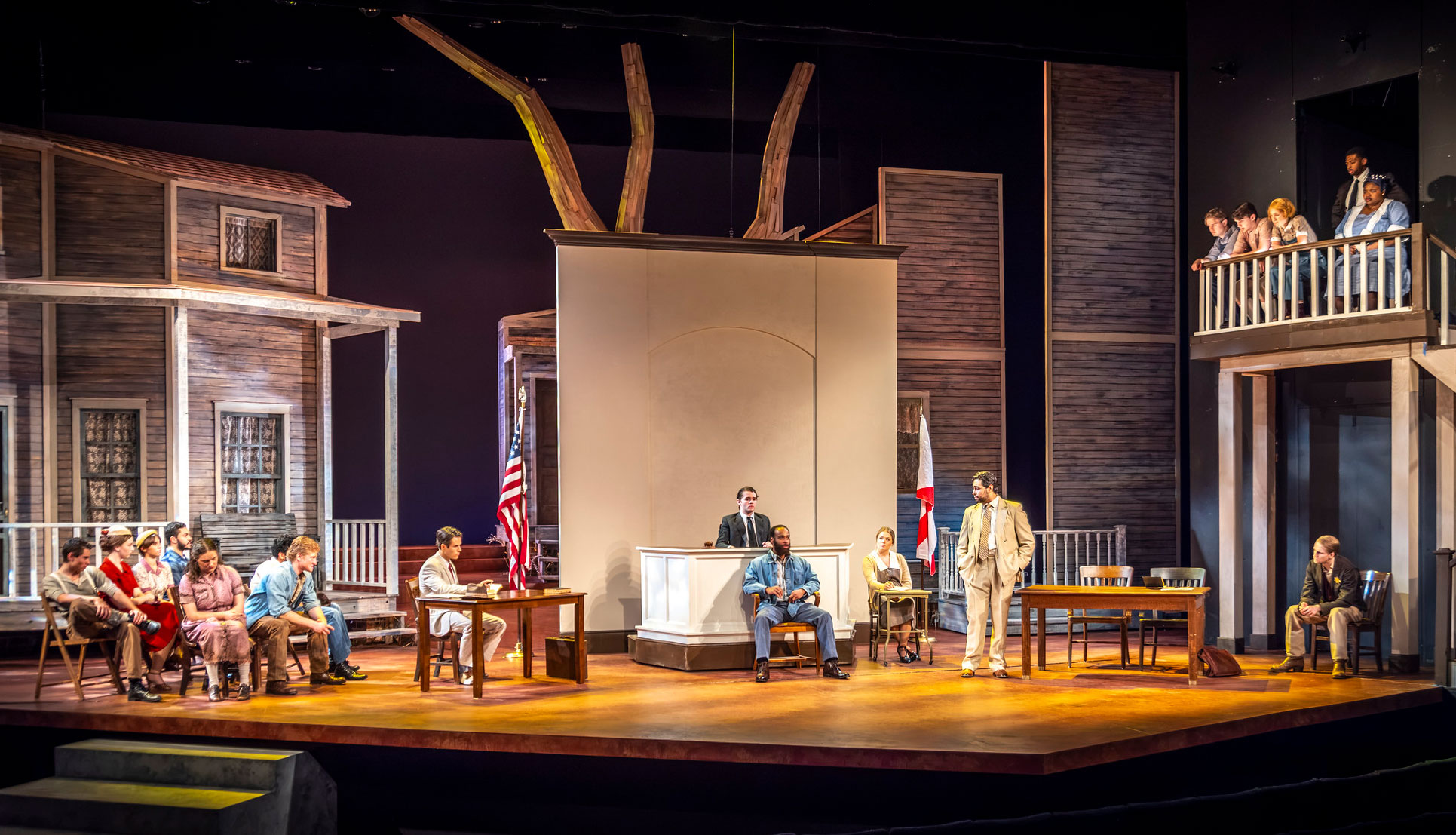
The cast of SMU’s “To Kill a Mockingbird” during a pivotal scene in the show.
“We spend days mulling over scenes and trying to make it work, and the directors and teachers guide us, but the process itself is student driven,” Kindel explains. “We are our own creators and thus, when it comes to make work, at our young age, it will always take time.”
While mainstage productions provide opportunities to work on larger-scale performances with faculty guidance, students can also take full creative ownership of their work through SMU Student Theatre (SMUST), a student-led organization that produces a variety of performances throughout the academic year. With productions organized entirely by students, SMUST offers opportunities to explore different roles, experiment creatively and gain practical experience managing a production.
“All theatre students are constantly making connections of what we're learning in class to our rehearsals, performances, etc,” theatre student Joseph Sostre explains. “We're always trying to see how our training can be implemented and SMUST makes it really easy to frequently implement our trainings in rehearsal and performance.”
For Sostre, that opportunity to apply his training has taken on a new dimension through Trapped, an original play he is writing and directing. Set in a New York City apartment during a snowstorm, Trapped follows two strangers who meet through an online dating site. When the building's entrance freezes shut, the pair find themselves unexpectedly confined together, creating an opportunity to explore vulnerability, connection and the risks of falling in love.
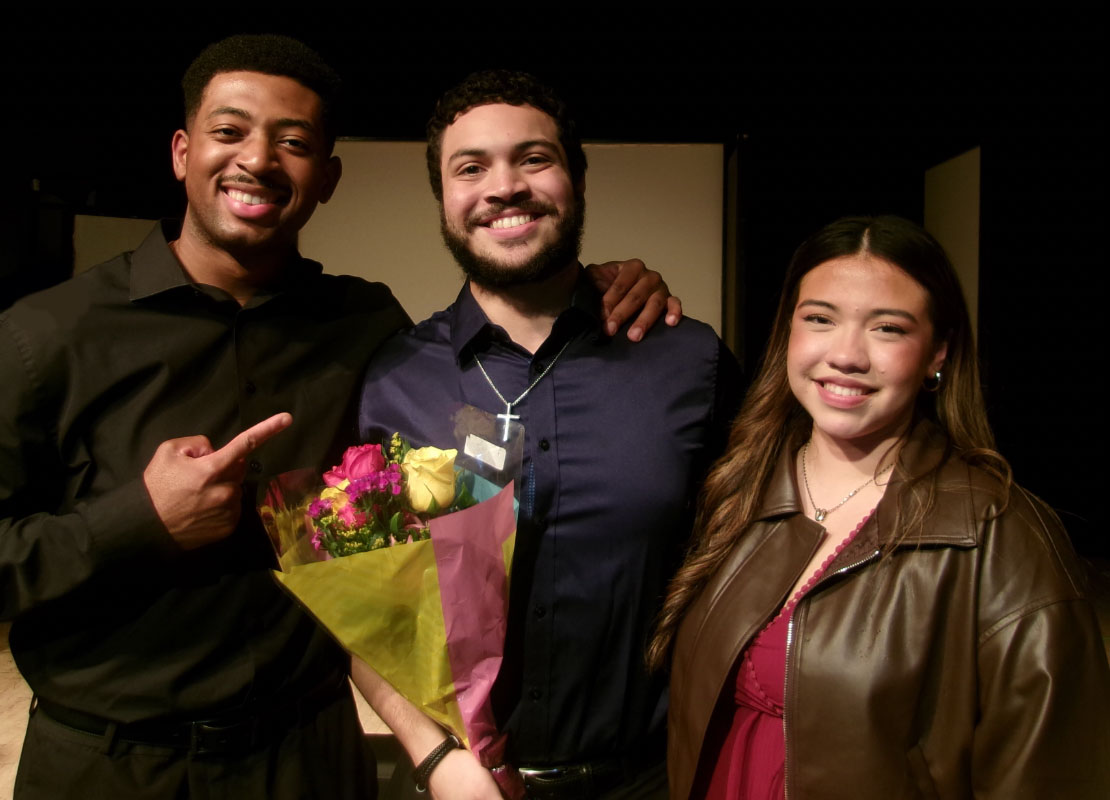
Sostre (middle) with fellow theatre students and stars of his show, Brayden Revis (left) and Amy Garcia (right).
While Sostre has approximately three years of directing experience, Trapped marks his first venture into playwriting. Developing the script has involved extensive revisions and adjustments, teaching him that creating theatre is an ongoing process of experimentation rather than a pursuit of perfection.
Taking on both responsibilities has also allowed Sostre to draw upon lessons learned through his coursework, productions and fellow students: “Even though it is a scary and risky thing to put up a SMUST as a sophomore, I felt ready enough from what I have learned, not only from faculty, but from my fellow artists in the department to be able to take up this responsibility.”
Through faculty-guided training and independent creative opportunities, Division of Theatre students like Kindel and Sostre are discovering that some of their most valuable lessons come not from the final performance, but from the collaboration and creative exploration that make it possible.