Sand could be key to safer, stronger civil infrastructures
Sand-filled dampers withstand extreme temperature effectively, research finds.

In brief:
- Pressurized sand-filled dampers could be a cheaper and more environmentally friendly alternative to traditional oil-filled dampers.
- Unlike conventional silicon oil dampers, which can leak and require costly replacement, sand dampers were shown to remain effective under extreme temperatures and moisture conditions.
- Researchers plan to further test sand-filled dampers, this time both through simulations and in real-world situations using a large-scale structure.
Engineers have been working to protect buildings, bridges and other structures from severe weather and natural hazards damage for centuries, but one of the best methods may begin with sand, according to a study published in the ASCE Journal of Engineering Mechanics and a subsequent study published in ASCE Journal of Structural Engineering.
Many high-rise buildings, bridges and other structures use dampers to mitigate vibrations and absorb vibration energy, reducing the amount of stress placed on the structure’s beams and columns. These devices help increase the longevity of the building, but traditional, liquid-based dampers are costly and difficult to replace.
A study shows that pressurized sand dampers perform better under extreme temperatures and provide a cheaper, more environmentally friendly option for construction.
“Most dampers used in civil engineering applications and other shock absorbers use silicon oil to dissipate energy. But the challenge with these devices is that…they may leak prematurely, because the dampers are subjected to a variety of loads including long-duration loading,” said lead study researcher Nicos Makris, Addy Family Centennial Professor in Civil Engineering at SMU Lyle. “What is different and truly innovative with our pressurized sand damper is that it contains sand rather than oil.”
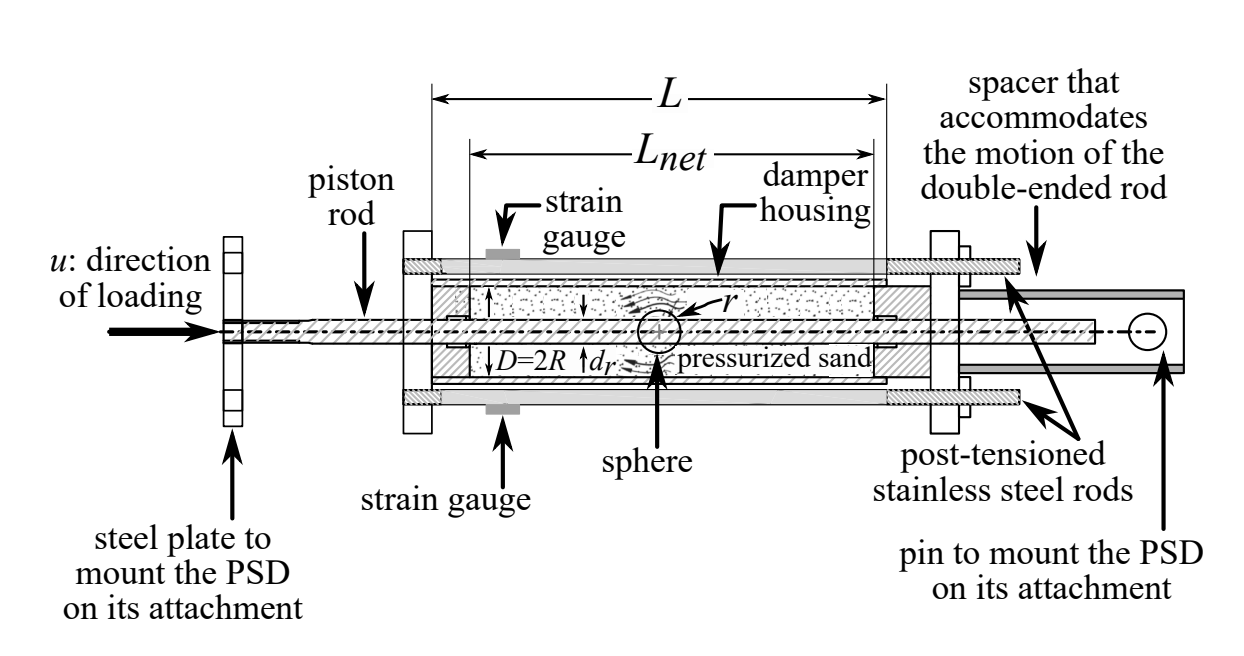
The pressurized sand-filled damper SMU created absorbs energy and reduces movement as a sphere moves through tightly packed sand. External steel rods create the pressure, while strain gauges monitor their tensile force in real time. Credit: ASCE.
Makris first got the idea to replace oil with sand inside dampers when Bay Bridge in California surprisingly had all of its 94 oil dampers start leaking less than five years after they were installed.
“When viscous dampers are subjected to continuous loading, this can increase the temperature inside the damper housing, resulting in the viscous heating effect that can in turn damage the end seals that protect the oil from leaking out,” said Kostas Kalfas, assistant professor of structural engineering at Texas State University. “We cannot just go and add more silicon oil, because viscous dampers are complicated mechanisms. It needs to be removed completely from the structure and sent back to the manufacturer for them to replace or repair it.”
While the dampers are damaged or are in the process of being replaced, the building is more susceptible to vibrations. While severe weather events could cause damage during this time, even normal wind and other weather can affect the building’s inhabitants, said Liang Cao, University of Mississippi incoming assistant professor of civil engineering.
In high rise buildings, even if the structure is fine, too much vibration means people may get motion sickness and can no longer work in that building,” he said. “So even if the building is structurally sound, you have an economic loss.”
Swaying skyscrapers have also been associated with tiredness, low mood and difficulty concentrating.
In comparison, pressurized sand dampers can be replaced or repaired within a few hours of being damaged, Kalfas said.
“The sand damper is very easy to build and monitor,” he said. “This is something that a lay person or a machinist can accomplish in-situ, so you don’t have to send it back to the manufacturer.”
Cao; Kalfas; James Ricles, professor of civil engineering at Lehigh University; Makris and Usama El Shamy, Interim Department Chair of Civil and Environmental Engineering at SMU Lyle, tested the sand dampers at internal temperatures of up to 140 degrees and as low as 42 degrees to ensure they could withstand extreme conditions.
The researchers also tested whether wet sand changed the damper’s ability to perform and found it did not.
“That means even if the humidity causes moisture to form in the damper, it’s still functional,” Cao said.
In the next phase, Cao and Kalfas plan to test sand dampers both through simulations and in real-world situations using a large-scale structure.
“We have already shown that the damper is stable in different temperatures, different conditions, and now we need to do optimization tests for the dampers in dynamic conditions,” Cao said. “We want to show the effectiveness and test how it works in a full-scale structural system.”
This material is based on work supported by the National Science Foundation grant nos. CMMI-2036131 at Southern Methodist University and CMMI-2037771 at Lehigh University. Any opinions, findings, and conclusions or recommendations expressed in this material are those of the author(s) and do not necessarily reflect the views of the National Science Foundation. – University of Mississippi and SMU