New Year’s with George Washington: Despair and Defiance
The beginning of the new year often marked a defining change in Washington’s leadership, says SMU historian

DALLAS (SMU) – On January 1, 1776, George Washington defiantly raised the Union flag on Prospect Hill high above British-occupied Boston. The flag-raising 250 years ago represented new oaths for members of the reorganized Continental Army, a new start for deserters and others who had strayed from military disciplinary and an in-your-face message to the British Army.
SMU historian Alexis McCrossen opens her forthcoming book on the history of New Year’s in America with this scene.
“What an extraordinary New Year’s Day,” she says, “A defiant flag-raising ceremony, the formation of a renewed army and clemency for those who had left the army.”
New Year’s continued to be a significant season for Washington throughout the Revolutionary War and during the early years of the country, she says.
McCrossen is a cultural historian who studies an emerging area in historical research, temporal studies, a new way of looking at the past through the study of the measurement, importance and recognition of time. Her forthcoming book, How the New Year Became the Time of Your Life: A History, is expected to be released in November, 2027.
A “melancholy prospect”
On New Year’s Eve, 1776, not expecting reinforcements until spring, Washington confided in a letter to a correspondent, “the old year closes with a melancholy prospect.” He was short 10,000 soldiers to maintain the siege over Boston and in desperate need of supplies.
On Jan 1, however, Washington rallied. His encampment had received a copy of King George III’s October 27 speech to Parliament, McCrossen says. The king’s mocking description of the efforts of the Continental Congress and Army as “a desperate conspiracy” and the suggestion that they would be crushed were insulting and inspiring.
Ater Washington’s troops raised a flag that was visible from the Boston harbor, a thirteen-gun salute was fired, followed by thirteen cheers, McCrossen says. British General Howe and his troops wrongly assumed the Americans were surrendering. Instead, the newly enlisted recruits swore a “Continental Oath of Allegiance.”
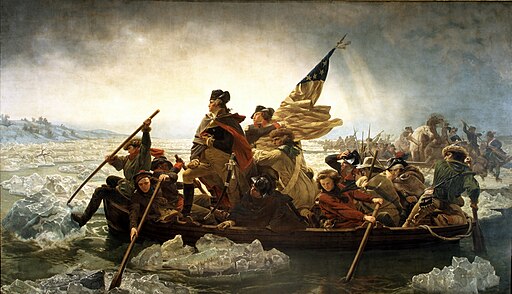
Emanuel Leutze, “Washington Crossing the Delaware” (1851), Metropolitan Museum of Art.
New Year’s 1777, no holiday ceasefire for Washington’s Army
The 1851 Emanuel Leutze painting, “Washington Crossing the Delaware,” depicts a stern Washington standing in an open boat as soldiers row him across the icy river, surprising British troops early on Christmas Day. The surprise attack began a decisive battle against the British where the American troops took 1,000 prisoners and reportedly ate the Christmas rations the British left behind as they retreated. On New Year’s Day, Washington issued a reminder and orders to his troops, setting moral standards for fighting forces – “humanity and tenderness to women and children will distinguish brave Americans, contending for liberty, from infamous mercenary ravagers.”
1778 in Valley Forge, a New Year’s toast to desperate soldiers
Encamped during a bitter winter In Valley Forge, Pennsylvania, 12,000 of Washington’s soldiers prepared to resume fighting when warmer weather arrived. More than 2,000 soldiers died there, not from battle but from disease. On Jan. 1, 1778, Washington ordered a New Year’s gill of spirits for each soldier, the equivalent of about two shots. Jan. 1 was a critical day for the Washington’s army - it was the day troops re-enlisted to fight another year.
“Good spirits were essential,” McCrossen says.
1784 A quiet New Year’s at Mount Vernon
In 1783, George Washington promised his wife, Martha, he would be home for the holidays. John Jay negotiated the Treaty of Paris, ending the war shortly before Christmas, 1783. On Dec. 23 in Annapolis, Maryland, Washington resigned his commission as commander-in-chief of the Continental Army and headed home to Mount Vernon.
1790 - A 141-year New Year’s tradition begins
After his inauguration as president in April of 1989, Washington hosted the first President’s Open House for all Americans on Jan. 1, 1790 in the temporary capital in Manhattan, New York. It was a grand affair, McCrossen says. Its formality and ceremony drew from King George III’s reception for the court of St. James on Jan. 1, 1776.
Beginning with George and Martha Washington’s 1790 party, through President Herbert Hoover in 1931, U.S. presidents hosted an open house at the president’s residence on New Year’s Day for all Americans.
Jan 1, 2026 - The Flag Flies Again on Prospect Hill
The American flag is still raised on Jan. 1 every year on Prospect Hill to commemorate the day in 1776, when a defiant George Washington ordered the flag raised to signal not surrender, but staunch determination to continue the fight for freedom.
About Alexis McCrossen: SMU Professor of HistoryAlexis McCrossen is a cultural historian, specializing on the history of time and timekeeping. Her forthcoming book, How the New Year Became the Time of Your Life: A History, is expected to be released in November, 2027. Her previous books include Holy Day, Holiday: The American Sunday (2000) and Marking Modern Times: Clocks, Watches and Other Timekeepers in American Life (2013). She has spent New Year’s all over the world, including in the Kingdom of Tonga which sits on the International Dateline, and so is one of the first places in the world to greet the new year.
##
SMU is the nationally ranked teaching and research university in the dynamic city of Dallas, and a member of the prestigious Atlantic Coast Conference. SMU’s alumni, faculty and more than 12,000 students in eight degree-granting schools demonstrate an entrepreneurial spirit as they lead change in their professions, communities and the world.