Inside SMU’s archaeology lab, volunteers young and old preserve history
Students, researchers and volunteers work together in the Archaeology Research Collections to preserve artifacts spanning half a million years.

On his first day volunteering at SMU’s Archaeology Research Collections (ARC) lab this summer, high school student Eric Weinberg met Christy Bednar, a longtime volunteer with a particular expertise in stone tools. As they talked, Weinberg learned that Bednar had spent years excavating in the deserts of Egypt and Sudan, working alongside some of the biggest names in the field, including her late husband, Fred Wendorf, who founded SMU’s Department of Anthropology.
“I was really surprised,” Weinberg said. “For somebody who is just beginning in archaeology, like me, it’s really valuable to meet and volunteer alongside someone like that.
That moment captures what makes the ARC’s volunteer program special. In the lab, tucked into Heroy Hall, faculty, postdoctoral researchers, students and volunteers work side by side to catalog, preserve and study artifacts and records, spanning Middle Stone Age sites in Africa, Paleoindian camps, ancestral Caddo and Wichita villages, Spanish missions and a North Texas Freedmen community.
Recent projects have also included artifacts recovered from beneath the John F. Kennedy Memorial in downtown Dallas and from reservoir excavations across North Texas.
Preserving artifacts from sites that no longer exist
In many cases, the lab holds the only surviving record. “Our collections provide faculty and students at SMU and other universities the possibility of asking entirely new research questions about the human past,” said ARC Director Matthew T. Boulanger, “and they usually come from archaeological sites that no longer exist.
“I like to think of what we do as part librarian, part detective,” he said. “Artifacts are non-renewable resources and we must be good stewards of them. Because technology is constantly advancing, preserving these items today could lead to somebody in the future being able to do something very cool and answer questions about our past we can’t even think of.”
Bednar trained as an archaeologist and contributed to a 2018 international volume of research published in Wendorf’s honor. Her current assignment carries a quiet symmetry: she has been organizing the ARC’s collections of Middle Stone Age and Early Stone Age artifacts from Africa, material dating back as much as a half a million years, from the same region and era that defined her decades of fieldwork.
“I know something about how to work with artifacts, especially stone tools, and at my age, this is gratifying,” Bednar said. “It may seem like just a volunteer shift, but for me it’s extremely meaningful. I like to be helpful, I like to use my skills while I can, and this is congenial ground.”
Part of that congeniality, she said, comes from the mix of people in the room: graduate students on their way to professional careers in archaeology and younger students just beginning to discover the field.
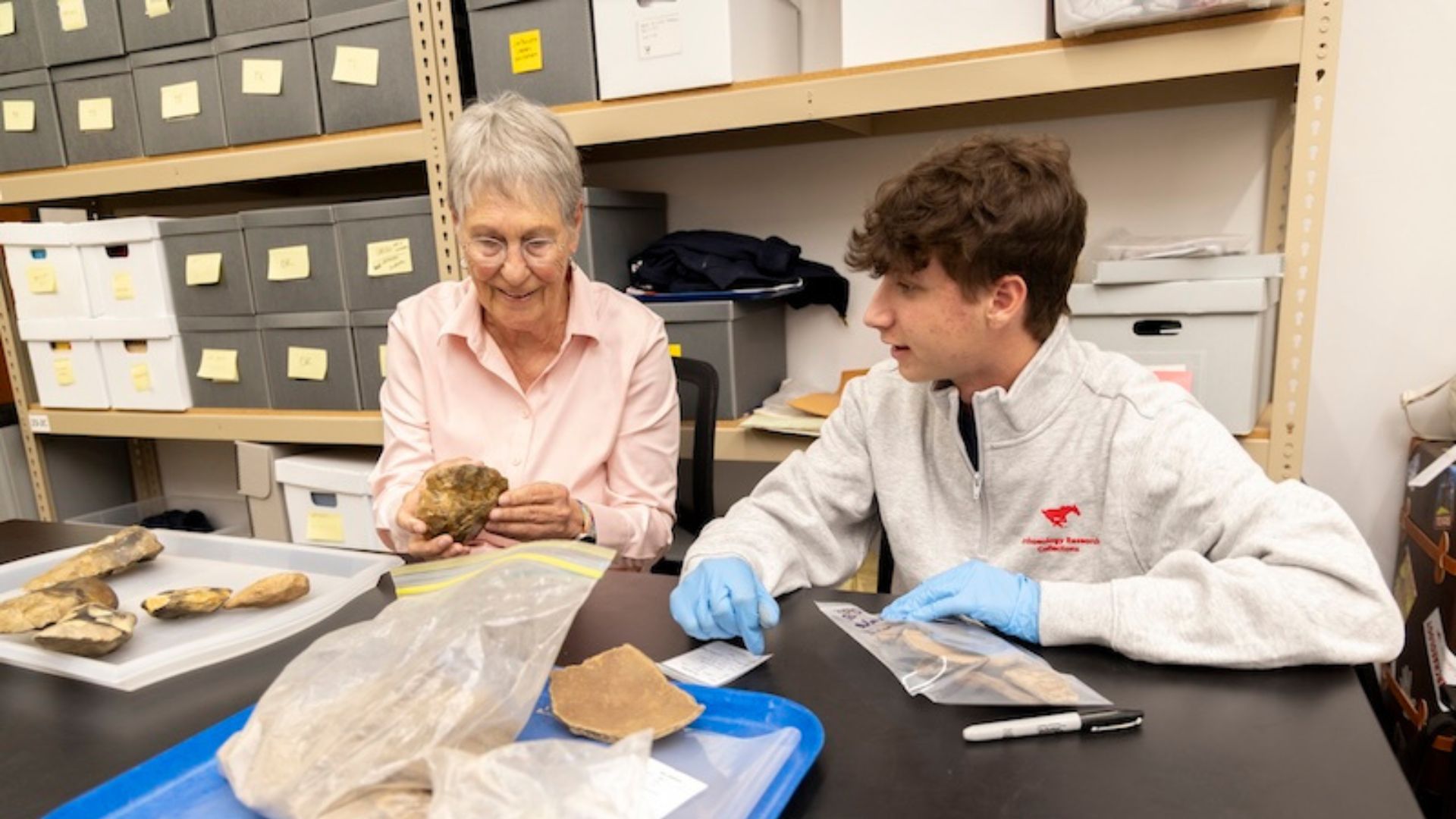
How a high school student became an archaeology volunteer at SMU
Weinberg’s path into the lab started with a seventh-grade history class and an announcement his mom spotted late in his freshman year: a monthly Saturday open lab day at the ARC, coordinated through the North Texas Archeological Society. He went, met Boulanger, and was hooked by a demonstration of flint knapping, the ancient craft of shaping stone tools.
“I came in not really having any experience or knowledge, but Dr. Boulanger has taught me a lot,” Weinberg said. “I just really liked it, so I kept coming back on Saturdays. Since then, I’ve gotten more involved, and this summer I’m going to two field schools.”
The ARC hosts monthly lab days in partnership with the North Texas Archeological Society, generally on the last Saturday of each month. More information is available at ntxas.org/smu-lab-days.