
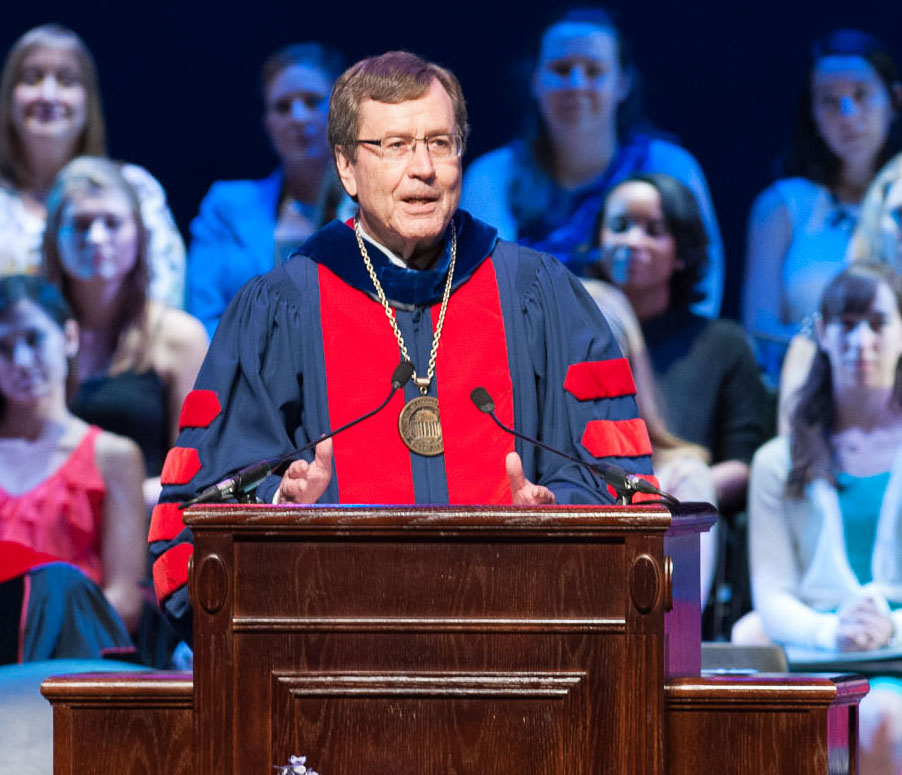
Opening Convocation 2015 speech by SMU President R. Gerald Turner
Your Centennial Predecessors and You
 So far, in your short time at SMU, you have passed several milestones: Move-In Day, Corral, and now Convocation. Of course, the last and most important one will occur tomorrow when you truly begin your path toward a college degree. For our first-year students, the four years will go very quickly. So make the most of the time. By the way, your parents expect you to graduate in that time! If you already have other plans to expand it, I can’t advise you whether to start breaking this possibility to them now, or surprise them near the end of the four years. You are on your own with that discussion. Those of you who are transferring will have varying periods of time here, but your years here, too, will go much faster than you might wish they had. For all of you, it is a great time in your life, and we are delighted that you will be living it at SMU.
The Centennial of our founding was 2011, so at Convocation in 2011, I discussed the reasons that what is now The United Methodist Church and citizens of the City of Dallas combined to begin the incredibly difficult process of building a new university. They selected the motto for the university, “Veritas Liberabit Vos,” or “The truth will set you free.” This quote from Jesus captured the desire of members of the Church to provide an opportunity for students to learn ultimate or spiritual truth. For many from the City, this motto underscored their support for the benefits of freedom, both economic and political, to provide for social, economic, and political stability and development. Thankfully, the joint commitment of these two powerful forces worked effectively through all the struggles of creating a university and securing its future during World War I and the economic disaster of the Great Depression throughout the University’s first three decades.
As you have been told numerous times, on September 24th we will celebrate the 100th Anniversary of the Opening Day of Class at SMU. By the standard of most major private universities like SMU, we are one of the youngest. And I tell people, that our youth is why we are energetic and run as hard as we do, in that we try to make up for having had less time to develop than many of our sister institutions. Nevertheless, this four-year celebration that we have called our Centennial Era, from the 100th anniversary of our founding in 2011 to this upcoming celebration of our opening in 2015, has been a great opportunity to introduce more people to SMU and to make large leaps in terms of academic quality and facilities. Few classes of students get to be “Centennial classes” as have you and others getting under way during this four-year era. Unless you intend to enroll for a continuing education class during the Bicentennial in 2115, this is your chance to enjoy a Centennial, so make the most of it.
I’m sure you have seen pictures of what SMU looked like on September 24, 1915, with Dallas Hall and the women’s dorm, now called Clements Hall, sitting in large grass fields with three wooden facilities. This whole area was outside of the northern boundaries of the City of Dallas and had been farmland for decades. The enrollment on that September 24th day was 456, which grew to 706 by the end of the spring semester in 1916. We now have approximately 11,000 students every fall.
In 1915 the population of Dallas was approximately 125,000. Now, the Dallas Metroplex region is approaching six million. As I mentioned, the University was founded by the mutual support of what is now The United Methodist Church and the business and civic leaders of Dallas. At the time, most of our students were Methodists. This past year, about 16% were Methodist with every major world religion also represented. Most of the students at that time were from Texas, really the surrounding area of Dallas. Today, each first-year class is shaped to consist of approximately 50% of students from out of state and 50% from Texas. I should add that the 50% of us who are native Texans hope that those of you from out of state will soon lose your very noticeable accents.
As I mentioned, when SMU opened, there were only five buildings with Dallas Hall and Clements Hall in use. The three that were primarily wooden burned about 10 years later after they opened. Now we have 101 buildings on this campus, and we also have a campus in Plano and one in Taos. You will absolutely want to check out the one in Taos, and plan to spend a summer semester there. In July we opened the beautiful Carolyn and David Miller Campus Center on that campus in the Kit Carson National Forest just outside of Taos. Go to smu.edu/Taos to check it out.
During your time on campus, you will be able to avail yourself of incredible learning opportunities that can change your life. Dallas employers and those outside Texas expect SMU students, based upon their predecessors, to be well-educated, to know how to interact with other people, and to have had internships and other kinds of out-of-classroom learning opportunities that are unique to living in a dynamic city like Dallas. I truly believe that there are few places, if any, which compare with the opportunities in business, engineering, cultural institutions, education, charities, and many others that you will find here.
In 2044, 25 years after your graduation from SMU, you will return at age 47 for your silver anniversary reunion. For many alums, reunion events cause them to reflect on the sources of the success they have experienced up to that time. At the top of that list are always 1) the quality of academic experience here, 2) the outstanding faculty who meant a lot to them, 3) the close network of friends that they stayed in touch with, and 4) the unique internship and other experiences that being in Dallas provided for them. I daresay, one item that should be in that list, but probably won’t be because by this time in their career it is usually taken for granted, is the ability they honed at SMU to communicate effectively in writing, speech, and computation. These are absolutely fundamental skills, and like most fundamentals, they often go unappreciated and stay under the radar. You will build upon them with additional information in accounting, engineering, theater, science, and many others, but below these specific skills and areas of knowledge, communication ability remains fundamental.
One of the great, but unrecognized, glass ceilings that people put on themselves is their limitation in communication skills. That is the most common complaint that I hear from employers about this generation of college graduates. If you can write, speak, and compute well and accurately, you have such an advantage over those who do not. I can tell you that during my career, I have had to turn down applicants for high-level administrative positions because of their limited communication skills, particularly in writing. If you don’t write well, it will haunt you throughout your career. So, take your rhetoric classes seriously, and take classes in history, philosophy, political science, English, religious studies, and other areas where you have to write a lot.
One of the great blessings of my college experience was that I had several professors who took the time to ink up my papers. As you can imagine, I was frustrated with it at the time, but their effects have blessed my life. I would never have realized that by the time I was 47 that it would be so important in my life to be able to write well. You need to have this ability. If you don’t, make sure you take care of that while you are here. If you need to improve, and faculty will let you know, don’t ignore it. Learn from the red ink! Red ink is your long-term friend. Red ink is good, as long as you see less and less of it over the semester.
The second foundational area of knowledge that I would urge you to enhance while you are here is your ability to recognize ethical conflicts and to be able to discuss the “should,” the “ought,” or the “right” of life. The lack of a moral compass undermines the quality of life for many people and certainly lowers the trust factor that people feel for them. You want to be able to trust your friends and future spouse. They and your future employer will want to be able to trust you, and any person who reports to you will want to trust you as a person of integrity. Part of the “shaping” anticipated in our branding of “World Changers Shaped Here” is that our students will be or will become compassionate, ethical people, people of integrity. It is truly a lifelong calling.
The news is replete with successful people who have taken a great fall due to their not recognizing ethical issues, or simply ignoring them. We have an ethical component in each major, and I urge you to delve deeply into the questions that are raised. These are some of humanity’s most interesting and challenging issues. The “why’s” of life are much more interesting than the “what’s.”
After you graduate, in instances where you are given responsibility, those providing you that opportunity will assume that you would recognize conflicts of interest, instances when personal gifts or benefits would be improper for you to accept, and misuse of authority or power. In addition, they will assume that you would know how to treat people ethically. You don’t want to disappoint them. It won’t be a good day for you if they find out that you don’t have clear ethical standards and are not good at recognizing ethical conflicts. No matter what your intended major, make sure that in your four years here that you better educate yourself both in ethical decision making and in writing as well as possible.
1915-2015 Similarities and Differences
When SMU opened in 1915, there was a dark cloud hanging over the world as these first 456 students came to SMU. By 1914, World War I was already under way in Europe, although the United States did not directly enter combat until 1917. Nevertheless, when these students opened classes at SMU, it was obvious that it was simply a matter of time before our friends in Europe would need American troop support. Unfortunately, there were 11 SMU students who left campus and never returned, perishing in World War I. There is a memorial to them (donated by the senior class of 1924) that you may have not yet noticed, at the southeast corner of Hillcrest Avenue and University Boulevard just west of Perkins Administration Building, which is directly north of our current location in McFarlin Auditorium. You will often see small American flags placed around it by a neighbor who has taken an interest in making sure that the sacrifice of those students is properly honored.
As you know, there are currently plenty of hot spots around the world with hundreds of thousands of people suffering from displacement, ravages of war, religious intolerance, or simply the fear of constant military action around them. Some of you have served our country in combat, for which we are deeply grateful, and some of you will have future military commitments in hostile places. Thank you for that commitment to our country and the freedom we enjoy. However, most of you will need to commit yourselves to preparing to address issues that are located inside the country more than without. The challenges will also require some serious preparation for you to be able to do so effectively. Although many of these challenges certainly existed in 1915, they were usually kept buried and not openly confronted. By the time the 50th anniversary of our opening occurred in 1965, these issues were certainly at the forefront of social unrest and have reemerged in several different forms in 2015.
For example, we are all concerned about increases in racial tension in the United States. Those of us who went to college around 1965 helped to work through some overtly difficult times. In fact, the terrible events in Charleston this summer brought back many bad memories and should remind us all that we don’t want to regress to what was a more socially primitive time. Today, racial and ethnic issues are in many ways more subtle, but nevertheless just as vexing. For those of you who went to a high school that was predominantly one race or one ethnicity, or one religion, you potentially have a disadvantage in being able to contribute initially to this effort simply because of a lack of experience with people of other races or ethnicities. I urge you to understand that one of the things on which your success in the future is going to depend is your ability to overcome this disadvantage and learn to work with people from all backgrounds. And you can’t learn to do that as an observer; you have to interact regularly with people from backgrounds and races different from your past experience. Here is another place those communication skills and ethical standards I discussed earlier can be of great assistance. SMU, with 25% of your class composed of racial minorities and 6% from other countries, provides a great laboratory for all of you to overcome any lack of experience in this crucial area. You will never have a better opportunity.
Another internal challenge you are immediately facing involves the evolving standards of sexual relationships. This evolution is somewhat the fallout of the sexual revolution under way in 1965. (Yes, students, the generation of your Pawpaw and Memaw were the hip dudes and chicks of this era.) The last six months have seen a continuing list of state and federal laws trying to address campus and judicial issues surrounding sexual misconduct and assault. At a time in which some people would like to view sexual experience as just another skill-based activity, it has become increasingly clear that for many, the emotional cost of such a cavalier approach is high and that sexual assault and sexual exploitation occur much more often than has heretofore been acknowledged.
You can assume that in 1915 the women’s and men’s dorms were separated by distance and electrically-charged barbed wire, with a deep moat surrounding the Women’s Dorm, but the pendulum of social mores has swung back forcefully from this extreme to what is often the other extreme. A frivolous attitude regarding consent for sexual relations and an unwillingness to recognize the legal impossibility of an intoxicated person (at a .08 level or greater) giving consent, plus disinterest in the rights and health of others, can get you into situations with outcomes that will follow you for many years to come, as you complete college somewhere other than at SMU. Taking personal responsibility for one’s actions and having friends who accept mutual responsibility for themselves and others are critical for healthy relationships in highly populated areas like the Residential Commons.
In 1915 students faced very daunting issues. And, in 2015, there are also serious challenges for entering students to address. Be wise; expand your world view; accept that all Mustangs are valued. So, treat each other with the respect each of you is due.
Conclusion
In summary, I will tell you that I have absolutely no concern that you will get a state-of-the-art education in whatever major you take at SMU. It is obviously the responsibility of the faculty and administration to make sure that is true, but I know you will find that it is. While you are both doing well and enjoying your time here, I urge you again to make sure that you avail yourself of this opportunity to strengthen any weakness you have in the basic fundamental skills of communication and ethical decisionmaking as you broaden the diversity and international composition of your pool of friends. After you leave SMU, you won’t have as much time to work on these skills as you do now. If SMU graduates continue to exhibit these fundamental skills, as well as specific areas of expertise, SMU will have another great century. World Changers will continue to be shaped here.
It is a great time to be at SMU. It is an historic time to be at SMU. We look forward to beginning your quest with you tomorrow morning. So, set your alarm clock to ring loudly so that you will be ready to Pony Up!!