Underground methane leaks may cultivate microbes that help consume them
SMU researchers offer new insight into what happens to methane before it reaches the atmosphere.

In brief:
- The strongest methane-oxidation potential occurred within a narrow near-surface zone where methane rising from below encountered oxygen entering from the atmosphere.
- Researchers identified microbial groups and the methane-processing genes they carry that were concentrated within this active zone
- Metagenomics linked this zone to Actinomycetota, common soil bacteria only recently recognized as methane oxidizers and revealed one reconstructed genome carrying four distinct monooxygenase systems.
- The findings suggest that soils affected by persistent methane leaks may do more than transform some methane before it reaches the atmosphere: they may also favor flexible microbial traits adapted to repeated methane exposure.
Researchers at SMU have identified where naturally occurring soil microbes consume methane released from underground natural gas leaks before it reaches the atmosphere.
A new study published in the journal Environmental Science & Technology found that methane-consuming microbes were most active in a narrow zone near the surface where methane rising from below meets oxygen entering from the atmosphere.
The findings also identified previously underrecognized soil bacteria that appear well adapted to repeated methane exposure, offering new insight into how soils respond to persistent underground leaks.
“We know a great deal about measuring methane once it reaches the ground surface, but much less about what happens as it moves through the soil,” Smits said. “By combining a controlled natural gas release with measurements at different depths, we were able to identify where methane and oxygen overlap and where methane-consuming microorganisms have the greatest opportunity to act before reaching the atmosphere.”
A controlled underground natural gas release
To investigate how soil microorganisms respond to an underground natural gas leak, the research team conducted a controlled field experiment in which natural gas was released at a known rate below the ground surface. Led by SMU researchers Kathleen Smits and Alexander Chase, the team tracked methane as it moved through the soil and analyzed changes in soil chemistry and microbial communities across the plume.
Rather than a uniform response, the gas carved out structure. The greatest potential for microbial methane consumption occurred within a relatively narrow zone where methane migrating upward from the release encountered oxygen entering the soil from the atmosphere. That narrow band showed the clearest biological signs of methane processing in the entire experiment.
“When we think about human impacts on the environment, the story is usually negative: we release pollutants, damage ecosystems, and erase biodiversity,” Chase said.
“Persistent methane leaks are no different and have probably pushed many soil organisms out of affected areas. But some microbes found ways to persist, use the methane and turn that disturbance into an opportunity. In that sense, the same leaks creating the climate problem may also help us discover part of the solution.”
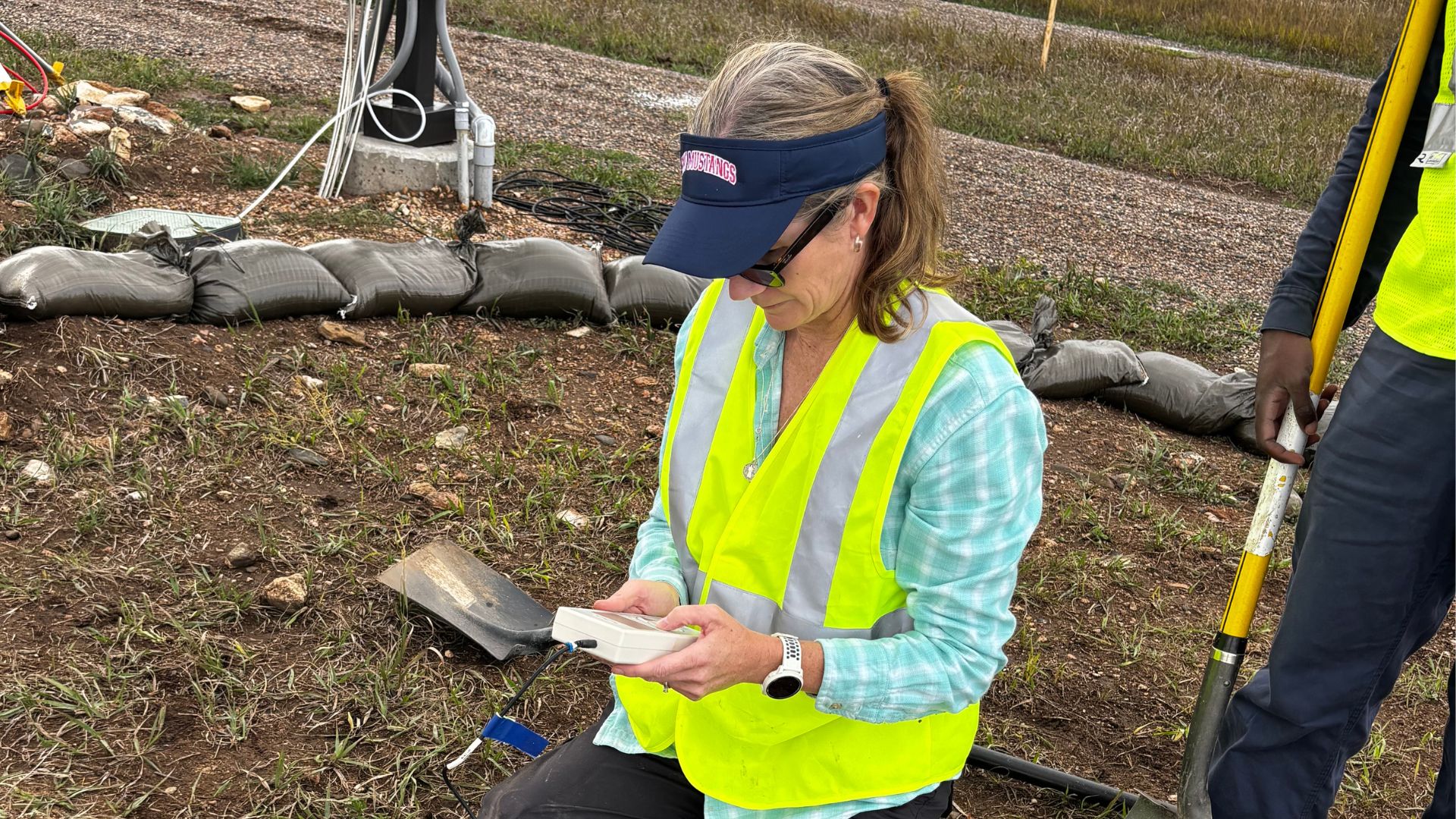
Kathleen Smits, the Solomon Professor for Global Development in SMU's Department of Civil and Environmental Engineering, at the field site.
The microbes with the right tools
Many known methane-eating microorganisms come from unusual methane-rich environments, such as deep-sea seeps and landfills, and many are difficult to grow in the laboratory. The researchers used metagenomics (sequencing DNA directly from the soil and reconstructing microbial genomes from the resulting genetic material) to determine which organisms were present in this narrow zone and what metabolic pathways they carried.
One group stood out: the Actinomycetota, common soil bacteria only recently recognized as capable of consuming methane. The SMU study suggests that this capacity may be more widespread than previously recognized and particularly useful in soils where methane arrives in pulses rather than remaining continuously abundant.
“Until only a few years ago, these bacteria were not really considered methane eaters,” said Chase. “It made me realize that nature may have evolved a much broader toolkit for responding to methane leaks than we thought. I probably should not be surprised. Microbes always find a way.”
Since some Actinomycetota can use multiple carbon and energy sources, they may be able to persist between methane pulses and respond rapidly when methane returns. Their concentration near the methane-oxygen boundary suggests that widespread underground leaks may favor a broader and more flexible set of methane-processing microbes than scientists have traditionally recognized.
Methane also altered the surrounding soil chemistry. The researchers found that methane transport, microbial activity and soil chemistry were tightly connected, showing that underground leaks reshape both the biological and chemical environment as methane moves toward the surface.
What the findings mean for methane emissions
The study establishes where methane oxidation is most likely to occur and identifies the environmental conditions and microbial functions associated with it. While researchers did not measure how much methane is consumed, the findings provide a more complete understanding of what happens between an underground natural gas release and the methane that ultimately emerges at the ground surface. They also point to the need for future studies that directly quantify how much methane is consumed under different soil, environmental and leak conditions.
The study was led by Chase and Smits and coauthored by J.R.R. Navodi Jayarathne of SMU's Department of Civil and Environmental Engineering, and Motahare Haghighatjoo and Neil J. Tabor, of SMU’s Department of Earth Sciences.
This work was funded in part, under the Department of Transportation, Pipeline and Hazardous Materials Safety Administration (693JK32010011POTA). The views and conclusions contained in this document are those of the authors and should not be interpreted as representing the official policies, either expressed or implied, of the Pipeline and Hazardous Materials Safety Administration, the Department of Transportation, or the U.S. Government. The research was also funded by SMU start-up funds and supported by the Dedman College of Humanities and Sciences research fund.