Autonomous vehicles could potentially cut DFW congestion
New SMU-led study finds widespread adoption of driverless vehicles would improve traffic efficiency.

Driverless cars could ease commutes in Dallas-Fort Worth, a new study led by SMU suggests.
SMU civil and environmental engineering professor Khaled Abdelghany and his collaborators used a sophisticated North Texas travel model to evaluate how connected and autonomous vehicles (CAVs) might impact traffic by 2045.
They found that widespread adoption of these autonomous cars would reduce congestion and travel delays in the DFW region—even without adding a single new lane of highway.
“Traffic congestion is often driven not only by high demand but also by speed variability and stop-and-go behavior, which reduce flow efficiency,” noted Abdelghany, a fellow at the Stephanie and Hunter Hunt Institute for Engineering and Humanity. “Autonomous vehicles may help mitigate these effects through smoother and more coordinated driving.”
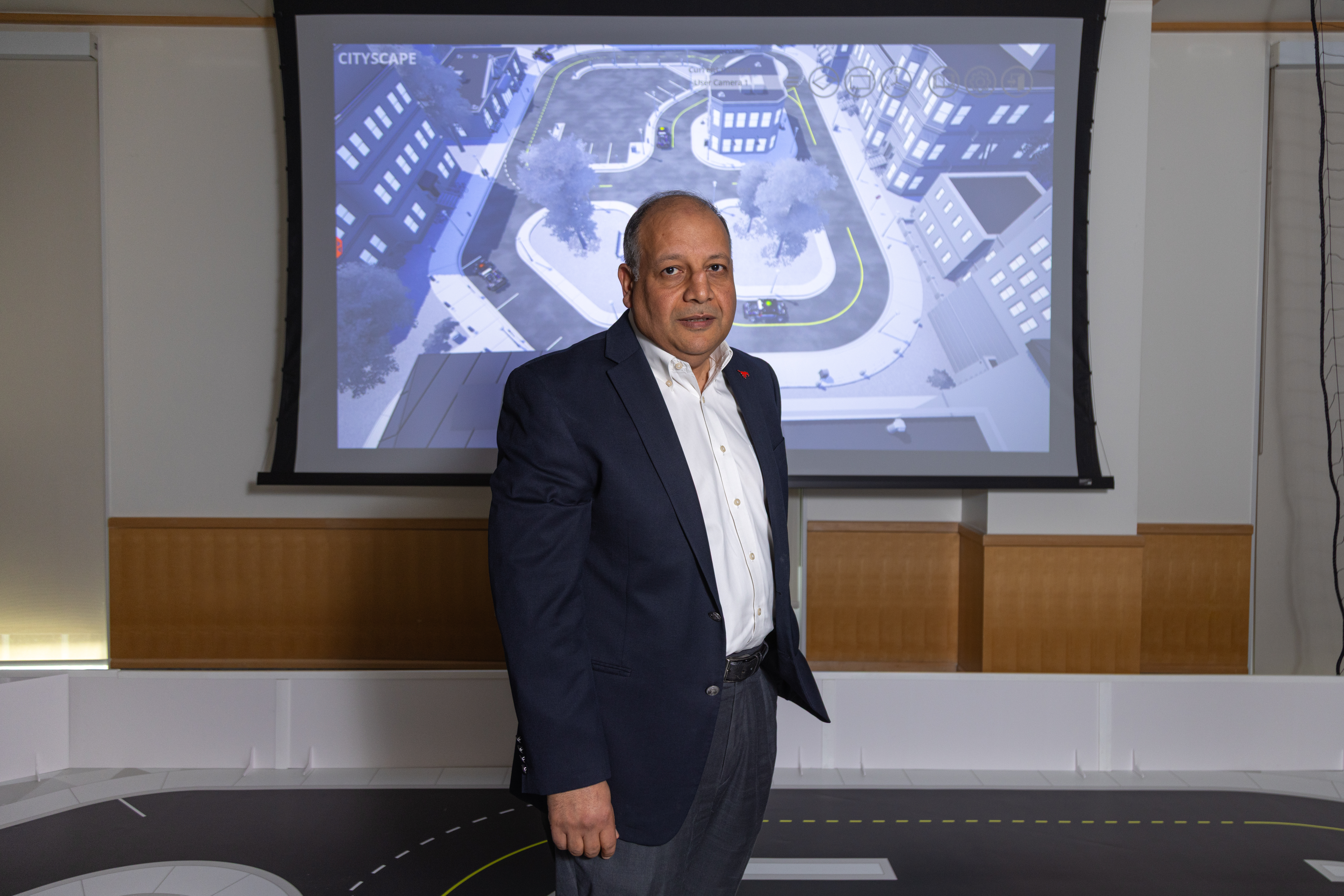
Team led by SMU civil and environmental engineer Khaled Abdelghany used a North Texas travel model to assess how driverless vehicles could affect traffic by 2045. Credit: SMU.
How the study was done
Abdelghany’s team used an advanced regional model developed by the North Central Texas Council of Governments (NCTCOG)—called the Transportation Analytical Forecasting Tool (TAFT)—to test three scenarios.
First, they evaluated how different percentages of fully autonomous vehicles on major roads such as U.S. 75 and Interstate 635 would affect traffic flow. Second, they assessed what the added impact of real-time communication between driverless vehicles and traffic signals might be on travel times. Finally, the team explored what the effect might be on DFW traffic, if commuters who no longer had to drive lived farther from their workplaces.
Covering 13 counties in Dallas-Fort Worth, TAFT is used by regional planners to predict how people and goods will move throughout the area. This regional model supports long-range planning by identifying potential congestion points and estimating how population and job growth could affect travel demand.
In a total of 25 experiments, researchers had the model test scenarios with either 25%, 50% or 100% driverless cars. All experiments were benchmarked against a 2045 base scenario that assumes no connected and autonomous vehicles in the traffic composition.
Autonomous vehicles could improve commutes
The study, published in the Journal of Urban Technology, found that full adoption of driverless vehicles had the greatest effect on reducing congestion compared to lower adoption rates.
By 2045, the study found that DFW could see:
- Shorter travel times. At 100% driverless cars, traffic delay fell by 33%, meaning commuters spend significantly less time stuck in congestion.
- Faster commutes through relocation. With full adoption, daily vehicle-hours traveled (VHT) would decrease by at least 19%, if households and jobs gradually moved from the core parts of Dallas, Tarrant, Collin, and Denton counties to peripheral areas or other cities. VHT is the total amount of time spent by all vehicles traveling within a transportation network or roadway system during a given period.
- Minor improvement at intersections. Technology that allows self-driving cars to communicate with traffic signals only provided a small extra benefit beyond full adoption of autonomous vehicles traveling within a transportation network or roadway system during a given period.
Partially funded by NCTCOG, the study was conducted by Abdelghany, in collaboration with Behruz Paschai, a senior research engineer with the Texas Transportation Institute’s Travel Forecasting Program, and Abby Morgan, an associate engineer at Kittelson & Associates, Inc.
Abdelghany acknowledged that some people remain skeptical about driverless vehicles. But he said the benefits are substantial, including mobility for people who aren’t able to drive—such as the elderly, visually impaired, or disabled—making transportation more inclusive.