Shaping the U.S. futsal pipeline and North Texas soccer culture
SMU alumni behind City Futsal welcome the world to Dallas.

America may be having an international soccer moment, but the small-sided, hard-court version of the global game — futsal — is what shapes the players who go on to define it. For SMU alumni Esteban and Manuel Mariel ’09, that conviction is the foundation of a fifteen-year company.
The twin brothers grew up in Brazil, where futsal is the lingua franca of youth soccer development, before relocating to the United States and transferring to SMU as sophomores. Both played for the Mustangs — Manuel as a forward, Esteban as a midfielder and defender — and both competed for U.S. Youth National Teams. In 2011, two years after graduating with economics degrees, they launched what was then called Dallas Futsal. The first tournament, held at SMU’s Crum facility, drew 80 teams.
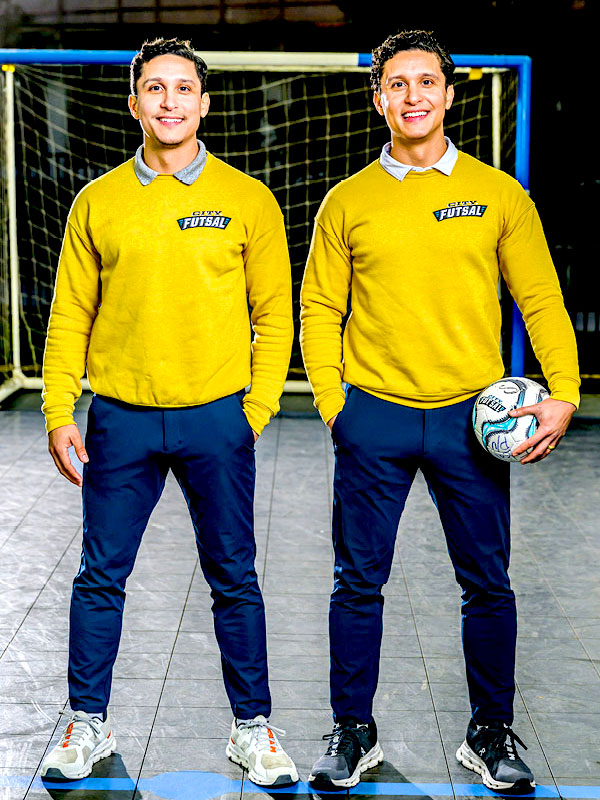
“When we started, the market for this didn’t exist,” said Esteban Mariel, City Futsal’s president. “We weren’t opening another soccer business. We were making the case for futsal as the right developmental tool for soccer players, and then building the venues to deliver it. That took fifteen years. The World Cup coming to Dallas is the reward.”
Futsal is played four-versus-four with a goalkeeper, on a hard court, with a smaller, denser ball designed for tighter control and quicker play. The format compresses the game into the decisions and touches that matter most.
“Futsal is like playing basketball with your feet,” Manuel said. “It sharpens decision-making, agility, and ball control in ways the eleven-a-side game can’t replicate. We don’t treat it as an alternative to soccer. It’s the foundation.”
Today, City Futsal is among the leading futsal operators in the U.S. The company runs leagues, tournaments, pickup games, and camps for youth and adult players at its venues in Dallas and The Colony. Four more locations are in development: Grapevine and Allen open this year, with Keller and a Far North Dallas site at Dallas International School coming online by early 2027 — bringing the system to six locations across North Texas.
In 2012, the brothers launched the Futsal Development and Scouting Program (FDSP), the first youth futsal-for-soccer training program in the U.S. The next year they began an exchange program with Santos FC in Brazil. Players who came through City Futsal courts include Tomás Pondeca (Corpus Christi FC and the U.S. Men’s Futsal National Team), Jaedyn Shaw (San Diego Wave and the U.S. Women’s National Team), Patrick Koffi (FC Versailles, France), and Bailey Sparks (FC Tulsa, and a former Mustang). Many more went on to play in college.
Both Mariels credit their student-athlete years at SMU with shaping how they run the business.
It’s not your typical college experience, but it prepares you for everything we do now. You learn how to work inside a team, how to follow a process, and how to figure out where you’re most valuable. That’s exactly the job of running a small business.
Manuel Mariel, VP and Co-Founder, City Futsal
The pandemic forced the brothers to consolidate, concentrating on the Dallas location and adding a 5v5 turf field. They treated the disruption as a reset rather than a setback — a chance to reallocate resources and rethink what the next decade of growth should look like.
That next decade starts now. The region is hosting nine FIFA World Cup 2026 matches at Dallas Stadium in Arlington — more than any other host city in the tournament, including a semifinal — with SMU serving as an official training site. The Mariels see the moment as an inflection point for soccer in North Texas and a chance to plant futsal’s flag in the U.S. soccer landscape for good. City Futsal will host open pickup games at both its Dallas and The Colony locations during the tournament and will show every match on its big screens.
“The World Cup landing in Dallas is the moment we’ve been building toward,” Esteban said. “We’re opening our courts to anyone who wants to play, anyone who wants to watch, and anyone who wants to do both. Come for the games. Stay for the neighborhood.”
City Futsal remains a family-run business. Esteban and Manuel work alongside their father Federico, sister Ximena, and younger brother Felipe. Their stated mission is to build small-sided soccer and futsal venues in neighborhoods where players of every age and level can play, develop, belong, and come back to.
“The ball doesn’t care how old you are or how good you are,” Esteban said. “It only matters that you keep showing up. That’s what we’re building — across North Texas, and for everyone the World Cup is about to introduce to this game.”