How SMU’S MADI is helping develop food strategy to end rising hunger in Dallas
Partnership with Dallas-Dallas County Food Plan Collaborative aims to create a more resilient, nutritious and locally connected food system.

It’s an unfortunate paradox.
While many Dallas residents struggle to access affordable, nutritious meals, large quantities of edible food are discarded each year. At the same time, the city's reliance on distant food sources leaves its supply vulnerable to disruptions from extreme weather, transportation issues, and market fluctuations.
With the help of SMU’s Master of Arts in Design and Innovation (MADI) program, Dallas-Dallas County Food Plan Collaborative is seeking to combat these issues by creating a comprehensive, actionable strategic plan later this year that focuses on food insecurity and systemic issues and fosters local resilience and nutritional accessibility.
“There have been so many efforts that have been tried with addressing food insecurity and food deserts. But unless you’re looking at the whole system, it’s really difficult to resolve that, because it is a systems issue,” said Whitney Strauss, who is the project lead for the Dallas-Dallas County Food Plan Collaborative.
Using a human-centered approach to bring meaningful changes
To determine what should be in the strategic plan, the MADI program is leading several workshops with local food producers, hospitals, food banks, government officials and other key stakeholders across five focus areas: food access, local food systems, food as medicine, food waste, and emergency food response.
At these workshops, MADI is taking a Human-Centered Design approach to ensure the people experiencing the challenge are at the center of how solutions get created.
“We’ve explicitly-designed custom workshops that pull and tease out tacit knowledge for the people that are doing this every day,” said Jessica Burnham, director of the MADI program, which has a long history of partnering with organizations across North Texas to solve complex issues through design research and innovation.
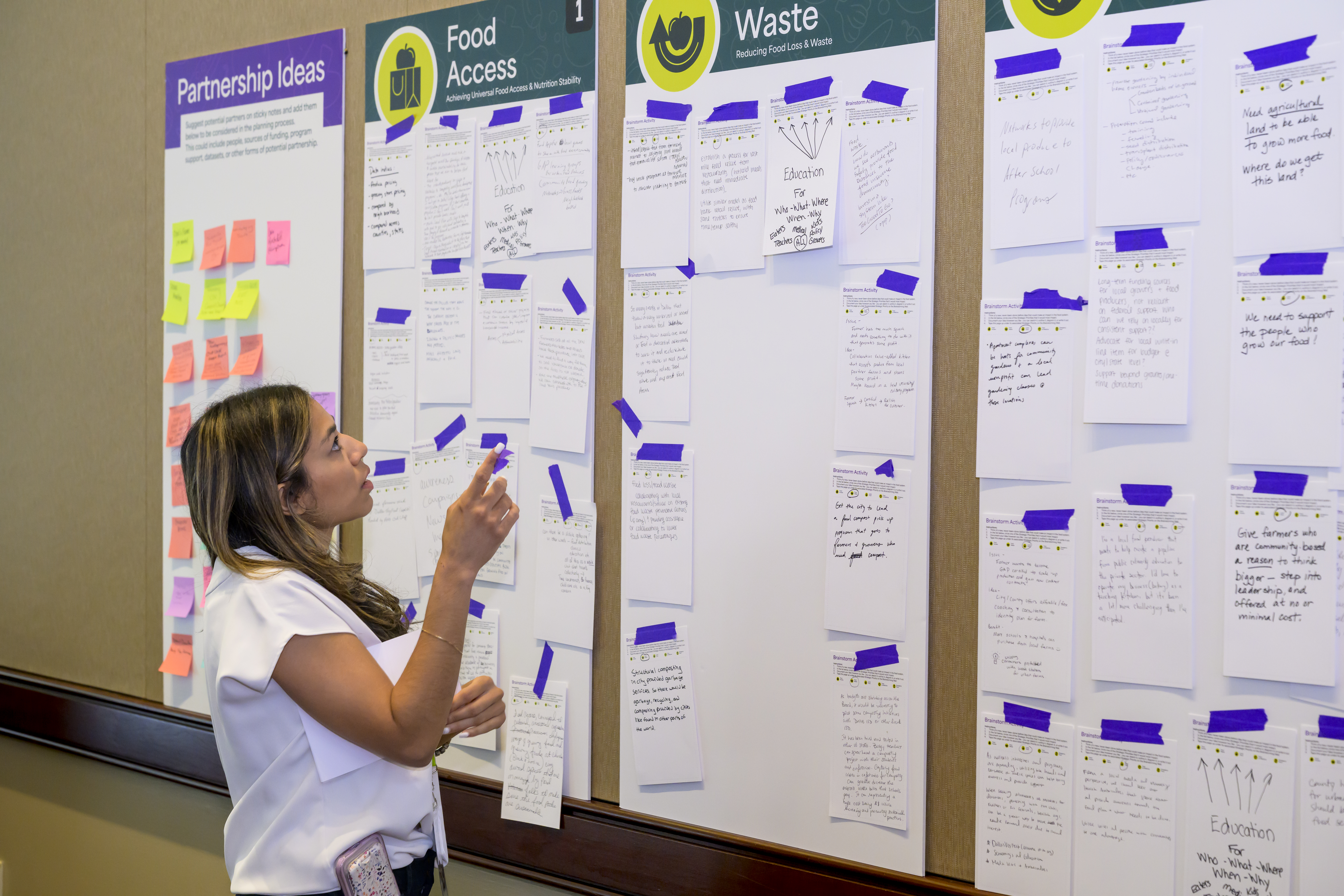
The MADI program is leading several workshops with local food producers, hospitals, food banks, government officials and other key stakeholders across five focus areas: food access, local food systems, food as medicine, food waste, and emergency food response. Credit: SMU.
“We already know where the problems are. We don’t need to keep starting over from scratch,” Burnham said. “We need to start from where the current efforts are already happening and connect people.”
Those connections are already starting to bear fruit. For instance, conversations facilitated in one of the workshops led to a local farm connecting with UT Southwestern, which is now purchasing locally grown produce for campus dining operations.
Burnham said that an action-oriented mindset during these brainstorming sessions is intentional.
A better understanding of how food moves through Dallas and Dallas County
MADI is also helping with an initiative to create two maps that organizers hope will reveal how Dallas County's food system actually works — and where it falls short.
The first is a "value network map" designed to show how different parts of the food system connect with one another. Instead of simply plotting locations, the map will trace relationships among farms, distributors, food banks, community organizations and consumers. The goal is to identify where strong partnerships exist, where gaps remain and whether too much of the region's food network depends on a handful of organizations.
Burnham said that kind of visualization could help the community become more resilient. For example, if a major source of funding disappears or a large food distributor faces disruptions, the map could reveal whether alternative connections exist or whether entire parts of the system could be left vulnerable.
The second map uses geographic information system, or GIS, technology to create a detailed picture of Dallas County's food landscape. The effort is intended to replace assumptions with data, showing where food resources across the county’s 30 cities are abundant, where they are scarce and how communities are connected across municipal boundaries.
Burnham designed the workshops with the help of former MADI student Matthew Barkley. MADI students Sebastian Napuri Mendoza and Raghupati Lal – along with Alain Mota, MADI’s Design Project Manager – are also assisting with the workshops.
Burnham stressed that the strategic plan and maps will be living documents that can evolve as needed, just like the city of Dallas.
“There are always new issues that will come up, and once one thing starts to get better, other things will start to show up in different ways,” she said. “September is our big goal for making our plans public, but it’s more than that. It’s a whole new process and mindset towards our food in our city and in our county.”