The Coordinated Theoretical-Experimental Project on QCD
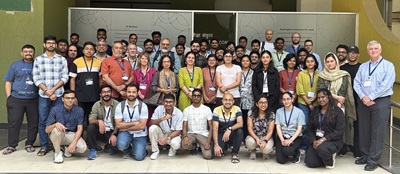 CTEQ is a multi-institutional collaboration of theorists and experimentalists pursuing a broad program of research in high-energy physics, centered on Quantum Chromodynamics (QCD) and its implications for the Standard Model and physics beyond it. CTEQ research projects, along with our summer schools and workshops, are generously supported by the National Science Foundation and the Department of Energy through grants awarded to the universities and national laboratories of our member institutions.
The CTEQ Collaboration was established in 1990 with the goal of bringing theorists and experimentalists together to address fundamental questions about nucleon structure. Its research focuses on lepton–nucleon deep-inelastic scattering and on understanding processes involving large momentum transfers in high-energy physics experiments.
Since 1992, more than one thousand physicists have participated in the CTEQ Summer Schools, which have played a seminal role in advancing knowledge of Quantum Chromodynamics (QCD), its applications to precision electroweak measurements, and its importance in searches for physics beyond the Standard Model. The schools provide exceptional value to students, offering a unique opportunity to learn directly from leading experts while developing a broader understanding of both theoretical and experimental perspectives. They have become an important training ground for early-career researchers in both disciplines. It is particularly rewarding to see many former students return in later years as lecturers, reflecting the lasting impact of the program and its role in nurturing the next generation of physicists.
At SMU, faculty members Fredrick Olness and Saptaparna Bhattacharya are prominent members of the CTEQ Collaboration and contribute to its research, leadership, and educational mission.
Professor Fredrick Olness studies the quantum chromodynamic properties of nuclei to advance our understanding of nucleon structure and heavy-quark production within perturbative Quantum Chromodynamics (QCD). A longstanding leader within the CTEQ Collaboration, he has served as a co-spokesperson and currently chairs the CTEQ Summer School Committee, where he helps shape the collaboration’s educational programs and mentor the next generation of QCD researchers.
Professor Saptaparna Bhattacharya’s research focuses on the rarest electroweak processes accessible at the Large Hadron Collider: the production of three gauge bosons and the scattering of vector bosons. These processes are governed by the self-interactions of the W, Z and Higgs bosons, which makes them among the most sensitive probes of physics beyond the Standard Model. She interprets them within the framework of effective field theory, where deviations from the Standard Model are parameterised in a common language that connects collider measurements to results from across particle physics. Her group in ATLAS measures triboson and vector-boson-scattering processes with Run 2 and Run 3 data, studies the polarisation of the bosons involved, and develops machine-learning and simulation-based inference methods that extract the most information from each event. She also develops advanced event-generator workflows for the ATLAS experiment, leveraging state-of-the-art, GPU-enabled implementations of widely used event generators and high-performance computing facilities. Event generation is the first and a computationally demanding step of every collider simulation, so this work aims to make precise, higher-order simulations faster and more affordable as the LHC moves into its high-luminosity era. Her broader interests extend to the physics case for future colliders, including the FCC-ee electroweak and Higgs factory and a multi-TeV muon collider.