Electron-Ion Collider and SURGE
The Electron-Ion Collider (EIC)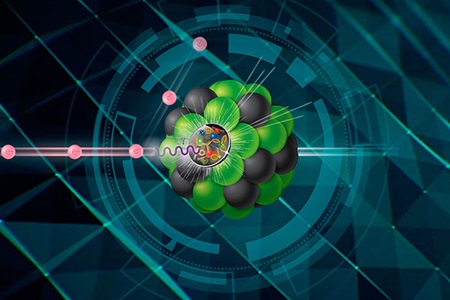
The Electron-Ion Collider (EIC), now under construction at Brookhaven National Laboratory (BNL) on Long Island, New York, is a next-generation facility designed to explore the fundamental building blocks of matter. This massive, 2.4-mile-long (3.8-kilometer) underground accelerator will bring beams of electrons and atomic nuclei together at extraordinarily high energies. By observing what happens in these collisions, scientists will gain new insight into how the tiny particles inside atoms interact and how they give rise to the matter that makes up our world.
The Electron-Ion Collider (EIC) will collide electrons with protons and atomic nuclei to create detailed snapshots of their inner structure—much like a CT scan reveals what is inside the human body. By studying how the electrons scatter, scientists will map the quarks and gluons that make up protons and neutrons and learn how these tiny particles interact.
The gluons carry the force that holds quarks together—the strongest of the fundamental forces of nature. The EIC will provide an unprecedented opportunity to understand this powerful force and the essential role that gluons play in creating the matter that surrounds us. The discoveries made at the EIC could also lay the scientific foundation for technologies of the future.
The Saturated Glue (SURGE) Collaboration is a Topical Collaboration in Nuclear Theory
The SURGE Collaboration seeks to discover and explore a new regime of matter in which gluons become extremely dense inside protons and atomic nuclei. The collaboration combines high-precision theoretical calculations with experimental data from particle and nuclear accelerators around the world. This work will help scientists better understand how gluons behave under these extreme conditions and make detailed predictions for the Electron-Ion Collider (EIC), where this new regime can be studied in unprecedented detail.
Gluons mediate the strong force that binds the quarks inside protons and neutrons. Under extreme conditions, the number of gluons inside a proton or nucleus can become enormous. Eventually, the gluons become so densely packed that they create a new type of matter known as the Color Glass Condensate (CGC). The name reflects the role of “color” charge in the strong interaction and the characteristic properties of this dense, coherent state of gluonic matter, which evolves slowly compared with the rapidly fluctuating quantum fields it describes.
Precisely measuring the strength of gluon fields—the most powerful fields in nature—will reveal how gluons interact with one another and how these interactions generate the structure and properties of protons and nuclei, which ultimately make up the vast majority of visible matter in the universe.
Research at SMU
At SMU, Professor Fred Olness is a member of the SURGE Collaboration and serves as group convener for the Global Fitting Working Group. His research focuses on developing computational tools that incorporate gluon saturation effects into global QCD analysis frameworks, enabling these phenomena to be studies and compared across a broad range of experimental datasets. This work extends Professor Olness's longstanding contributions to global QCD analyses through both the CTEQ and xFitter collaborations.