
Native American roots run deep for SMU Alum
 Tony BlueJacket |
DALLAS (SMU) — One of the pilgrims on the Embrey Human Rights “American West” trip is a recent SMU alumnus who carries in his DNA a unique connection to Native American history and culture.
Tony’s BlueJacket’s fifth great-grandfather was Native American war tribal leader “BlueJacket” (1743-1810), who served with legendary Shawnee leader Tecumseh. BlueJacket’s fierce protection of his tribe’s ancestral lands reached its peak during the Northwest Indian War (1785-1795) and earned him great respect as a war chief.
America’s controversial treatment of its indigenous people will come into sharp focus during the 10-day trip, but many of the complex issues to explored won’t be new to Tony, an Irving native who this May earned a B.A. in human rights and B.S. in anthropology from SMU. He grew up participating in powwows, blessing and naming ceremonies, and other tribal customs.
“Most of my family still lives on or around Shawnee territory, and all five of my aunts and uncles have served the tribe at one point or another,” he says. Mainly he looks forward to “the spiritual connection to be gained on the journey,” and says he hopes to see a few family members while in South Dakota.
 BlueJacket (right) from the painting by Howard Chandler Christy |
After the Northwest Indian War brought defeat for many Native Americans, the BlueJacket family and many others would begin to face traumatic upheaval. War Chief BlueJacket joined other tribal leaders in signing the Treaty of Greenville, which ceded to the U.S. large sections of land bordered by Lake Erie and Michigan to the north and the Ohio River to the south. Ultimately the Bluejacket family would endure forced removal west from a region now encompassing Ohio, West Virginia and Kentucky. They moved first to Kansas, then to northeastern Oklahoma and southwestern Missouri where the Eastern Shawnee Tribe eventually would be based.
The tribe’s first chief was Tony’s great-grandfather, Walter BlueJacket, and fourth chief was his grandfather, Julian BlueJacket. Its current chief is Dr. Glenna Wallace, whom Tony communicates with often about life decisions, he says.
When it comes to successfully teaching the complex historical and societal issues faced by Native Americans, this country still has a long way to go, BlueJacket says, “but I’m thrilled the Embrey Human Rights Program is leading the way for SMU.”
Tony joined SMU in 2013 as an Academic Honors Transfer Student, and was awarded a scholarship to SMU after receiving an Honors Associates Degree in Arts (and 4.0 GPA) from El Centro College in 2012.
While at SMU, Tony participated in such transformative trips as the annual Civil Rights Pilgrimage through the Deep South, a two-week Holocaust study trip to Poland and Student Leadership Initiative research project in Costa Rica. He also was named 2014 “Student of the Year” by the American Anthropological Association and was a member of three academic honor societies.
It’s fitting that the “American West” trip will cap off his scholarly work at SMU — at least for now. “Every generation of BlueJacket has left a mark on American history,” he says. Now it’s his turn.
In September Tony will join the University of Amsterdam to pursue a master’s degree in social and cultural anthropology with an emphasis on human rights. His goal? To one day teach human rights and help spread human rights programs to more institutions and universities.
His academic and human rights work at SMU isn’t something he can quantify. “It’s truly priceless,” he says. “It’s not only changed my life forever, but it also will continue to change the lives of those I help. I will never stop paying it forward.”
Tony wants to help indigenous peoples, including his own tribe, “but I’m not ethnocentric in focus,” he says. “My passion lies where I find cause, and with people who need help the most – everyone, everywhere. That said, Native Americans are still very much entrenched in a battle for civil rights in the U.S.”
Tony also hopes to one day live in a “country with no reservations, where all current native territories will be given real sovereignty – the deeds to our land without government oversight and control,” he says. “Some tribes are infinitely better off than others, with others on the brink of complete extinction. I’m hopeful First Nations (indigenous peoples) will continue to build bridges of inclusive community and outreach for each other.”
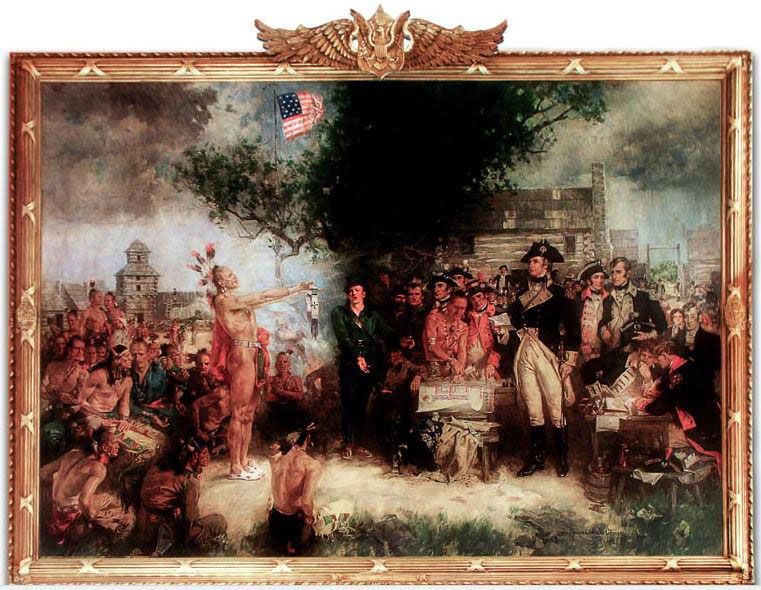
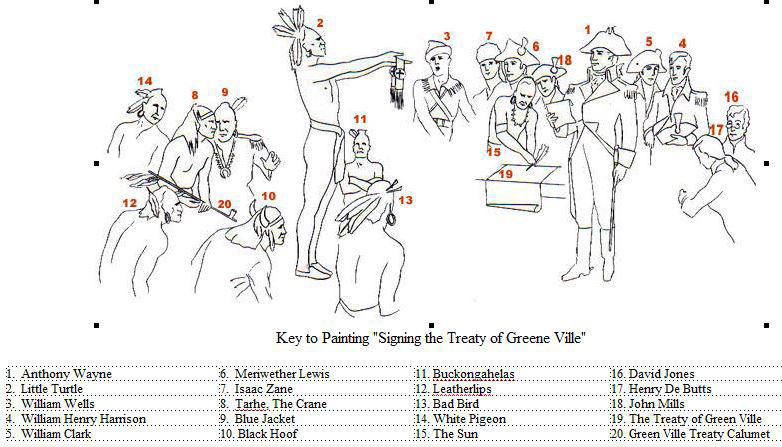
Both of Tony BlueJacket’s fifth great-grandfathers — revered Native American warriors from his paternal and maternal lines — are depicted in Howard Chandler Christy’s “Signing the Treaty of Greene Ville” painting commemorating the 1795 event: “BlueJacket” (in blue jacket and red sash at left of warrior standing with peace offering) and “Black Hoof” (second from bottom left). Also depicted are renowned explorers Meriwether Lewis (at left behind warrior signing treaty) and William Clark (standing second from right).
Painting Identity Chart
# # #
21273-nr-06/08/15