Summer program trains Lyle students to think like researchers
Engineers, computer scientists and mathematicians spent six weeks conducting interdisciplinary research through an NSF-backed summer program.

A research program for interdisciplinary undergraduates
This summer, the Lyle School of Engineering teamed up with the SMU Department of Mathematics to host Modeling and Computations for Complex Systems, a summer research intensive backed by the National Science Foundation. The Research Experiences for Undergraduates (REU) program welcomed engineers, computer scientists and mathematicians for six weeks of focused research and learning in autonomous systems and mathematical modeling.
The first several weeks were dedicated to technical training, divided by discipline. For Lyle’s engineers and computer scientists, electrical and computer engineering professor and REU program co-director Joe Camp led undergraduates through a hands-on experience focused on swarm systems and autonomous learning.
A student’s day-to-day experience included lectures, coding, experiments and team-based problem-solving. Through interdisciplinary learning, students formulated their own research questions and used Lyle’s research infrastructure to test them.
“The REU program is less like a traditional course and more like day-to-day research,” Camp explained. “Students meet with faculty and graduate mentors, read relevant papers, refine a research question, write and debug software, collect experimental data, and analyze whether the results support their original hypothesis.”
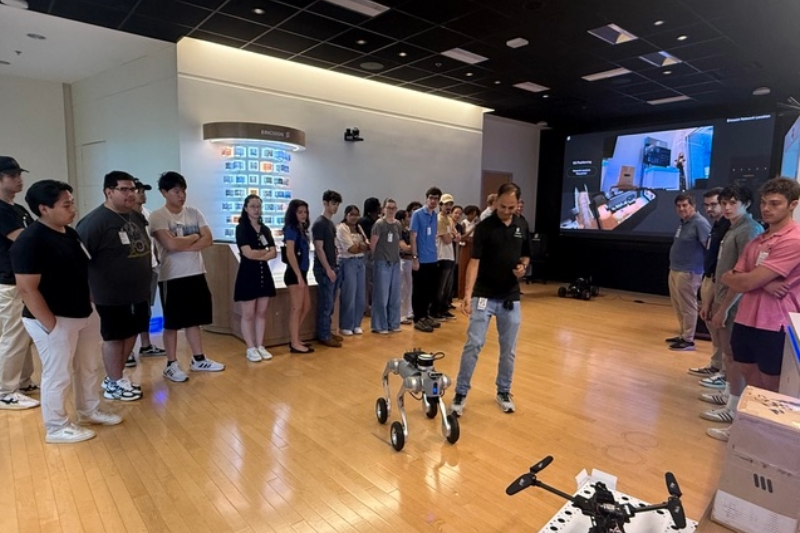
In the Autonomous Drone Teaming Lab, led by Camp, students had access to Lyle’s full battery of complex drone technology, wireless measurement equipment and GPU computing resources. Within the enclosed drone experimentation facility, students had the autonomy to conduct their own experiments based on the lessons they had learned.
“The program is highly experimental,” Camp continued. “Students work on problems at the intersection of artificial intelligence, wireless communications, computational modeling, and autonomous systems.”
“Working with real drones, students see firsthand the difference between an algorithm that works in simulation and a system that must operate with imperfect sensors, noisy data, communication limitations, and real safety constraints.”
Like all research, Camp emphasized, progress is not always linear. Students learn to diagnose failures and decide what comes next, much like they would in their own labs. Along the way, undergraduates also gain experience presenting their research, asking questions, learning new technologies and engaging with industry organizations such as Ericsson and Shield AI.
In the final few weeks, engineers, computer scientists and mathematicians came together with program co-director and mathematics professor Alejandro Aceves to explore how math and engineering offer complementary perspectives for solving complex problems.
Camp emphasized that the goal of the REU is not just to offer a research experience but to build confident and competent researchers who dare to bring their ideas to life – a focus Camp describes as the most rewarding part of hosting the program.
“At the beginning, students may be hesitant because they have never worked with drones, wireless systems, advanced computing, or a research problem without a known answer,” Camp explained. “Over the course of the program, they begin making their own technical decisions, proposing experiments, questioning results, and explaining their work with greater confidence.”
“Most importantly, I hope students leave believing that they belong in these technical and research communities. A successful summer means the confidence, relationships, and intellectual foundation to pursue the next opportunity.”
About the Bobby B. Lyle School of Engineering
SMU’s Lyle School of Engineering thrives on innovation that transcends traditional boundaries. We strongly believe in the power of externally funded, industry-supported research to drive progress and provide exceptional students with valuable industry insights. Our mission is to lead the way in digital transformation within engineering education, all while ensuring that every student graduates as a confident leader. Founded in 1925, SMU Lyle is one of the oldest engineering schools in the Southwest, offering undergraduate and graduate programs, including master’s and doctoral degrees.
About SMU
SMU is the nationally ranked teaching and research university in the dynamic city of Dallas, and a member of the prestigious Atlantic Coast Conference. SMU’s alumni, faculty and more than 12,000 students in eight degree-granting schools demonstrate an entrepreneurial spirit as they lead change in their professions, communities and the world.