SMU Lyle Unveils New AI and Autonomous Systems Labs
New Quanser-powered laboratories are advancing hands-on learning in AI, robotics, autonomous systems, and digital twins for students and researchers.

The SMU Lyle School of Engineering recently celebrated the unveiling of a new suite of teaching and research laboratories developed in partnership with Quanser, a global leader in engineering education and research technologies.
Spanning the first and second floors of the Embrey Engineering Building, the newly constructed Lyle Applied Artificial Intelligence Laboratory (LAIL) and the Dynamic Systems, Controls, Robotics & Mechatronics Labs bring more than 1800 square feet of learning space and Quanser-powered equipment. The effort is designed to deepen hands-on learning and research in artificial intelligence, robotics, autonomous systems, and cyber-physical engineering.
Together, the labs create an environment where students and faculty researchers can work across autonomous vehicles, drones, mobile robotics, digital twins, and AI agents in a connected Quanser ecosystem.
“We are considered the only university in the United States to have all of these technologies in one place,” Ammar Yacoub, a doctoral candidate in mechanical engineering who spearheaded the labs’ development and curriculum design, explained.
The facilities have a dual focus: advancing research while providing students with access to the technologies most critical to engineering and industry today. Upstairs, students move through mechatronics, controls, and robotics laboratories, working hands-on with physical systems. Downstairs, in the LAIL lab, students and researchers alike have access to NVIDIA GPU-powered autonomous vehicles, robotic platforms, and drone systems integrated with high-fidelity digital twins.
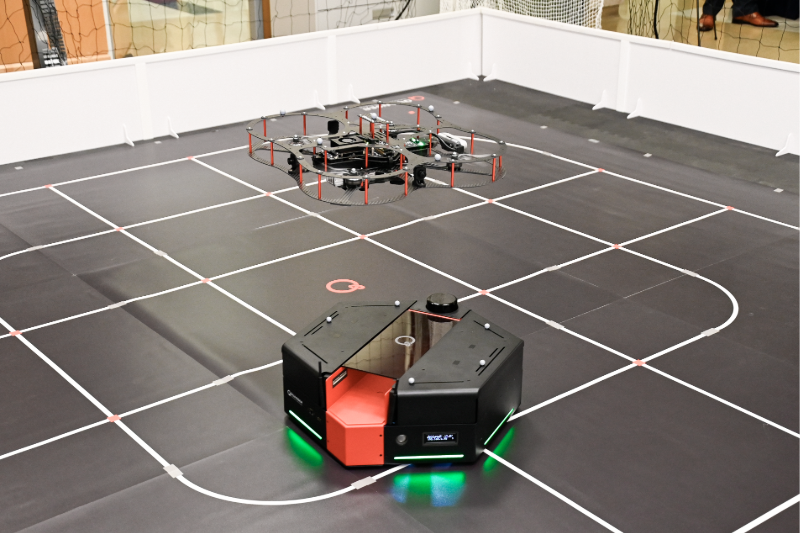
Drone technology in the Lyle Applied Artificial Intelligence Laboratory (LAIL).
The Quanser interactive labs function as a learning-focused digital twin of their real physical systems, enabling students and researchers to safely explore, test, and validate new ideas and control algorithms in a realistic virtual environment.
“We’re closing that gap, connecting theory to the hardware aspect,” Hallie Morgan, a mechanical engineering doctoral student who worked extensively in implementing the facilities, explained. “Being able to say, ‘I know this, because I’ve put my hands on this equipment and used these technical concepts before,’ will put students way ahead of the job market for years to come.”
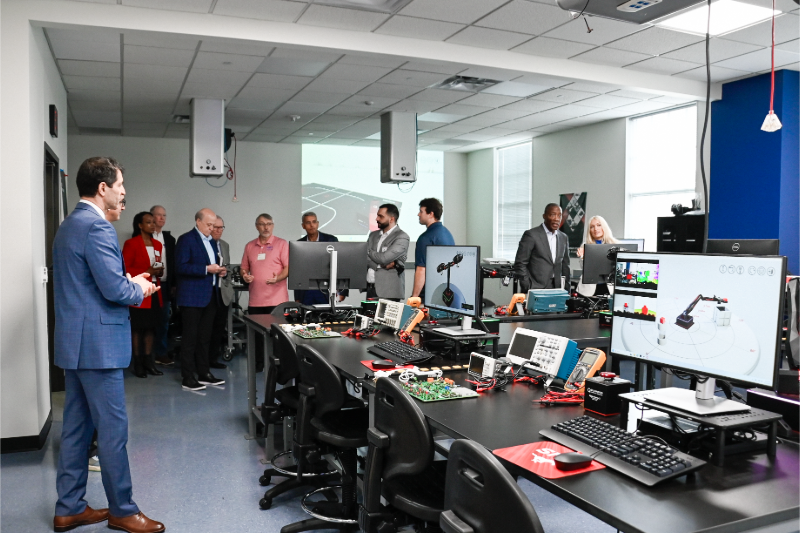
Dynamic Systems, Controls, Robotics & Mechatronics Labs feature interactive digital twins of Quanser technology for hands-on student learning.
And, in an age where autonomous systems and AI literacy matter more than ever for up-and-coming engineers, the new additions open the door for multidisciplinary learning and collaboration across Lyle disciplines.
“Our students will not only be mechanical engineers — they will have experience in electrical engineering, computer engineering, and controls,” Yacoub emphasized.
As artificial intelligence, automation, and autonomous systems continue to reshape engineering as we know it, these new laboratories, alongside a revolutionary Quanser partnership, intend to keep students and researchers working directly at the frontier of this discovery.
“These laboratories represent a major step forward in our mission to prepare future-ready engineering leaders,” Mary and Rich Templeton Dean of SMU Lyle School of Engineering Nader Jalili emphasized, “creating opportunities to solve complex challenges, drive innovation, and shape the future of engineering.”
About the Bobby B. Lyle School of Engineering
SMU’s Lyle School of Engineering thrives on innovation that transcends traditional boundaries. We strongly believe in the power of externally funded, industry-supported research to drive progress and provide exceptional students with valuable industry insights. Our mission is to lead the way in digital transformation within engineering education, all while ensuring that every student graduates as a confident leader. Founded in 1925, SMU Lyle is one of the oldest engineering schools in the Southwest, offering undergraduate and graduate programs, including master’s and doctoral degrees.
About SMU
SMU is the nationally ranked teaching and research university in the dynamic city of Dallas, and a member of the prestigious Atlantic Coast Conference. SMU’s alumni, faculty and more than 12,000 students in eight degree-granting schools demonstrate an entrepreneurial spirit as they lead change in their professions, communities and the world.