Students put AI agents and smart devices to the test
Students explore emerging questions in AI and device security.

How should AI agents communicate with one another? And as smart devices collect increasingly sophisticated sensor data, what new security questions emerge?
Students spent three weeks investigating questions like these during the 2026 Summer Research Bootcamp at SMU, held July 6–24 at SMU Lyle School of Engineering.
Now in its second year, the program grew from five students in 2025 to 11 students in 2026. SMU Lyle and the Global Education Institute (GEI), a longtime partner of the school, collaborated on the program.
Working alongside faculty and doctoral student mentors in the Department of Computer Science, students explored two areas of research: communication protocols for multi-agent large language model systems and security in human-computer interaction with smart devices. Students worked in six research groups under the guidance of Jia Zhang, Robert H. Dedman, Jr. Chairperson of the Department of Computer Science; Chen Wang, O'Donnell Foundation Professor of Digital Innovation in Engineering and Computer Science; and Xihao Xie, clinical assistant professor of computer science.
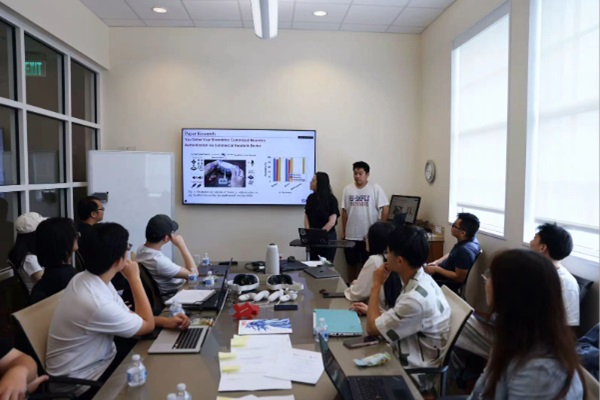
Rather than simply studying existing work, students designed experiments, built prototypes, collected and analyzed data and evaluated their findings. On July 24, they presented their work to Lyle faculty during a research showcase in the Department of Computer Science.
.jpg?h=400&w=600&hash=268E49086F0CCE03B779CE65ED0FD9F9)
Exploring security in smart-device interaction
One research track, led by Wang with guidance from Jingwei Zhang, examined security questions arising from new ways people interact with smart devices.
Students worked with devices including smartphones, smartwatches and virtual reality headsets, designing prototype applications and collecting audio, video and sensor data. They then used tools including MATLAB and Python to process the data, examine patterns and build preliminary classification models.
For SMU graduate student Linwei Li, the process meant learning how to move from uncertainty to a research question that could be tested.
“I am honored to have participated in this three-week summer bootcamp program. It gave me the opportunity to explore a field that I had never encountered before: customized biometric authentication. One of the most interesting parts of this project was exploring technical areas that I had never worked with before, especially sensor data collection and audio data processing. When we first developed the data collection app, we were unsure which data would be relevant to our research or whether the data we collected was reliable. With guidance from Professor Wang and Dr. Zhang, we reviewed related research and developed a clearer direction. We then evaluated and tested different sensor data, such as checking whether heart rate changed when wearing or removing a smartwatch, whether pressure data varied when moving between floors or staying still, and whether increasing the sampling rate could improve our classification task. This process taught me how to turn technical uncertainty into meaningful research questions and validate our ideas through experiments.”
— Linwei Li, SMU graduate student in software engineering
In their bootcamp experiments, students built biometric identification models using motion-sensor data. The models achieved nearly 97% accuracy in both virtual reality hand-tracking and smartwatch user identification. Students also identified an eye-tracking interface layout principle that could inform future device design.
Testing how AI agents communicate
A second research track, led by Xie and Zhang with guidance from Chang Liu, focused on communication among AI agents.
Multi-agent systems use multiple specialized AI agents to work together on a task. Students examined how the way those agents communicate could affect performance, reliability and cost. They designed seven multi-agent communication protocols and built a benchmark framework covering 24 tasks, allowing them to compare the protocols with one another and against a single-agent baseline.
SMU graduate student Chuan Zhang encountered a more fundamental question along the way: How should an AI system evaluate an answer when there isn't necessarily one objectively correct response?
“This summer research program was a very valuable experience for me. At first, I felt nervous because I had never done research before and had no idea how to start. With help from Professor Xie and Ms. Jenny, I learned a lot. One question kept bothering me during the project: we needed to build an AI evaluator, but how can AI judge answers to subjective questions, such as which answer is more useful or helpful? Our group had a lively discussion about this. For my part of the project, I made all the scoring criteria objective, so I could avoid this problem for now. But after talking with Professor Xie, I learned that AI judgment is an active research area. Even after the summer program, I hope to keep studying this question and find my own answer. My biggest lesson was simple: when you do not understand something, do not be afraid to ask. Many of my new ideas came from those conversations. I also learned that trying to make everything perfect can slow you down. Once I stopped worrying so much, I made progress and finished my research. I am truly thankful to everyone.”
— Chuan Zhang, SMU graduate student in computer engineering
The students' results also illustrated the complexity of designing multi-agent systems. No single communication protocol performed best across every task category. Performance varied depending on the task and its complexity.
Among the architectures students tested, a manager-led protocol achieved the highest average output-quality score. Students also found that “hallucination propagation” — when an error produced by one AI agent is carried through the rest of the system — was the leading cause of failure in their experiments.
.jpg?h=400&w=600&hash=5197A23A32ABA73F14EB625198F4EF7B)
Continuing beyond the bootcamp
For some participants, the research has continued beyond the summer program.
Yongbin Huang participated in the inaugural GEI Summer Research Bootcamp in 2025 and continued working with faculty on research projects afterward. He co-authored an academic paper in April 2026 and later accepted an offer to pursue a Ph.D. in computer science at SMU.
Huang returned to the bootcamp July 13 to speak with this year's students about his research experience and the transition from master's to doctoral study.
The 2026 students concluded their three weeks by presenting and defending their work before faculty. Along the way, they practiced identifying potential confounding variables, questioning evaluation methods and revising their approaches as their experiments developed — processes that are central to conducting research.
About the Bobby B. Lyle School of Engineering
SMU’s Lyle School of Engineering thrives on innovation that transcends traditional boundaries. We strongly believe in the power of externally funded, industry-supported research to drive progress and provide exceptional students with valuable industry insights. Our mission is to lead the way in digital transformation within engineering education, all while ensuring that every student graduates as a confident leader. Founded in 1925, SMU Lyle is one of the oldest engineering schools in the Southwest, offering undergraduate and graduate programs, including master’s and doctoral degrees.
About SMU
SMU is the nationally ranked teaching and research university in the dynamic city of Dallas, and a member of the prestigious Atlantic Coast Conference. SMU’s alumni, faculty and more than 12,000 students in eight degree-granting schools demonstrate an entrepreneurial spirit as they lead change in their professions, communities and the world.