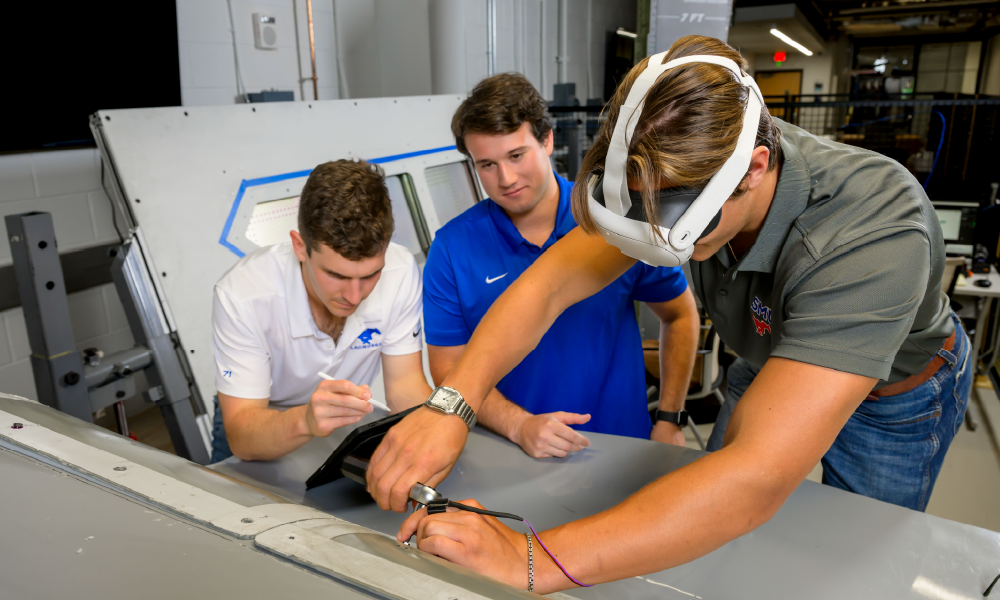
Expert faculty work with M.S. Biomedical Instrumentation students to develop technology to heal the future.

Graduate programs

Master’s in biomedical instrumentation

Design the future of biomedical instrumentation

Program format

In-person and online

Commitment

Full time or part time

Duration

Two years (full time);
Three years (part time)

Overview

SMU Lyle’s M.S. in biomedical instrumentation program bridges the gap between engineering and medicine. It equips you with deep expertise in either electrical engineering or mechanical engineering to develop biomedical systems and applications.

Through rigorous coursework and hands-on projects, you’ll learn to design, analyze and test cutting-edge devices that advance patient care.

Thinking Grad School? Think SMU.

Envisioning a brighter future? Think grad school at SMU, where you join a lifelong family network and see immediate returns on your educational investment. Take your new big step at SMU.

Student success

Our graduates consistently secure positions at leading companies and organizations in private and public sectors. SMU biomedical instrumentation master’s students become leaders in biomedical device testing, design and analysis.

This program prepares you to excel in the following areas and professions:

  • Medical device design and manufacturing
  • Healthcare technology management
  • Biomedical engineering research and development
  • Regulatory affairs and quality assurance
  • Rehabilitative and adaptive technology
  • Medical hardware product management
  • Neuroengineering and brain-computer interfaces
  • Surgical robotics

Top 20%

Best National Universities

U.S. News & World Report (2026)

9:1

Graduate student-to-faculty ratio

26%

of Lyle Engineering graduate students are women

Student stories

SMU graduate student Khengdauliu Chawang has developed a miniature pH sensor that can tell when food has spoiled in real time.

Ending food waste with technology

An SMU graduate student, Khengdauliu Chawang ’24 has developed a miniature pH sensor that can tell when food has spoiled in real time.

Requirements

  1. Application
  2. Application fee
  3. Official transcripts
  4. English language proficiency documentation (if applicable)
  5. All applicants must have a bachelor’s degree in mechanical engineering, electrical engineering, computer engineering, biomedical engineering or related fields with an undergraduate cumulative GPA of 3.0 or higher on a 4.0 scale.

All applications are holistically reviewed.

View all requirements

Ready to apply?

Get started here.

Tuition and financial aid

Tuition and costs

Explore the cost breakdown of tuition for graduate programs.

Financial aid

Find information on scholarships and financial support available at SMU.

Curriculum and learning

Featured courses

ECE 7340

Medical Systems Designs

Explores physiology, communication with physicians and other researchers, and learning where possible new devices could be designed.

ME 7348/ECE 7348

Physiology of Engineers

Students learn the tools for nanoscale fabrication, characterization and manipulation as well as the production, isolation and purification of biomaterials and biomolecules.

ME 7350

Bioinstrumentation II (Therapy)

Explores current therapeutic instruments, recognizing the common elements, reviewing current studies, and discussing the potential targets for new applications.

Outside the classroom

  • Centers and institutes

    Grow as an engineer with collectives that promote leadership, innovation and entrepreneurship.

  • Maria Murad with friends in Jordan

    Internships

    Get practical experience to develop industry skills, build a professional network and gain valuable insights. Internships can open doors to future opportunities and contribute to long-term career success.

  • Clubs and organizations

    Explore interests, develop leadership skills and connect with like-minded peers.

  • SMU students working with plants at Bontham Family Farms

    Community engagement

    Apply your classroom knowledge to real-world issues while making a positive impact.

Research

Participate in graduate research opportunities and tackle real-world challenges in biological systems and biomedical application.

Lyle students and faculty perform research that has global implications, taking advantage of state-of-the-art facilities and funding from government agencies, foundations and private companies.

Faculty

Facilities

SMU Lyle students have access to state-of-the-art facilities where they can conduct research, meet with industry leaders, and gain skills on new and established technologies.

SMU engineering students use state-of-the-art technology in the Center for Digital and Human-Augmented Manufacturing

Center for Digital and Human-Augmented Manufacturing

Combines research innovation and industry partnerships to explore how digital twins, AI, virtual reality and more will shape the future of manufacturing.

The Hart Institute for Technology, Innovation and Entrepreneurship gives engineering students a platform to solve global problems.

Hart Institute for Technology, Innovation and Entrepreneurship

A co-venture of SMU Cox and SMU Lyle, the institute provides opportunities to create new products and processes for the marketplace and business plans to determine how to take these products to the world.

Request more info about this program

Request more info about the M.S. in biomedical instrumentation

Loading...

Frequently asked questions

Biomedical instrumentation combines engineering principles with science and medicine to design, create, analyze and test equipment, devices, computer systems and software.

Graduates of the biomedical instrumentation master’s program are highly trained due to the opportunity to engage in research leading to a master’s thesis or a project in conjunction with industry, differentiating them from the competition.

According to the Bureau of Labor Statistics, employment of biomedical engineers is projected to grow 5% over the next decade. Additionally, U.S. News & World Report ranks the occupation eighth in best engineering jobs.

SMU’s Master of Science in mechanical engineering can be completed within the typical two-year duration when attending full-time. Students can also take advantage of our flexible learning options, including weekend classes, to pursue their degree while working or adhering to other life demands. Part-time commitment and weekend format typically takes at least three years to complete the degree.

Electrical engineering biomedical research opportunities include:

  • Medical implants
  • Flexible biomedical sensors
  • Noninvasive electromagnetic-wave sensing
  • MEMS and microfluidics
  • Wireless devices and systems

Real-world projects leverage a partnership between SMU and Pegasus Park, a 23-acre hub for biotech innovation in Dallas. Additionally, students pursuing a Master of Science in biomedical instrumentation are able to do research at the Biomedical Instrumentation and Robotics Laboratory. These opportunities touch upon fundamentals in analytical dynamics, nonlinear control of mechanical systems, computer-aided design and virtual prototyping, applied mathematics, data acquisition, signal processing and high-performance actuators.

Potential roles include biomedical systems engineer, biomedical device designer, clinical engineer, research scientist, biomedical instrumentation specialist and product development engineer.

Many biomedical engineers work in medical device manufacturing, wearable technology, healthcare services and research, and biotechnology.

Graduates must choose two courses from the following technical electives:

  • Computational Neuroscience
  • Topics in Applied Signal Analysis
  • Biomechatronics
  • Microcontroller Architecture and Interfacing
  • Microfluidics and Microfabrication
  • Heat Transfer Biomedical Sciences
  • Optimal and Robust Control
  • Frequency Domain Methods in Linear Control Systems
  • Selected Problems