Rethinking Natural Gas Leak Detection from the Ground Up
Dr. Kathleen Smits knows that when it comes to locating natural gas leaks, technique matters. That’s why her lab is teaming up with gas utilities across the nation to make tried-and-true methods even stronger.

Dr. Kathleen Smits with SMU’s Maguire Energy Institute in the Cox School of Business and Lyle’s Department of Civil and Environmental Engineering has just been awarded a $260K grant to lead first-of-its-kind industry research in reimagining how natural gas pipeline leaks are located – well before they pose a threat.
The cutting-edge project, supported by the Northeast Gas Association – an industry leader in safe and efficient gas delivery – represents the first nationwide effort to analyze the effectiveness of bar hole construction and its relationship to natural gas leak location accuracy, translating real-world data into actionable insights.
Bar hole drilling – well regarded as a standard industry practice for assessing gas concentration levels – involves driving a small-diameter rod vertically into the soil at regular intervals across the suspected leak site, providing a pocket where accumulation of leaked gas can be measured with specialized instruments. Although the reliable, low-cost technique has been around for decades, Dr. Smits thinks we can make the process even better.
“While bar hole drilling has long been a standard method for locating leak sources, little is known about how drilling techniques influence gas concentration readings and pinpoint success,” Dr. Smits explained. “Sometimes it’s important to take a step back and reassess standard practices – that’s where our curiosity arose.”
Alongside postdoctoral researcher Dr. Navodi Jayarathne and graduate student Isuru Bandara, Dr. Smits and her team are conducting a two-year nationwide effort to investigate the effectiveness of bar hole drilling operations in identifying below-ground natural gas leaks. The team will translate in-the-field data into science-backed drilling strategies that improve safety, efficiency, and repair.
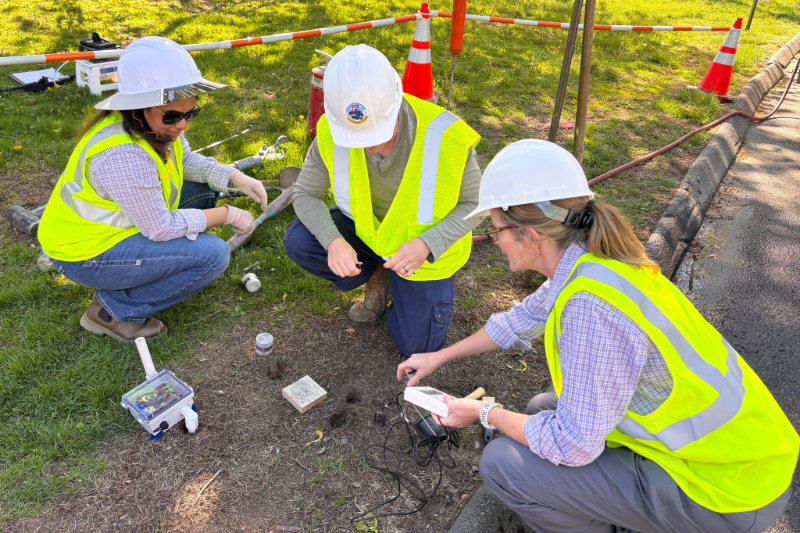
For communities, Dr. Smits emphasizes that the difference can be revolutionary: “An unidentified or improperly classified leak can develop into an ignition and end up in a residential structure,” Dr. Smits highlights. “In addition to visible damage, continuous exposure to methane – the major component in natural gas – can cause acute and chronic impacts for the surrounding community.”
The goal, Dr. Smits explains, is to translate scientific insight into something practical: “For boots-on-the-ground crews, we aim to define better practices in leak repair organization. In addition to scientific explanations, we’ll outline rule-of-thumb practices that ground crews can easily refer to and follow at a leak site.”
For Dr. Smits and her team, this first-of-its-kind collaboration underscores what engineering research at SMU Lyle is all about – impactful, science-driven work with the power to change lives and uplift communities. By bridging theory and application – translating concepts in civil and environmental engineering towards key industry challenges like leak repair prioritization – her project aims to make natural gas delivery safer and more efficient than ever before.
“Our work goes beyond the fundamentals – it’s engineering that’s targeted and specified towards demanding, real-world issues, making processes safer and more efficient,” Dr. Smits emphasized.
SMU Lyle is proud to celebrate the accomplishments of Dr. Smits and her team, and their commitment to human-centered, high-impact research – engineering solutions for a safer energy future.
About the Bobby B. Lyle School of Engineering
SMU’s Lyle School of Engineering thrives on innovation that transcends traditional boundaries. We strongly believe in the power of externally funded, industry-supported research to drive progress and provide exceptional students with valuable industry insights. Our mission is to lead the way in digital transformation within engineering education, all while ensuring that every student graduates as a confident leader. Founded in 1925, SMU Lyle is one of the oldest engineering schools in the Southwest, offering undergraduate and graduate programs, including master’s and doctoral degrees.
About SMU
SMU is the nationally ranked global research university in the dynamic city of Dallas. SMU’s alumni, faculty and nearly 12,000 students in eight degree-granting schools demonstrate an entrepreneurial spirit as they lead change in their professions, community and the world.