PhD Student Presents Mercury Research at UN COP-6
PhD student Linda Jaramillo-Urrego and advisor Dr. Kathleen Smits represent SMU Lyle at the UN COP-6 Conference, presenting community-driven mercury reduction research.

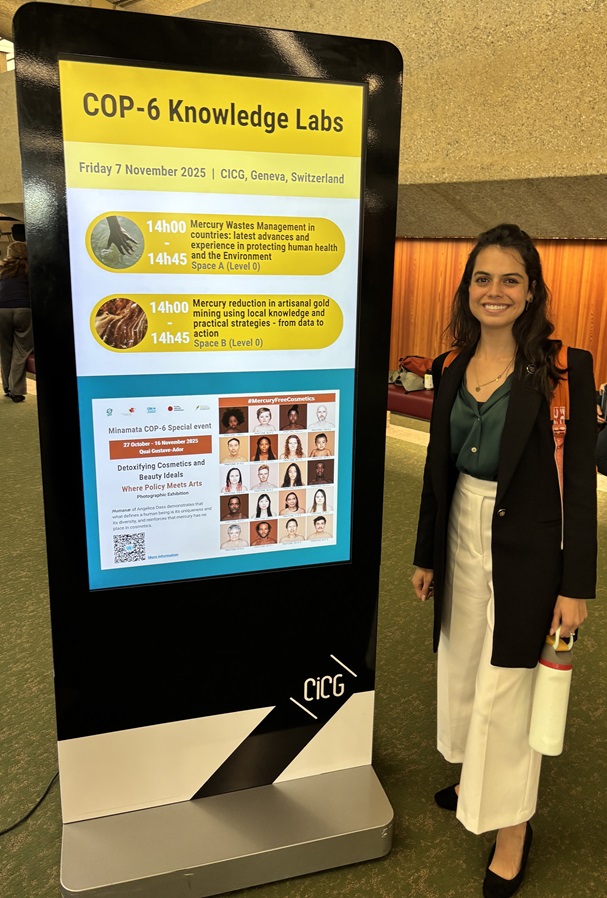
Linda Jaramillo-Urrego, a third-year doctoral student with SMU Lyle’s Department of Civil and Environmental Engineering, recently had the honor of presenting pioneering research in environmental pollution at the Sixth Conference of the Parties (COP-6) to the Minamata Convention on Mercury, held Nov. 3–7, 2025 in Geneva, Switzerland. Her work, in collaboration with SMU Solomon Professor for Global Development and Professor of Civil & Environmental Engineering, Dr. Kathleen Smits, highlights community-centered solutions to one of our foremost environmental threats — mercury emissions.
The Minamata Convention, which entered into force in 2017, is a United Nations-backed treaty aimed at protecting human health and the environment from mercury exposure. As part of the ongoing effort to eliminate mercury-based production, the COP-6 Conference brought together government officials, scientists, and advocacy groups from over 150 countries to review progress under the global treaty and discuss future strategies.
Mercury, a naturally occurring heavy metal with roots in industries like healthcare, cosmetics, and technology, is a potent neurotoxin with the potential to contaminate water, soil, and food systems, posing long-term health risks to individuals and communities around the world. The diplomatic efforts of the COP-6 Conference aim to identify scientific strategies to eliminate risks and prevent further harm associated with mercury emissions.
Focus on Artisanal Gold Mining
Jaramillo-Urrego’s research focuses on artisanal and small-scale gold mining (ASGM), which the United Nations identifies as the largest source of human-caused mercury emissions globally. In many regions, miners use mercury to extract gold because it is inexpensive and widely available, despite the associated health and environmental risks.
Under the Minamata Convention, countries are encouraged to assess mercury use through the development of National Action Plans (NAPs) to reduce emissions. Jaramillo-Urrego analyzed the mercury data from these plans which show wide variation in how countries estimate mercury use, including inconsistent data collection methods and limited reporting of uncertainty.
According to her research, these inconsistencies can reduce the usefulness of national estimates for guiding policy. She attributes many of the challenges to the informal nature of artisanal mining, where operations often move frequently and operate outside formal regulatory systems.
“Collecting precise data in this sector is difficult and resource-intensive,” Jaramillo-Urrego described. “Mining communities are often hard to reach, and there are valid concerns about sharing information.”
Emphasizing Practical Solutions
Rather than focusing solely on improved measurement, Jaramillo-Urrego’s research argued for greater emphasis on practical mercury-reduction strategies that are already in use at the community level.
Drawing on fieldwork in Colombia, she highlighted a traditional gold recovery technique that uses plant-based extracts to separate gold from sediments without mercury. The method, which has been used for centuries, relies on locally available materials and avoids the health risks associated with mercury exposure.
While such techniques are not widely reflected in national action plans, Jaramillo-Urrego emphasizes them as a demonstration of how local knowledge can complement technical and policy-driven approaches.
“Solutions developed within communities are often overlooked,” she said. “But they can be more accessible and more readily adopted than externally introduced technologies.”
Academic and Global Impact
Jaramillo-Urrego’s research is advised by Dr. Kathleen Smits, an SMU professor whose work focuses on environmental remediation and sustainable infrastructure. Together, their work contributes to interdisciplinary approaches to addressing pollution in mining communities.
By presenting at COP-6, Jaramillo-Urrego joined a small group of graduate researchers contributing directly to international environmental policy discussions, reflecting SMU’s emphasis on research with global impact and public relevance.
“Presenting at COP-6 was an opportunity to see how research is used beyond academia,” Jaramillo-Urrego explained. “It puts into perspective how international policy decisions affect real communities.”
“This experience reinforced the idea that research can inform decisions beyond the university,” she elaborated. “It’s meaningful to see it enter a global conversation.”
About the Bobby B. Lyle School of Engineering
SMU’s Lyle School of Engineering thrives on innovation that transcends traditional boundaries. We strongly believe in the power of externally funded, industry-supported research to drive progress and provide exceptional students with valuable industry insights. Our mission is to lead the way in digital transformation within engineering education, all while ensuring that every student graduates as a confident leader. Founded in 1925, SMU Lyle is one of the oldest engineering schools in the Southwest, offering undergraduate and graduate programs, including master’s and doctoral degrees.
About SMU
SMU is the nationally ranked teaching and research university in the dynamic city of Dallas, and a member of the prestigious Atlantic Coast Conference. SMU’s alumni, faculty and more than 12,000 students in eight degree-granting schools demonstrate an entrepreneurial spirit as they lead change in their professions, communities and the world.