From Ruins to Replica: The Lost Capital of Islamic Spain
Learn how the Meadows Museum, SMU Lyle, and UT Dallas are harnessing 3D engineering to preserve, reconnect, and reimagine the legacy of Madinat al-Zahra.

The SMU Meadows Museum and its Custard Institute for Spanish Art and Culture have developed a landmark research partnership with Lyle and UT Dallas — one that spans nearly eleven centuries of questions with regard to Islamic art, history, and influence.
At the center of the project is a tenth-century marble capital from Madinat al-Zahra, the palatine city built by the Umayyad caliph ʿAbd al-Rahman III just outside Córdoba. Constructed in the mid-tenth century as the ceremonial and administrative seat of the Umayyad Caliphate of Córdoba, the site stood at the heart of an Islamic polity that governed much of the Iberian Peninsula until the caliphate’s dissolution in 1031, when it fragmented into a series of Taifa kingdoms.
The capital represents the earliest historical acquisition on display at the Meadows Museum, and the only Islamic object in a museum devoted to Spanish art, giving a voice to the rich cultural and historical influence of Muslim rule, a stronghold across Iberia for more than seven centuries.
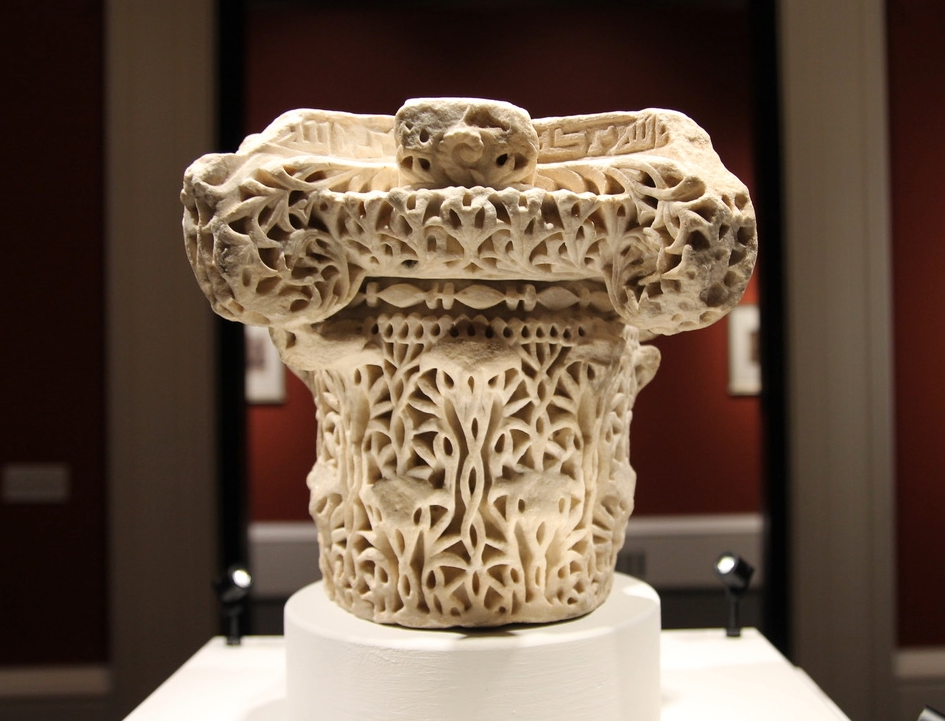
Unknown maker. Capital from Madinat al-Zahra’, c. 965. Carved marble. Meadows Museum, SMU, Dallas. Museum purchase, Meadows Museum Acquisition Fund, MM.96.0. Photo by Cristina Aldrich.
Within Madinat al-Zahra—celebrated in later sources for its magnificence—marble capitals crowned the colonnades of reception halls, courtyards, and administrative spaces. Many were intricately carved with vegetal ornament; some also bore epigraphic inscriptions invoking blessing or naming patrons, though not all were inscribed and Qur’anic text was not universal. Together with stucco panels, marble revetments, and carefully orchestrated architectural vistas, these elements formed part of a highly controlled ceremonial environment that articulated Umayyad caliphal authority in material form.
The palace-city was sacked during the civil wars of 1009–1010, in the final decades of the Umayyad Caliphate, and was largely abandoned soon thereafter. Over the following centuries, its structures were quarried for building materials and its terraces reused for pasture, leaving only fragmentary remains visible above ground. Although antiquarians identified the site in the mid-nineteenth century, sustained and systematic archaeological excavations began only in 1910. By that time, architectural fragments of various scales had already circulated for centuries—reused in later buildings, displaced through spoliation, or entering private and museum collections in the early years of excavation.
This highly ornamented architectural fragment, measuring just eleven inches tall, traveled from Paris to the Meadows Museum in 1996. Like many fragments from Madinat al-Zahra, its precise architectural context, circumstances of removal, and full chain of ownership remain difficult to reconstruct.
For nearly two decades, the capital stood on view in the Meadows Museum galleries with minimal contextual framing, positioned among later Spanish works. In conversations about how best to present this architectural fragment, Museum Director Amanda Dotseth proposed re-examining its display and giving it a more considered physical presence, including a new pedestal. Building on that initiative, the exhibition Unearthing the Legacy of Islamic Spain (September 15, 2024–January 5, 2025)—proposed by Cristina Aldrich, Center for Spain in America (CSA) Fellow—developed a broader interpretive framework around the object. Rather than treating the capital as an isolated remnant, the exhibition situated it within the long afterlives of Islamic architecture in Spain and the nineteenth-century rediscovery, study, and reinterpretation of al-Andalus through art, photography, and scholarship.
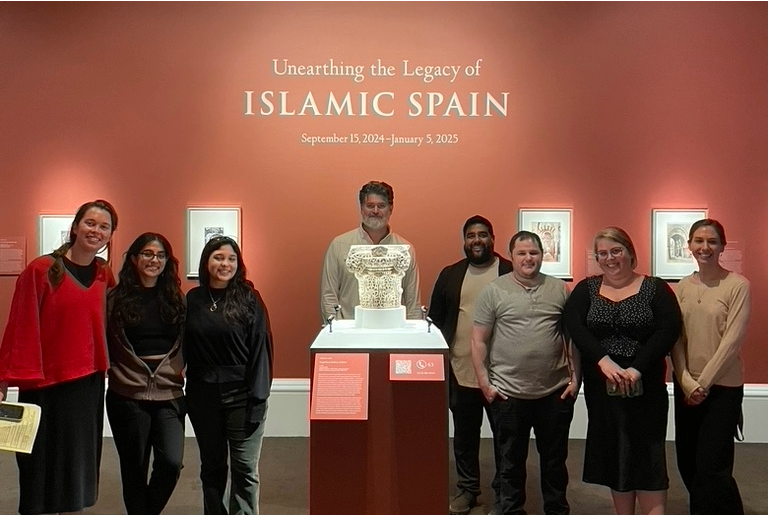
“ Unearthing the Legacy of Islamic Spain ” (2024-2025). Meadows Museum, SMU, Dallas. Photo by Cristina Aldrich.
But they weren’t done yet. The success of the exhibit encouraged Aldrich to wonder if there were other ways to bring the artifact to the main stage — not just for students and museumgoers, but for curators, researchers, and experts across the world.
The project developed into a cross-institutional and cross-disciplinary collaboration, bringing together scholars and technical specialists from the Meadows Museum, Southern Methodist University, and the University of Texas at Dallas. Core contributors include Dr. Ali Asgar Alibhai (UT Dallas), Dr. Anna Ficek (SMU Custard Institute), Dr. Matthew Boulanger (SMU Archaeological Research Collections), and engineers from SMU Lyle’s Deason Innovation Gym, including JT Ringer. Dr. Luis Rueda Galán (Meadows Museum) joined the project at a later stage, contributing expertise on Umayyad architecture and material culture. Together, the team launched the Madinat al-Zahra’ 3D Capital Digitization and Research Collaborative, with the primary aims of documenting the capital through high-resolution 3D scanning, preserving a detailed digital record of its current condition, and creating new tools for research, teaching, and public engagement that situate the object within the broader corpus of surviving architectural fragments from Madinat al-Zahra’.
The Lyle Deason Innovation Gym served as a technological hub, acquiring high-resolution EinScan HX2 technology, a non-destructive light and laser scanning model, to carefully preserve every detail of the delicate capital at millimeter accuracy. This process yielded a near-perfect digital model, which serves as both a conservational baseline and a research tool, from which the team developed a 3D printed, life-size replica.
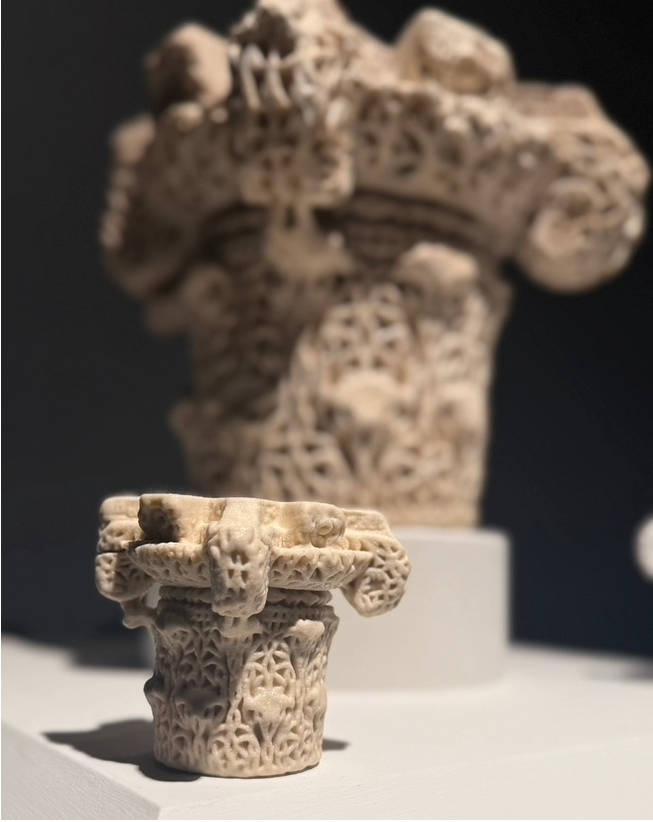
Replica. Photo by Cristina Aldrich.
Central to the project’s mission of public access, their printed model serves as a durable replica for close study and experimentation, while also enabling tactile, multi-sensory access, preserving the experience of art, culture, and history for Meadows Museum visitors with blindness and low vision. The project represents an incredible and much-needed step forward in the development of interactive, impactful exhibits for individuals with disabilities, with the hope of modeling accessibility practices for use in Meadows and beyond.
Building on Professor Ali Asgar Alibhai’s earlier study of the capital’s Kufic inscription, the project’s high-resolution 3D scan has enabled a more detailed examination of the text and its integration with the carved surfaces of the capital. The digital model allows for closer analysis of the inscription’s legibility, layout, and repetition across the object, supporting Alibhai’s broader research on the capital and its possible original placement within the architectural complex of Madinat al-Zahra’. References to paradise, blessing, and divine beneficence—long recognized in the inscription—take on renewed significance when considered alongside questions of ceremony, visibility, and architectural context.
Graduate students from the University of Texas at Dallas, including Anna Shovlin, Nida Jaffer, Amine Faali, and Jonathan Lee, have contributed to the project in a range of technical, research, and documentation roles, supporting the digital and collaborative dimensions of this ongoing work. Together, their insights establish a pattern which may be used to unite artifacts in collections across the world, reweaving the beautiful historical tapestry of Madinat al-Zahra.
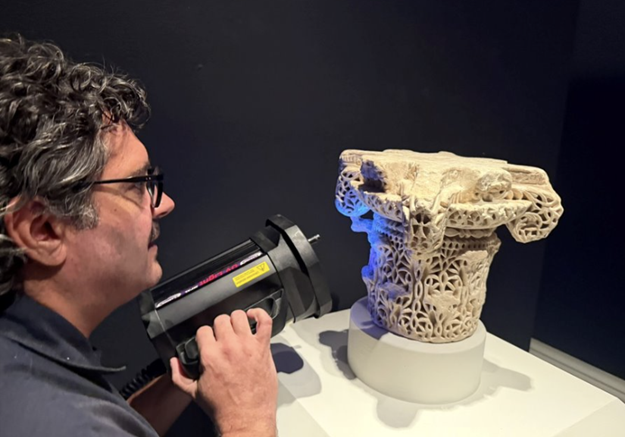
Dr. Luis Rueda Galán (Meadows Museum, SMU). Examination of the capital with UV light. Photo by Cristina Aldrich.
“Bism Allāh al-Raḥīm. Tabāraka alladhī in shā’a jaʿala laka khayr Allāh. Baraka min Allāh. Ghibṭa kāmila.”
“In the name of God, the Merciful. Blessed is He who, if He willed, would bestow upon you God’s beneficence. Blessings from God. Complete happiness.”
Cristina Aldrich of the Meadows Museum recently had the honor of presenting the team’s revolutionary insights at the 2025 Middle East Studies Association (MESA) Annual Conference in Washington, D.C., held from November 22nd to 25th. Her paper, entitled “Digitizing Al-Andalus: 3D Technologies in the Study of Madinat al-Zahra’s Artistic Legacy,” brings this collaboration to the global stage.
Although the team is just getting started, with efforts underway to develop a shared, long-term database of Umayyad capitals, the project serves as a vital step forward in the use of digital tools and cross-disciplinary collaboration to deepen artistic and historical inquiry, reconnecting artifacts and expanding access for scholars, researchers, and museum visitors worldwide.
“This project is just a beginning—a proof of concept for how digital tools can enhance humanistic research on Islamic art,” Aldrich explained. “The vision is a collaborative online platform where these 3D models can be compared side-by-side—with consistent metadata and imagery.”
“Our project offers a replicable model: how a university museum, using accessible tools, can transform a single object into a catalyst for research, teaching, and public engagement.”
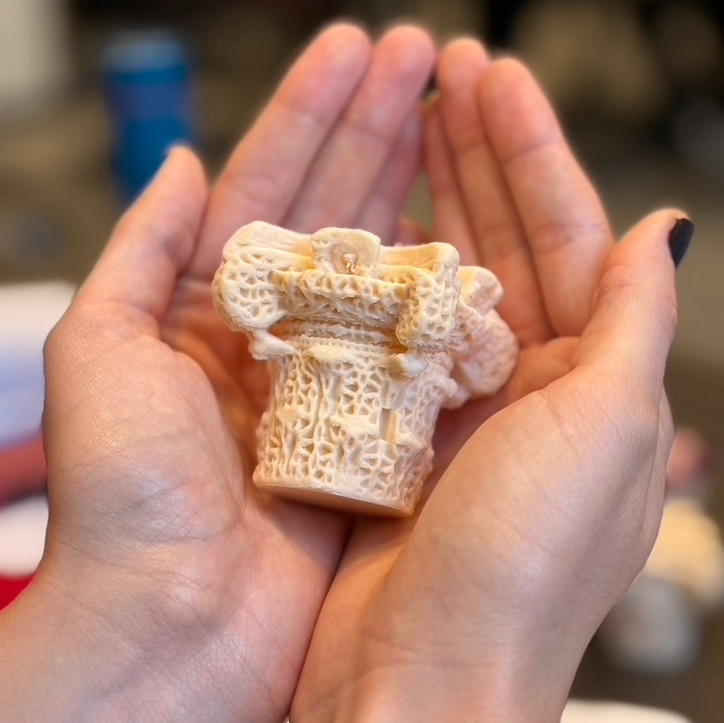
Replica. Photo by Cristina Aldrich.
And for SMU Lyle, the collaboration highlights the underexplored intersection of the arts and sciences, demonstrating that creativity and technical skill are closer than they appear. By calling upon other disciplines, we bridge divides to unlock new expertise, developing research with a stronger practical impact.
“Our role was to help make the tools and expertise accessible, investing in new scanning technology and supporting its use directly at the Meadows Museum,” J.T. Ringer, Deason Innovation Gym manager and project collaborator, shared. “Our efforts were a strong example of how flexible, shared spaces like the DIG can support learning and creative inquiry across disciplines.”
“While we are physically located in Lyle, my hope is that this project increases awareness of the DIG as a campus-wide resource. The DIG is strongest when people with diverse interests, methods, and expertise share the same creative space. Cross-campus engagement not only leads to better work, but also helps ensure that the DIG can continue to grow and be sustained as a shared resource.”
Ultimately, the project places the Meadows Museum, SMU Lyle, and UT Dallas at the center of historical innovation, revolutionizing the study and appreciation of Islamic works of art while perfecting methods that can be applied to disciplines around the world.
About the Bobby B. Lyle School of Engineering
SMU’s Lyle School of Engineering thrives on innovation that transcends traditional boundaries. We strongly believe in the power of externally funded, industry-supported research to drive progress and provide exceptional students with valuable industry insights. Our mission is to lead the way in digital transformation within engineering education, all while ensuring that every student graduates as a confident leader. Founded in 1925, SMU Lyle is one of the oldest engineering schools in the Southwest, offering undergraduate and graduate programs, including master’s and doctoral degrees.
About SMU
SMU is the nationally ranked teaching and research university in the dynamic city of Dallas, and a member of the prestigious Atlantic Coast Conference. SMU’s alumni, faculty and more than 12,000 students in eight degree-granting schools demonstrate an entrepreneurial spirit as they lead change in their professions, communities and the world.