Step 2: Estimate the next year’s project caseload


To calculate how many attorneys a provider needs, the provider must apply the NPDWS standards (case weights) to the next year’s projected caseload. This projected caseload must be a reliable estimate of new (incoming) cases by case type for the next year (as noted in Step 1, this is commonly a fiscal year). 

To estimate the next year’s caseload, a provider could simply use the previous year’s caseload, but there are several other accepted methods of projecting future caseloads from historical caseload data. Three accepted methods (multi-year average, adjusted average, and statistical modelling) are described below. Ultimately, the provider must determine which method of estimating the projected caseload works best for them.

Multi-year Average

A simple way to project next year’s caseload is to average the past few years of caseload data for each case type. When an average is recalculated, year after year, using the most recent years’ data and dropping the oldest year from the previous calculation, it is called a moving (or rolling) average. Using a moving average, instead of the most recent year’s caseload data, reduces the influence of outlying values or one-time events. Many state court systems use a three-year or five-year moving average to project caseloads and calculate the need for judges and court staff. 


The Impact of COVID-19:

The COVID-19 pandemic was an unprecedented disruption to every aspect of society, including individual behavior, policing, prosecutorial charging practices, and court operations. When an event, such as a pandemic, has such a great disruption on the relevant data it is appropriate to identify and exclude that data from a moving average. For this reason, when an average (e.g., a five-year or ten-year moving average) would typically include the years in which caseloads depart substantially from the norm because of the pandemic (typically 2020 and 2021), a provider should instead exclude these years from any calculations of average caseloads. It could be replaced with the previous year or simply excluded. For example, a jurisdiction that typically uses a five-year average could include 2018 and 2019, instead of 2020 and 2021 in its 2026 projection. Alternatively, the jurisdiction could simply exclude 2020 and 2021 and use only three years of data.

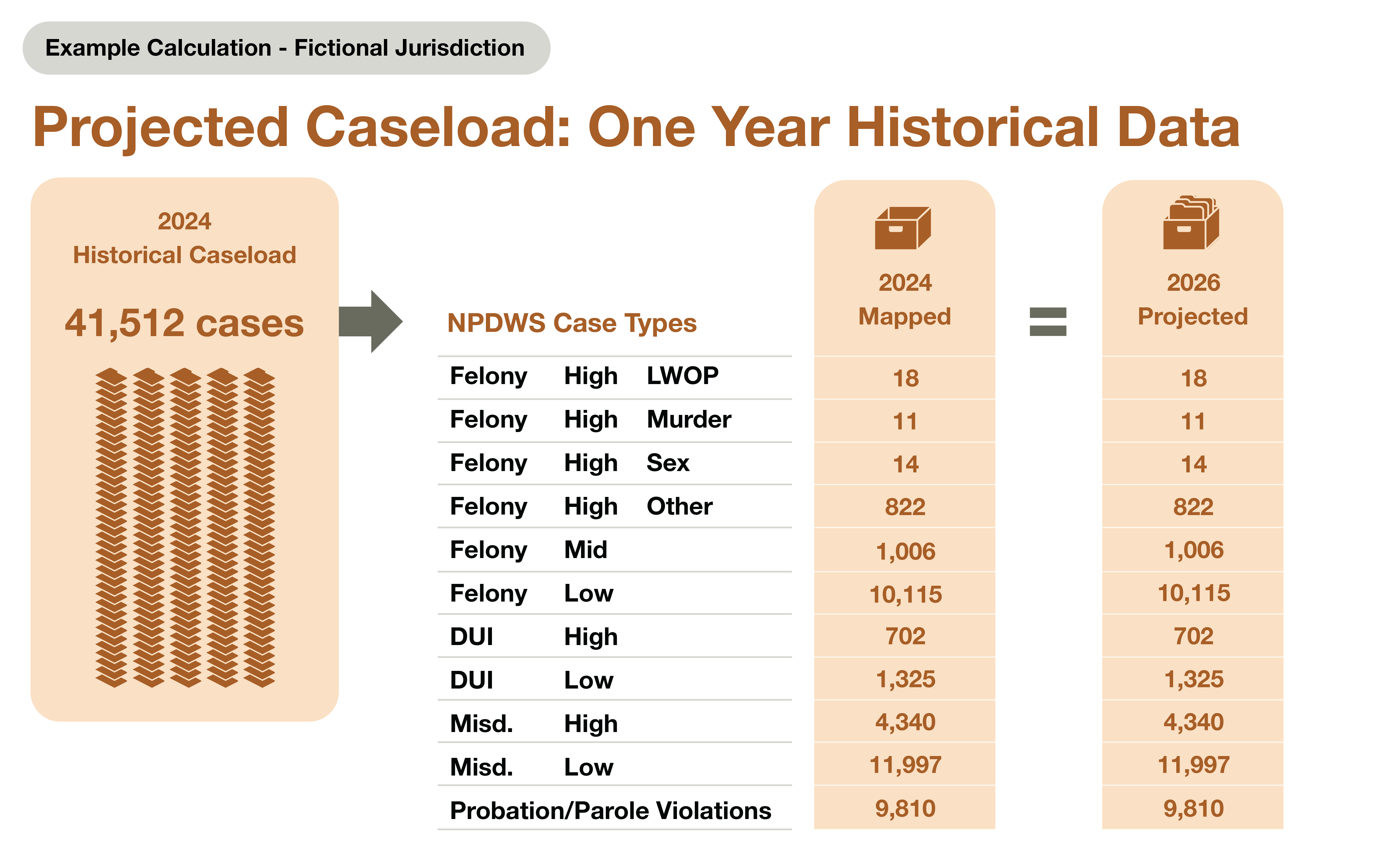
The below shows a 2026 caseload project for our fictional jurisdiction using a three-year average caseload (based on 2022, 2023, and 2024). The 2026 budgeting process is being conducted during 2025, so caseload data for 2025 are not yet available. 


Adjusted Average

In some instances, the public defense provider may have reliable information that will likely impact the next year’s caseload. For this reason, another plausible way of predicting next year’s caseload is to begin with a moving average (or the previous year’s caseload) and then include adjustments based on the provider’s expertise. For example, if a newly elected district attorney has announced plans to more aggressively go after DUI cases, it may be appropriate to increase the predicted DUI caseload or increase some DUI-Low cases to DUI-High.

The table below again shows historical (2022, 2023, 2024) and projected (2026) caseloads for the fictional jurisdiction. In this example, the public defense provider began with the three-year average, but then adjusted that average to account for two recent jurisdictional changes:

  • In 2023, the fictional jurisdiction adopted a new sentencing scheme that made some charges formerly classified as misdemeanors into felonies. After a review of charges, the provider believes that the increase in Felony-Low cases and the decrease in Misdemeanor-High cases in 2024 are a result of this change. Rather than using the three-year average, the director uses the 2024 Felony-Low caseload (11,914 cases) and the Misdemeanor-High caseload (4,208 cases) as the projected 2026 caseloads for those case types.
  • The fictional jurisdiction recently announced a second chance program for some low-level misdemeanor cases. People with no prior criminal history who have been charged with certain low-level misdemeanors (e.g., shoplifting under $100, public intoxication, open container) will receive an automatic dismissal if they are not rearrested within six months. The provider estimates, based on a review caseload data for these charges, that this will reduce Misdemeanor-Low cases by 20%. The provider therefore estimates the projected 2026 Misdemeanor-Low caseload at 80% of the three-year average Misdemeanor-Low caseload or 9,598 cases.


Statistical Modeling

Statistical time series models such as the ARIMA (autoregressive integrated moving average) model can predict future caseloads based on trends and patterns in previous caseloads. These models generally require the input of more years of data than a simple moving average. However, they can also identify and exclude or address anomalies, making them more accurate than a simple moving average. In the future, machine learning or AI technologies will likely be able to incorporate not only caseload data, but also crime rates, demographic changes, and economic changes to predict future caseloads. However, using such a statistical model will require the expertise of a qualified researcher. 


Continue to Next Step >