
Using the National Public Defense Workload Study
This is a carousel with auto-rotating slides. Activate any of the buttons to disable rotation. Use Next and Previous buttons to navigate


The National Public Defense Workload Study
The National Public Defense Workload Study solves this problem, empowering public defense providers, researchers, and policymakers to reliably estimate the number of attorneys needed to provide effective representation.
Public defense workload studies typically use a panel of expert defense attorneys to determine the average attorney time necessary to provide competent, reasonably effective representation for different types of cases. The resulting calculations are expressed as hours-per-case and are commonly called caseload standards or case weights.
The NPDWS used 17 jurisdiction-specific public defense workload studies and a national panel of experienced defense attorneys to determine the national standards for 11 types of adult criminal cases.
.png?h=2703&w=5310&hash=FB0172C7E5AF7EAE90C2874256D7E301)
This website provides a roadmap for public defense providers, researchers, and policymakers to apply the NPDWS standards, calculate their attorney time needs, and determine whether their public defense office or system has enough attorneys. It also addresses frequently asked questions (FAQs) about the NPDWS standards.
Applying NPDWS Standards to Understand Sufficiency of Attorney Staffing
If you are a public defense provider, researcher, or policymaker, you can use the NPDWS standards to determine how many attorneys you need to effectively defend the next year’s projected caseload. You can then compare the number of attorneys needed to the number of available attorneys to determine whether you have enough attorneys and, if not, how many additional attorneys you need.
This calculation requires five steps. This website walks you through each of these steps, describing the data you need and the calculations you must perform.
To conduct an attorney staffing analysis using the NPDWS, you must:
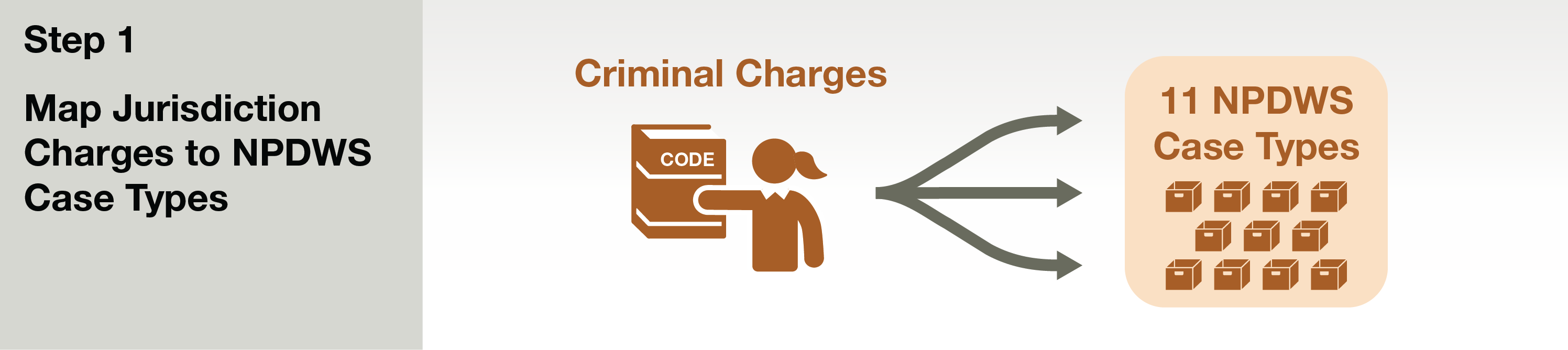
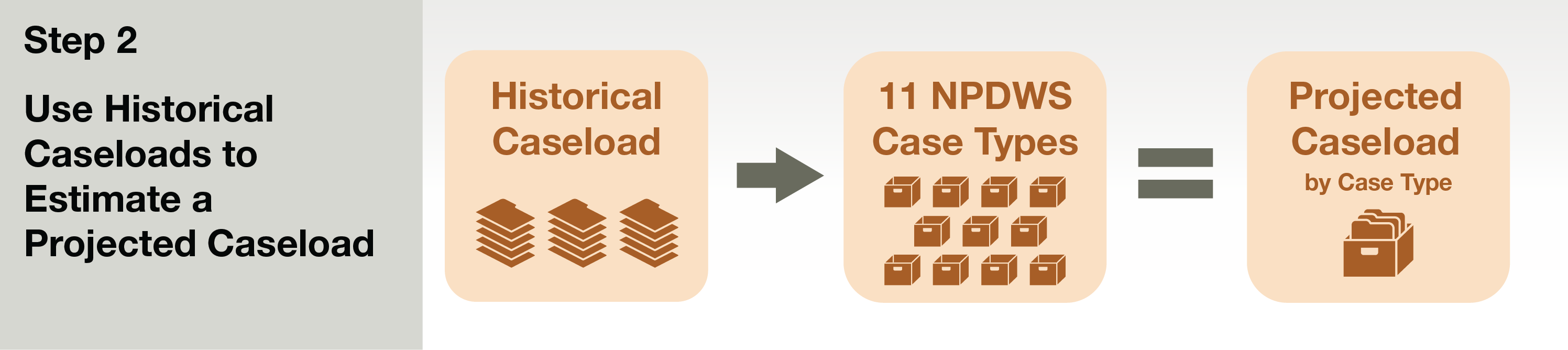
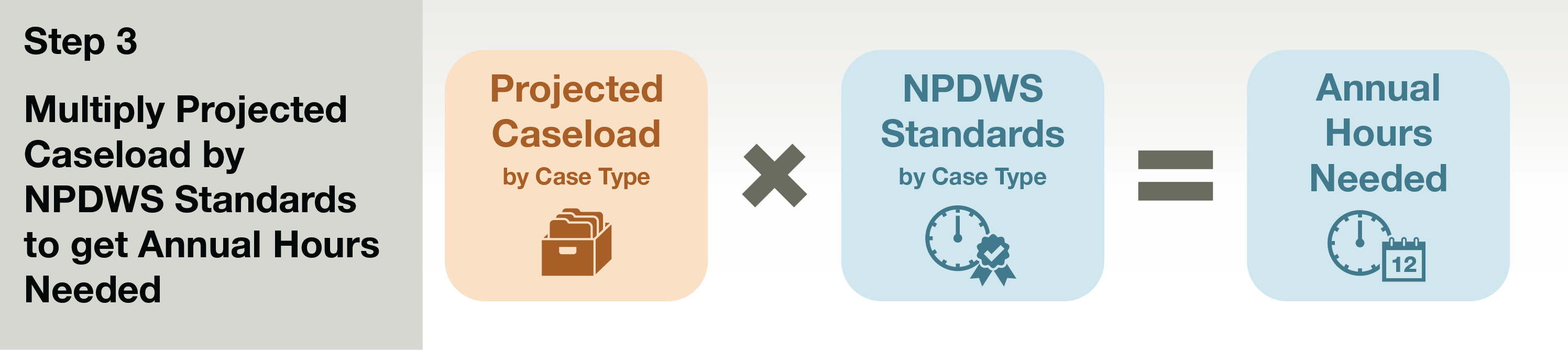
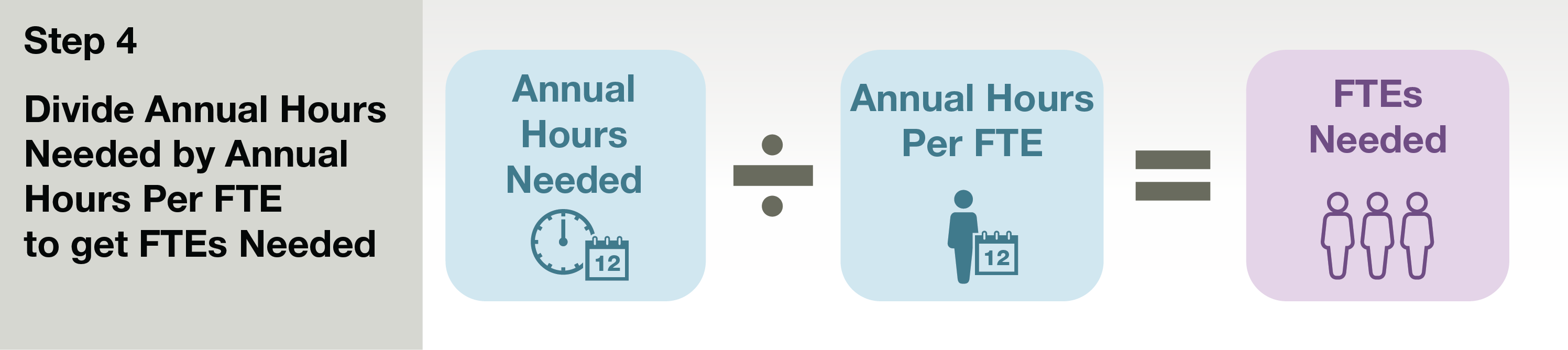
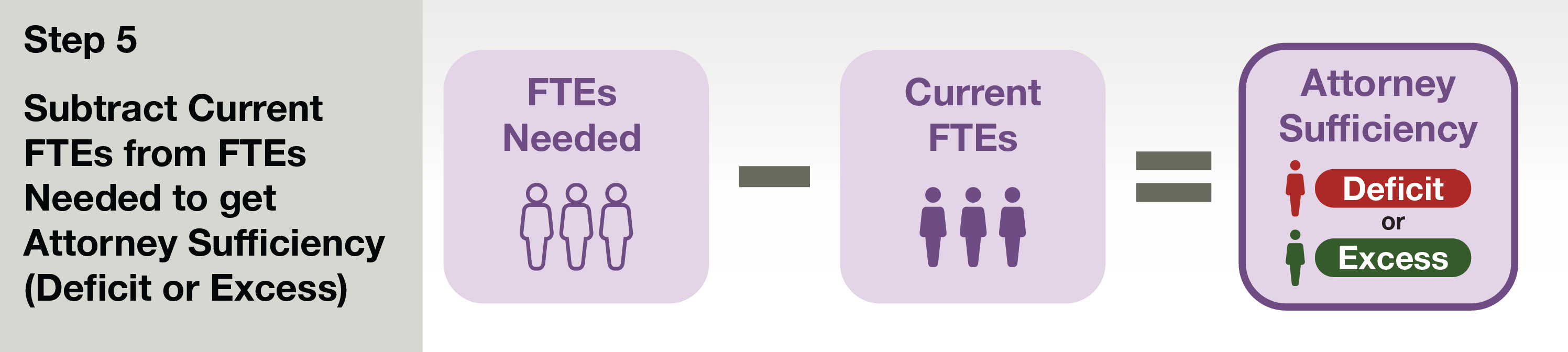
To learn more about each step, click on that portion of the formula.
FAQs on NPDWS
The NPDWS reviewed and considered the methods used in 17 jurisdiction-specific workload studies conducted between 2005 and 2022. In many of those studies, attorneys from the study jurisdiction determined the case types by considering how best to group cases that required similar attorney work. The NPDWS research team then reviewed the case types from these prior studies to identify the 11 case types used in the NPDWS. NPDWS at x (see also Chapter 3).
The research team noted that: “(1) the [case types] must be defined in a way that would translate into various state criminal codes in a straightforward manner, (2) they must reflect reasonable assumptions about relative differences between average attorney time expenditures, and (3) they must make intuitive sense to experienced defenders when asked to consider their own caseloads without requiring them to refer to a detailed list of statute citations.” NPDWS at 58.
The 11 NPDWS case types are:
• Felony–High–Life Without Parole (LWOP)
• Felony–High–Murder
• Felony–High–Sex
• Felony–High–Other
• Felony–Mid
• Felony–Low
• Driving Under the Influence (DUI)–High
• DUI–Low
• Misdemeanor–High
• Misdemeanor–Low
• Probation and Parole Violations
A national panel of 33 defense attorneys experienced in state courts participated in the process for determining the NPDWS standards. For each of the 11 case types, these attorneys considered the time needed for each of eight attorney task categories:
• Client Communication and Care
• Discovery and Investigation
• Experts
• Legal Research, Motions Practice, and Other Writing
• Negotiations
• Court Preparation
• Court Time
• Sentencing and Mitigation and Postadjudication
In estimating the time needed for each of these activities for each case type, the attorneys were asked to consider the time needed to provide “reasonably effective assistance of counsel.” In considering this standard, panel members were instructed to draw on the “‘prevailing professional norms’ of practice and applicable ethical rules for understanding what a criminal defense attorney needs to do for each and every client.” NPDWS at 53. The panel attorneys also received a summary of the 17 jurisdiction-specific public defense workload studies.
The panel attorneys first provided their independent “best estimate of the average time needed to provide reasonably effective assistance of counsel pursuant to prevailing professional norms for each activity type within each case type.” NPDWS at xi (see also Chapter 4 at 77-79). Then, the full panel met in person to compare and discuss their estimates. The goal of the discussion was to reach a reasonable level of consensus on the time needed for each case type.
Before discussion began, each attorney entered their initial estimates into a computer program, which allowed participants to see the range of responses by case type. NPDWS at 80-81. The research team then facilitated a discussion of the different case types, the necessary attorney tasks, and the time required to provide reasonably effective assistance of counsel. Throughout the discussion, each of the attorneys could change their estimates of needed time for each task but were not required to do so.
Discussion continued until a sufficient level of agreement among the panel participants was reached. NPDWS at 82.
Note: The NPDWS used a coefficient of variation to assess when the level of agreement among panel participants was sufficient. A coefficient of variation is a statistical measure that compares the data distribution against a data measure, here the median. For more on the level of agreement required by the NPDWS, see NPDWS at 82-85.
The NPDWS standard (case weight) is the average time needed to provide reasonably effective assistance of counsel in a case of that case type. In other words, the standard considers very simple cases, typical cases, and very complex cases of the case type, the time required across these degrees of complexity, and the likelihood of these different levels of complexity. The standard is an average, but, importantly, average is not necessarily typical. Indeed, it may be rare for any individual case to require exactly the NPDWS standard number of hours. Cases that go to trial will often take much longer, while cases that resolve earlier often take less time. Cases with extraordinary amounts of digital discovery will take more time, while cases with very clear video evidence will take less time.
Consider an attorney who has ten Misdemeanor-Low cases (cases A-J). The standard (case weight) for Misdemeanor-Low cases is 13.8 hours.
- Nine of the attorneys’ cases (A-I) end in guilty pleas or dismissals. Each of these cases take about 4 hours of attorney time, or less than half the standard (case weight). This includes conducting an initial interview with the client, attending an initial hearing to learn of charges, reviewing the charging document, reviewing initial discovery and video evidence, receiving the plea offer, presenting the plea offer to the client, and attending the plea and sentencing hearing.
- Case J, however, goes to trial. This requires significantly more investigation, additional client communications, motions practice, research, trial preparation, voir dire, trial time, and preparation for potential post-trial motions and sentencing. Case J requires a total of 100 attorney hours.
The total amount of attorney time required for all ten cases is 136 hours (9 cases x 4 hours + 1 case x 100 hours). This is very close to the standard (case weight) time for ten Misdemeanor-Low cases (10 x 13.8 = 138 hours).
Table X. Example: Actual case time v. Standard (case weight)
|
Attorney time (hours) |
||
|
Case |
Actual |
Case weight |
|
A |
4 |
13.8 |
|
B |
4 |
13.8 |
|
C |
4 |
13.8 |
|
D |
4 |
13.8 |
|
E |
4 |
13.8 |
|
F |
4 |
13.8 |
|
G |
4 |
13.8 |
|
H |
4 |
13.8 |
|
I |
4 |
13.8 |
|
J |
100 |
13.8 |
|
Total |
136 |
138 |
The NPDWS did not include capital crimes because (1) clients facing capital charges are often represented by specialized counsel; (2) separate standards apply to capital defense; and (3) capital cases have historically been subject to a higher level of scrutiny, including with regard to caseloads. Moreover, because only about half the states have death penalty cases, many of the attorneys on the NPDWS panel lacked the experience necessary to estimate the time needed for effective capital representation.
The NPDWS also did not examine juvenile court cases, dependency cases, appellate cases, postconviction relief cases, contempt cases, sentence modification cases, or civil commitment cases, among others. The NPDWS “did not include these types of representations because of the significant diversity between states in the procedural and substantive law applicable to such proceedings[.]” NPDWS at 60. Additionally, “local public defense delivery systems differ markedly as to whether defenders would be appointed to represent clients in matters[.]” NPDWS at 60. Moreover, specialty public defense attorneys often handle these case types, which would have required the NPDWS research team to convene separate expert panels with the necessary experience for each of these case categories. See, e.g., The New Mexico Project (ABA 2022) (using three separate panels to determine Adult Criminal, Appellate, and Juvenile case weights) ; The Oregon Project (ABA 2022) (using two separate panels to determine Adult Criminal and Juvenile case weights); The Indiana Project (using four separate panels to determine Adult Criminal, Juvenile Dependency, Juvenile Delinquency, and Appellate case weights).
Other Expressions of the NPDWS Standards
The NPDWS Standards are expressed as average hours-per-case for each case type. However, these standards can be converted into other types of standards, including case credits (relative case weights), annual caseload standards, and open caseload standards. More on converting the NPDWS standards to other types of standards COMING SOON!
Other Uses of the NPDWS Standards
The NPDWS standards have many other uses beyond estimating the staffing needs of a public defense provider. For example, they can help you understand the impact of statutory changes on attorney staffing needs and monitor individual attorney workloads. More on other uses of the NPDWS standards COMING SOON!