Step 1: Map Jurisdiction Charges to NPDWS Case Types
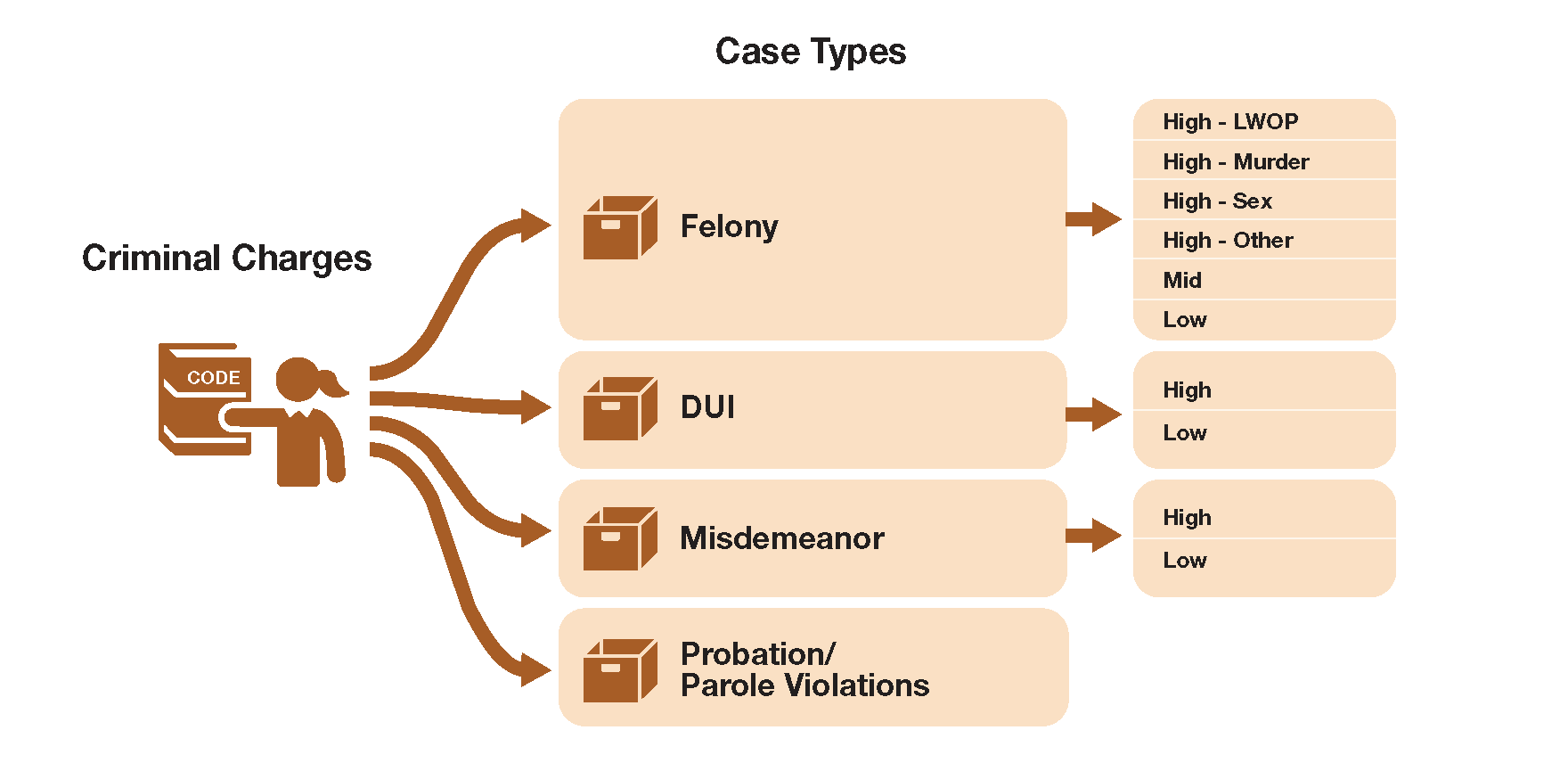
In defining the 11 case types, the NPDWS report offers three types of guidance: (1) a description of the types of criminal conduct that fit within each case type, (2) examples of charges that might fit within each case type, and (3) an expected sentencing range for each case type. The table below shows the NPDWS case type definitions.
NPDWS Case Types
|
Case Type |
Description |
Sentencing Range |
Examples |
|
01: FELONY – HIGH – LWOP |
Felonies with possible sentences of life without parole (LWOP) |
Life without parole |
|
|
02: FELONY – HIGH – MURDER |
Non-LWOP felonies involving intentional killing of a person |
Up to life with possibility of parole |
First degree murder; malice murder; second degree murder; felony murder |
|
03: FELONY – HIGH – SEX |
Non-LWOP felonies involving serious sex offenses |
More than 15 years (including life with possibility of parole) |
Rape; aggravated sexual assault; child sex abuse; child pornography with victim |
|
04: FELONY – HIGH – OTHER |
Non-LWOP felonies (including DUIs resulting in death), other than charges falling into the high felony categories for murder or serious sex offenses |
More than 15 years (including life with possibility of parole) |
Negligent homicide; manslaughter; aggravated assault; assault with a deadly weapon; kidnapping |
|
05: FELONY – MID |
Felonies (including DUIs resulting in death), including serious property crimes, serious drug distribution crimes, and less serious violent crimes |
Possible sentences of 3 to 15 years |
Arson; armed robbery; grand theft; breaking and entering; drug distribution or manufacturing; battery |
|
06: FELONY – LOW |
Felonies (including DUIs resulting in death), including less serious property crimes, less serious drug felonies, and minor crimes of violence |
Possible sentences of up to 2 years |
Theft; larceny; burglary; simple assault |
|
Case Type |
Description |
Sentencing Range |
Examples |
|
07: DUI – HIGH |
Repeat DUIs, serious DUIs, and DUIs causing non-fatal injuries (can be a felony or misdemeanor) |
Possible sentences of more than 2 years |
|
|
08: DUI – LOW |
First or successive DUIs (typically misdemeanors) |
Possible sentences of up to 2 years |
|
|
Case Type |
Description |
Sentencing Range |
Examples |
|
09: MISDEMEANOR – HIGH |
Serious misdemeanors (other than DUIs) involving enhanceable misdemeanors (such as misdemeanors triggering repeat offender sentencing), sex misdemeanors, or violent misdemeanors |
Any |
Domestic violence; misdemeanor assault; misdemeanor animal cruelty; exposure |
|
10: MISDEMEANOR – LOW |
Less serious misdemeanors (other than DUIs or those falling into the high misdemeanor category) |
Any |
Petty theft; drug possession; drug paraphernalia; trespass; status offenses; criminal traffic offenses |
|
Case Type |
Description |
Sentencing Range |
Examples |
|
11: PROBATION/PAROLE VIOLATIONS |
Probation or parole violations derived from either felony or misdemeanor offenses |
Any |
|
In your jurisdiction, these three definitions (description, example, sentencing range) may not align for all offenses. A criminal offense might fit the description of one case type, but its sentencing range might fit within another. You will need to use your discretion in determining the most appropriate case type.
Example 1: Jurisdiction X defines first-degree burglary as unlawfully entering a dwelling with intent to commit a crime therein and either (1) carrying a deadly weapon, or (2) causing physical injury to any person who is not a participant in the crime. First-degree burglary is punishable by up to 20 years in prison. Under the NPDWS, burglary is an example of a Felony-Low charge. However, the jurisdiction’s maximum possible sentence of up to 20 years in jail matches the expected sentencing range for a NPDWS Felony-High-Other case. In this circumstance, you will have to decide whether to map the charge as a Felony-Mid or Felony-High-Other case, rather than as a Felony-Low. To do so, you must consider both the likely sentence for this charge, as well as how much additional attorney work is involved with the first-degree burglary elements (here, a deadly weapon or bodily injury).
Example 2: In Jurisdiction Y, manufacturing an illegal narcotic is punishable by up to 20 years in prison. Under the NPDWS, drug manufacturing is an example of a Felony-Mid charge. However, the maximum possible sentence of up to 20 years in jail matches the expected sentencing range for a Felony-High-Other case. In this circumstance, you should consider the likely sentence for this charge, as well as how much the higher potential sentence increases attorney work on these cases. Based on these considerations, you could map this charge as either a Felony-Mid case or a Felony-High-Other case.
Mapping a jurisdiction’s criminal charges to the NPDWS case types can be a time-consuming task. However, it only needs to be completed once. After it is completed, you will only need to (1) categorize any new charges created and (2) adjust charge categories to account for any statutory change (e.g., new sentencing range).
 The benefit of making a conservative charge mapping choice
If you lack data or a robust basis for choosing to categorize a charge in the higher case type category, you should make the conservative choice and use the lower case type category. For example, consider a jurisdiction that has a sentencing range of 10-50 years for certain drug manufacturing offenses. In the NPDWS, drug manufacturing is an example of a Felony-Mid charge. Similarly, a sentence of 10 years would fit the Felony-Mid case type. However, the upper end of the allowed sentencing – 50 years – fits the expected sentencing range for a Felony-High-Other case. The provider does not know how often prosecutors seek the higher end sentences in drug manufacturing cases. The provider also does not believe that attorneys do significantly more mitigation or sentencing work in cases where the prosecutor seeks a higher sentence. Under these circumstances, the provider should categorize all of their drug manufacturing cases as Felony-Mid. Making this more conservative choice insulates the workload analysis from criticism of “padding” charges and, in turn, staffing and budgetary needs. Bluntly, making the conservative choice ensures that the provider is not subject to criticism for being lazy or trying to add in unnecessary time. For this reason, the Deason Center generally advises that, whenever an assumption is required, providers should make the conservative assumption.
FAQ: Mapping Charges to Case Types
Absent data on how often prosecutors pursue LWOP murder sentences, your workload calculations should categorize all LWOP-eligible murder cases as less-serious Felony-High-Murder cases, rather than as more-serious Felony-High-LWOP cases. Any written report should note that your estimate of attorney need is conservative— because you did not have the data to separate LWOP cases from non-LWOP murder cases, you counted all LWOP-eligible murder cases as Felony-High-Murder (the less serious case type). You should consider beginning to track how often prosecutors pursue LWOP in murder cases.
But I want to show how many of our murder cases are LWOP, is there anything I can do?
You could select and review a number of past murder cases to determine how often prosecutors sought LWOP in the selected subset of cases. You could then apply this rate to all LWOP-eligible murder cases to estimate how many cases should be categorized as Felony-High-LWOP. Sampling is a well-defined research method. Providers should consult with a researcher to determine the appropriate sample size and other research parameters. If you have a case type identification problem that might involve sampling, please reach out to the Deason Center. Our researchers may be able to offer advice or assistance, or be able to refer you to an appropriate researcher in your area.
For consistency, providers within the same jurisdiction should map charges to the same NPDWS case type. If the other provider followed the above procedure and made well-reasoned choices, you should follow their charge map. In some states, a statewide entity has provided guidance on mapping state criminal charges to the NPDWS case types. For example, in California, the Office of the State Public Defender published a guide for mapping common offenses in California to the NPDWS case types. This guide was intended not only to help county-based public defense providers seeking to apply the NPDWS, but also to ensure that they would do so in a consistent manner.