
Judge Elmo B. Hunter Legal Center for Victims of Crimes Against Women
The Judge Elmo B. Hunter Legal Center for Victims of Crimes Against Women provides representation to survivors of gender-based harms, including domestic violence, sexual assault, and human trafficking, in a broad range of legal areas. The Hunter Legal Center has partnered with established local community organizations to serve women who are most critically in need of legal assistance in matters such as family law matters, humanitarian immigration claims, and post-convocation relief. Students enrolled in the Hunter Center also engage in education, advocacy, and policy work to achieve systematic justice for survivors.
The Hunter Center also engages in in systemic advocacy and policy work to both prevent and seek long-term solutions to the problem of violence against women. Current focus areas include ensuring that perpetrators of domestic abuse do not have access to firearms, providing legal assistance to immigrant women and children in detention, and helping survivors of human trafficking get a fresh start by sealing or expunging their criminal records.
The Judge Elmo B. Hunter Legal Center for Victims of Crimes Against Women
Made possible by a generous gift from Ray L. and Nancy Ann Hunter Hunt. The Hunter Legal Center is named in honor of Mrs. Hunt’s father, a distinguished Missouri state and federal judge.
Judge Elmo B. Hunter Legal Center for Victims of Crimes Against Women
Dedication: February 28, 2014
About Judge Elmo B. Hunter
 The namesake of SMU’s new Legal Center was a distinguished judicial leader and public servant who served
as a judge in Western Missouri for 38 years. The Honorable Elmo Bolton Hunter was born October 23, 1915, in New Madrid, Missouri, and grew up in Jefferson City. He enrolled at the University of Missouri at Columbia at 16 and graduated in 1936 with an A.B. at the top of his class. He earned an LL.B degree in 1936 from the University of Missouri Law School, where he was ranked number one in his class. He went on to earn his LL.M. degree in 1941 from the University of Michigan Law School, again graduating at the top of his class.
On the day Pearl Harbor was attacked, Hunter enlisted in the U.S. Army, where he served in U.S. Army Intelligence throughout World War II. Returning to Kansas City, he worked for the Honorable Kimbrough Stone of the Eighth Circuit Court of Appeals. He left to serve as Senior Assistant City Counsel, City of Kansas City, Missouri, after which he worked as Special Assistant U.S. Attorney to prosecute war fraud cases.
He subsequently became one of four founding partners of the renowned law firm Sebree, Shook, Hardy and Hunter, known today as Shook, Hardy and Bacon. He left a thriving law practice to serve 14 years as a State District Judge in Missouri and later as Presiding Judge for the Missouri Court of Appeals. He sat by Special Appointment on the Missouri Supreme Court.
In 1965 Judge Hunter was appointed to the Federal Bench by President Lyndon B. Johnson, becoming the youngest Federal Judge in the United States. He subsequently sat by Special Appointment on numerous United States District Courts and Court of Appeals panels throughout the United States and Puerto Rico.
While serving as a Federal Judge, Hunter was appointed by U.S. Supreme Court Chief Justice Warren Burger to the Judicial Conference of the United States. He chaired the U.S. Judicial Conference Committee on Court Administration. He also served on the U.S. Judicial Conference Subcommittee on Judicial Improvements and on the U.S. Judicial Conference Committee on Long Range Planning.
Judge Hunter was a member of the American Judicature Society and was the only member in its history to serve both as its Chairman and President. In 1991 the Elmo B. Hunter Citizens' Center for Judicial Selection was formed to further the American Judicature Society's historic interest in judicial selection issues. Throughout his career, he was a tireless advocate for judicial merit selection and public education concerning the U.S. Federal and State Judicial System of the United States.
Judge Hunter was an active member of numerous civic boards and committees throughout his life, including service as Police Commissioner on the Kansas City Police Board. In addition, he valued the importance of higher education and served as Trustee of the University of Missouri, and was a member and Chairman of the Board of Trustees of the College of the Ozarks.
Judge Hunter’s achievements were recognized with numerous honors. In 1955 he received the Outstanding Alumni Service Award from the University of Missouri. In 1996 he received the Citation of Merit Award, the highest individual honor given by the University of Missouri School of Law.
In 2002 Judge Hunter received the American Judicature Society's Distinguished Service Award, recognizing his work promoting the effective administration of justice. For his extraordinary leadership in the Federal Judiciary, he received the Edward J. Devitt Distinguished Service to Justice Award.
He was married to Jane Ann Williams of Kansas City, Missouri, who died in 1949, and they had one daughter, Nancy Ann Hunter. He was married to Shirley Arnold Hunter for 51 years at the time of his death in 2003.
About Nancy Ann and Ray L. Hunt
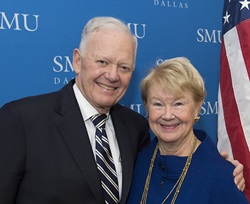 Nancy Ann ’65 and Ray L. Hunt ’65 are longtime contributors to community organizations that empower individuals to transform their lives.
Nancy Ann Hunt taught in elementary school before focusing more fully on community service, devoted in particular to the well-being of women and children. Though she prefers working behind the scenes, numerous organizations have recognized her leadership with awards. Among them are the Boy Scouts of America’s Silver Beaver Award, Robert S. Folsom Leadership Award of the Methodist Health System Foundation, Women’s Center of Dallas Maura Award, and the Genesis Women’s Shelter Jane Doe Award. She is chair-elect of the board of New Friends New Life, which helps victims escape the sex industry and build new lives for themselves and their children. Among numerous activities for SMU, she serves on the executive board of the Annette Caldwell Simmons School of Education and Human Development.
Ray L. Hunt is chairman, president and CEO of Hunt Consolidated, Inc. Mr. Hunt’s service to SMU has been multifaceted. He chaired the Board of Trustees after its restructuring in the late 1980s and now serves on the Board’s Trusteeship Committee and Executive Committee. Working with other SMU trustees and President Turner, he was instrumental in attracting the George W. Bush Presidential Center to SMU and serves on the Bush Foundation board. Elected to the Texas Business Hall of Fame in 1992, he received the first J. Erik Jonsson Award of the Greater Dallas Chamber of Commerce and was selected for the Linz Award, honoring humanitarian service. Mr. Hunt also received the Order of Marib Award from the Republic of Yemen, the only non-Yemeni to be so designated.
In 2013 Ray and Nancy Ann Hunt became the first couple to receive the J. Erik Jonsson Ethics Award from SMU’s Cary M. Maguire Center for Ethics and Public Responsibility, and both have received SMU’s Distinguished Alumni Award.
Read more
Advocating for a Fairer Definition of Duress
The current duress statute in Texas harms victims of human trafficking and domestic violence and Hunter Center students are working to change that. In collaboration with the Lone Star Justice Alliance, students drafted a white paper to support a bill that would allow defendants who were coerced into committing a crime to introduce evidence of past trauma related to their abuse. The white paper, and accompanying one pager, explain how the bill would allow judges and juries to consider the coercion and trauma suffered by survivors of sex trafficking and domestic violence when they are forced to commit a crime by their abuser. The research conducted includes a 50-state survey of how other jurisdictions apply the affirmative defense of duress.
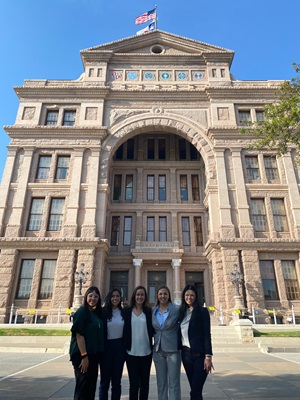
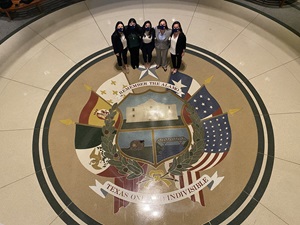
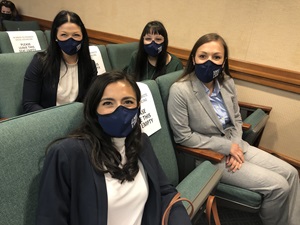
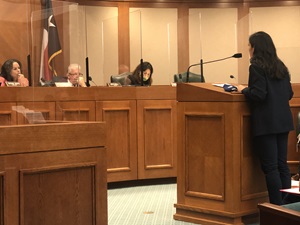
Professor Natalie Nanasi and students from the Hunter Center provided testimony to the Texas Legislature in support of a bill that would make the affirmative defense of duress fairer for survivors of human trafficking and intimate partner abuse.
Flawed Design: How the U Visa is Revictimizing the People it was Created to Help
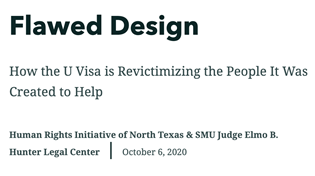
Congress created the U visa in 2000 to provide a pathway to legal status in the United States for immigrant survivors of crime. The visa is a lifeline for victims and a benefit to law enforcement officials, who can better detect, investigate, and prosecute crime with the assistance of survivors. But the U visa’s promise remains unfulfilled due to a series of design flaws.
In partnership with the Human Rights Initiative of North Texas, the Hunter Center’s Report, Flawed Design: How the U Visa is Revictimizing the People it was Created to Help, documents the challenges faced by U visa applicants as they wait nearly a decade for the government to adjudicate their petitions. To uncover the realities of living and working in the shadow of the backlog, Hunter Center students conducted long-form, semi-structured interviews with U visa petitioners and holders, collected stories from immigration practitioners from 9 states, and surveyed 143 immigration practitioners nationwide. The Report documents their findings – that the delay in adjudication has a devastating impact on survivors, causing them to experience job and housing insecurity, medical and mental health struggles, and separation from family members and loved ones.
The Report also critiques the U visa’s mandate that survivors engage with the criminal justice system, shining a light on the ways that the visa reinforces an unequal system and harms survivors – particularly Black and LGBTQIA survivors – who may never be able to access the U visa safely because interacting with law enforcement is not safe for them.
Read the detailed findings, and the recommendations for change, here: http://bit.ly/U-report-2020
Taking Aim at Family Violence: A REPORT ON THE DALLAS COUNTY GUN SURRENDER PROGRAM
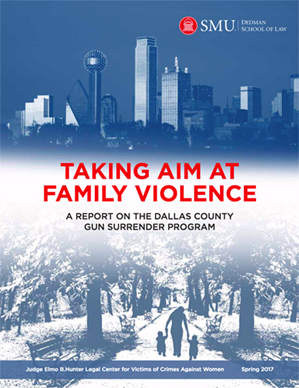
In May 2017, the JUDGE ELMO B. HUNTER LEGAL CENTER FOR VICTIMS OF CRIMES AGAINST WOMEN released a report entitled “Taking Aim at Family Violence: A Report on the Dallas County Gun Surrender Program.” The report is the culmination of a year-long study of a DALLAS COUNTY PROGRAM that provides a mechanism for domestic violence offenders, who are barred from possessing firearms under both federal and state law, a safe and secure mechanism to surrender their weapons. The authors analyzed the Dallas program as well as similar programs in other jurisdictions to provide stakeholders with recommendations and a roadmap for effectively reducing intimate partner femicides due to gun violence.
The Hunter Center continues to take a leadership role in Dallas County's efforts to remove firearms from the hands of prohibited possessors. Students and faculty have conducted numerous trainings for judges charged with ordering perpetrators of intimate partner violence to surrender their weapons and participate in the Dallas County Gun Surrender Task Force.
Most recently, the Hunter Center produced educational materials for survivors of domestic violence in Texas, including the website DisarmingTexasAbusers.org, to provide survivors with critical information about the law, their rights, and their safety.
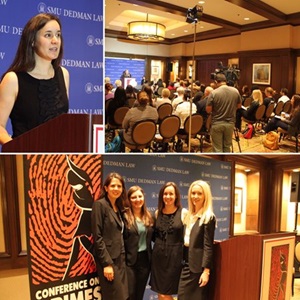
Professor Nanasi and Hunter Center students at a press conference announcing the release of “Taking Aim at Family Violence: A Report on the Dallas County Gun Surrender Program.
Combatting the Repeal of No Fault Divorce in Texas
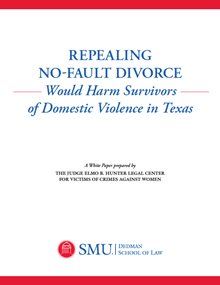
The Hunter Center, along with other SMU scholars, successfully combated efforts by the Texas legislature to repeal no-fault divorce—and return the state to a bygone era in which marriages could not be terminated without the assignment of blame. In a white paper, the Hunter Center details how requiring proof of fault in order to obtain a divorce would increase the risk of physical and psychological harm to domestic violence victims and their loved ones. The white paper also explains how a repeal of no-fault divorce would have adverse financial consequences on survivors, the court system, and the State of Texas.
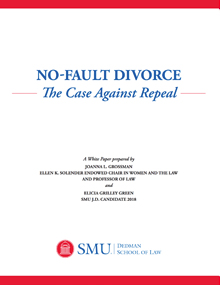
The Hunter Center’s white paper is a companion piece to a white paper authored by Professor Joanna Grossman and Elicia Grilley Green of SMU Dedman School of Law. That paper traces the historical and legal origins of no-fault divorce in the United States and explains why no fault divorce is an appropriate and necessary option for the dissolution of an unsustainable marriage.
Legislative Advocacy
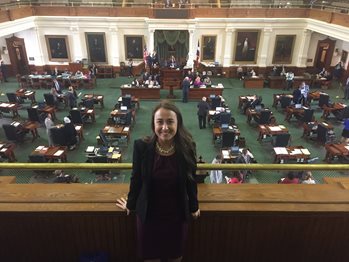
Hunter Center students are actively engaged in legislative advocacy to improve the lives of survivors of human trafficking in the state of Texas. Students worked in partnership with the nonprofit organization New Friends New Life to advance a number of anti-trafficking initiatives in the 2017 Texas Legislative session, culminating in the testimony of Hunter Center student Mackenzie Wortley on H.B. 2509, a bill that would increase access to Orders of Nondisclosure for survivors.
Karnes Family Immigration Detention Center Pop-Up Clinic
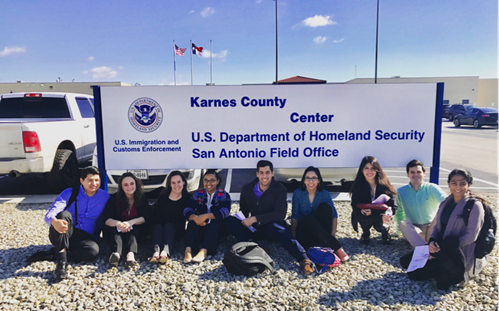
The JUDGE ELMO B. HUNTER LEGAL CENTER FOR VICTIMS OF CRIMES AGAINST WOMEN sponsored the School of Law’s first Pop-up Clinic over the 2017 Spring Break. Eight students sacrificed their vacation time to travel to the Karnes Family Immigration Detention Center to assist mothers and children being detained at the facility in their pursuit of asylum in the United States. Media coverage: ABA Journal (3/7/17)
NBC-5 (3/10/17)
Al Dia (DMN) (3/7/17)
Dallas Morning News (3/7/17)
WBAP 820/KLIF 570 (3/8/17)
Univision
SMU (Blog) (News)
Texas Lawyer
Due to the overwhelming success of the Pop-Up Clinic, the Spring Break program is now a permanent part of the law school's clinical program.
Community Education
The JUDGE ELMO B. HUNTER LEGAL CENTER FOR VICTIMS OF CRIMES AGAINST WOMEN regularly engages in community education projects that provide critical information and resources about domestic abuse, sexual violence and human trafficking. Examples of our community education include:
- Producing a video for the Vickery Meadow Learning Center, a nonprofit organization that teaches English literacy skills in low income, highly diverse neighborhoods of Dallas, about domestic violence laws in the United States.
- Presenting at the 2017 International Conference on Crimes Against Women, where students provided information about Orders of Nondisclosure for survivors of human trafficking.
Our Work
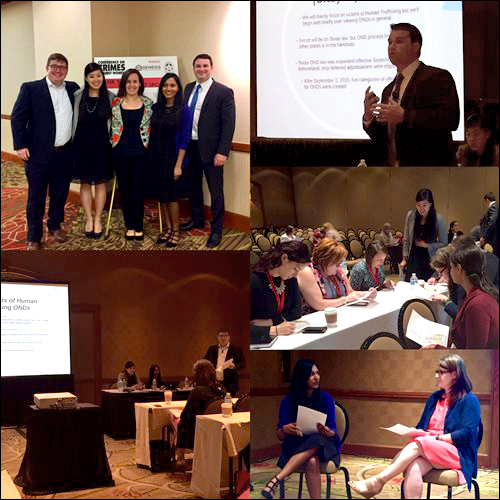 |
Educating law enforcement officers and advocates at the Conference on Crimes Against Women. |
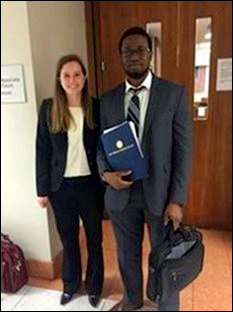 |
Victorious after obtaining an Order of Protection for our client, a survivor of domestic violence. |
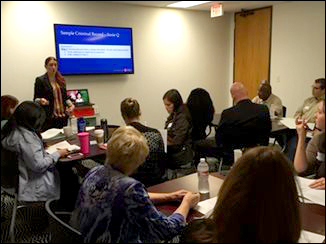 |
Conducting a training for New Friends New Life on trafficking survivors' eligibility for orders of non-disclosure. |
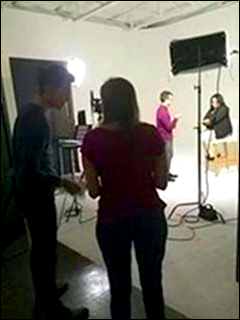 |
Overseeing filming of an educational video about domestic violence created for the Vickery Meadow Learning Center. |
Student testimonials
- “I acquired valuable practical skills, worked with an inspiring group of people, met and represented wonderful clients, and learned so much about the legal profession generally . . . I am excited about the opportunities ahead and the way that my clinic experience will propel me forward into a meaningful life of work.”
–McKenna Smith ’21 - “I have been fortunate to have many impactful experiences throughout law school, but few, if any, have impacted me in the way the clinic has … the Hunter Clinic has made me feel much more prepared to step into an attorney role.”
–Brooke Olsen '18 - “Lawyers doing this work are providing much-needed services, but this experience has shown me that these clients actually give us just as much as we give them.”
–Roslyn Dubberstein ’20 - “Where I once had only a surface-level awareness of domestic violence, I now better understand the complexities, prevalence, and systematic challenges of intimate partner violence. Applying the doctrinal learning from the past two years to real clients and cases was one of the most valuable aspects of my legal education thus far.”
–Anna Kuhlman '26 - “I saw the true impact my work had on someone’s life and that was the most rewarding thing for me. I am grateful to have experienced that moment through the Clinic. It will be a moment that I cherish throughout my legal career.”
–Sachi Dave '18 - “I wish that clinic were a required course for all law students. I will leave clinic and graduate feeling much more confident about my ability to find solutions and navigate the legal system as a first-year attorney.”
–Kelsey Vanderbilt ’20
“My experience in clinic has shaped the way I view social justice and advocacy for clients. Hands down the best part of my law school career.”
–Tiffany Clark '17 - “As an introvert, I thought I would feel anxious and awkward when meeting a client. But I was able to see a new side of myself as a vocal advocate for the client.”
–Joo Yeun Paek ’23 - “This has been the most beautiful learning experience I could have ever asked for because it helped me develop as both a human and a lawyer. Law school has been a taxing three years. There was immense growth, but there was also severe doubt. Clinic transformed much of my doubt into drive.”
–Roslyn Dubberstein ’20 - “The Hunter Clinic is the only place in law school where we really learned about how to effectively interact with and address the legal needs of clients. The entire experience was fundamental in rounding out my legal education."
–Aubry Talkington '16 - “I have had a crash course in asylum law and have also gained practical knowledge. Not only did I learn how to improve my interviewing skills and how to tell a story in my work, but I also learned how to take care of myself better.”
–Samantha Favela ’22 - “The clinic is like a slice of real-life practice in a controlled setting. Real frustration. Real problems. Real clients.”
–Chime Nwikoro '17 - “I never thought that I'd be applying what I learned in a contracts drafting course to my work for the Hunter Legal Center - but I did just that.”
–Monica Harasim '17 - “I am so very grateful to the SMU Legal Clinics for a myriad of reasons, including the Clinics’ ability to remind law students that there is a world at our doorstep where people desperately need legal services to help them secure the most basic fundamental life necessities.”
–Will Stovall '17
The Judge Elmo B. Hunter Legal Center for Victims of Crimes Against Women accepts a limited number of clients each semester.
If you need assistance with a legal matter, please contact our Administrative Assistant, Cristela Barillas at 214.768.2562.
Additional Resources:
National Domestic Violence Hotline: 1.800.799.SAFE (7233)
National Sexual Assault Hotline: 1.800.656.HOPE (4673)
Crisis Centers
Dallas Area Rape Crisis Center
24-hour local hotline: 972.641.7273
dallasrapecrisis.org
Parkland Rape Crisis/VIP
24-hour hotline: 214.590.0430
parklandhospital.com/phhs/vip-rape-crisis-center.aspx
Trauma Support Services of North Texas
Phone: 972.709.4904
tssnt.org
Domestic Violence Shelters
Genesis Women’s Shelter and Support
24-hour hotline: 214.946.HELP (4357)
genesisshelter.org
The Family Place
24-hour crisis hotline: 214.941.1991
familyplace.org/
Brighter Tomorrows
24-hour hotline: 972.262.8383
brightertomorrows.net
New Beginning Center
Crisis hotline: 972.276.0057
newbeginningcenter.org
Hope’s Door
24-hour crisis hotline: 972.422.7233
hopesdoorinc.org
Mosaic Family Services
24-hour crisis hotline: 214.823.4434
mosaicservices.org
Salvation Army - Domestic Violence Program
24-hour local hotline: 214.424.7208
salvationarmydfw.org
Law Enforcement / Government
Dallas Police Department, Domestic Violence Unit
214.671.4304
Dallas County District Attorney’s Office, Family Violence Unit
214.653.3528
Dallas County District Attorney’s Office, Protective Order Unit
214.653.3528
Attorneys General’s Child Support Division
1.800.252.8014
Legal Resources
Legal Aid of Northwest Texas
Phone: 214.748.1234
lanwt.org
Legal Action Works /CitySquare
Phone: 214.827.1000
citysquare.org/law
Texas Advocacy Project
Family Law hotline: 800.777.FAIR (3247)
Sexual assault legal hotline: 888.296.SAFE (7233)
texasadvocacyproject.org
Dallas Volunteer Attorney Program
Phone: 214.243.2236
dallasvolunteerattorneyprogram.org
Mosaic Family Services
Phone: 214.821.5393
mosaicservices.org/how-we-help/legal-representation
Human Rights Initiative
Phone: 214.855.0520
hrionline.org
Catholic Charities
Phone: 866.223.7500
ccdallas.org
Refugee and Immigrant Center for Education and Legal Services (RAICES)
Phone: 817.717.9377
raicestexas.org
Texas Law Help
texaslawhelp.org
Academic Credit and Student Eligibility
The Clinic is a 6 credit course that is open to second and third year law students. Pursuant to the Student Practice Rules of the State Bar of Texas, students are eligible to enroll in the Clinic once they have completed one half of their hours for graduation (45 hours).The Hunter Legal Center will accept 8 students per semester in the fall and spring semesters; the Clinic is not offered during the summer.
Mandatory Orientation
Students enrolled in the Clinic must attend a two-day orientation that will be held before the semester commences.
Client Representation
Working in teams, students will have full responsibility for all aspects of client representation. Student attorneys will have extensive client contact and the opportunity to practice a number of core lawyering skills, including drafting client letters, legal memoranda, motions and written pleadings; interviewing, counseling and negotiating on behalf of clients; conducting intensive fact investigation; and litigating contested matters before a variety of tribunals. Student attorneys will also collaborate with community partners and work towards long-term solutions to the problem of violence against women through involvement in policy or advocacy projects.
Supervision of Student Attorneys
Students will meet with a supervising faculty member at least once per week (and more often when necessary) to discuss client matters, plan for future action to be taken in a case, and review and reflect upon recently executed decisions and actions.Classroom Component
Students in the clinic will enroll in a seminar which provides the legal and analytical foundation for their lawyering experiences. The classes, which include topics such as client-centered lawyering, developing case theory, client interviewing and counseling, case planning, and cross-cultural competency, will allow students to hone their lawyering skills and teach them to adopt critical perspectives on the practical issues they are experiencing in their casework. Students will study legal theories that will assist them in analyzing their lawyering experiences and challenging their assumptions, and provide them with resources to better understand their clients’ problems and devise effective solutions.Case Rounds
Student attorneys will participate in case rounds, facilitated discussions through which case developments and issues are shared with their fellow classmates. The discussions undertaken in case rounds help students grapple with the legal, procedural, and ethical issues that arise during their client representation.Faculty and Staff
Natalie Nanasi
Director of the Judge Elmo B. Hunter Legal Center for Victims of Crimes Against Women and Professor of Law
Demetrice Lopez-Loftis
Faculty Law Fellow of the Hunter Legal Center for Victims of Crimes Against Women and Adjunct Clinical Professor of Law
Cristela Barillas
Legal Assistant
Mailing Address
SMU Dedman School of Law
P.O. Box 750116
Dallas, TX 75275-0116
Physical Address
SMU Dedman School of Law
Carr Collins Hall
3300 University Boulevard
Dallas, TX 75205
Legal Clinics
Phone: 214.768.2562
Email: legalclinics@smu.edu