Tumbleweed County
 Applications for Appointed Counsel
Under the Tumbleweed County indigent defense plan, justices of the peace (JPs) were responsible for presided over magistration, which took place at the county jail. The JPs were supposed to ask arrested people whether they wanted to apply for counsel. They were also responsible for documenting magistration proceedings on one of two magistration forms—only one form asked them to record whether an arrested person wanted to apply for appointed counsel. JPs provided paper applications for people who indicated that they wanted to apply for counsel.
Tumbleweed JPs did not have the authority to rule on applications for appointed counsel. Instead, each day the JPs were supposed to collect any applications for counsel and send them to a county court judge for a decision.
Decisions of Appointment of Counsel
In their review of Tumbleweed misdemeanor magistration records, researchers did not find any completed applications for appointed counsel.
Key Findings
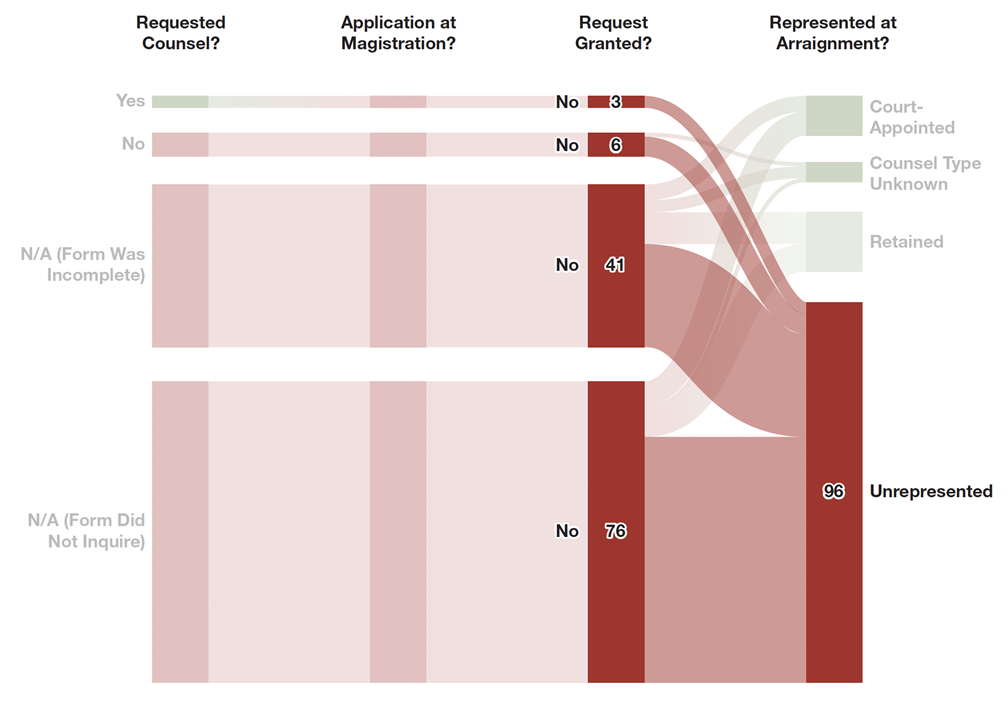
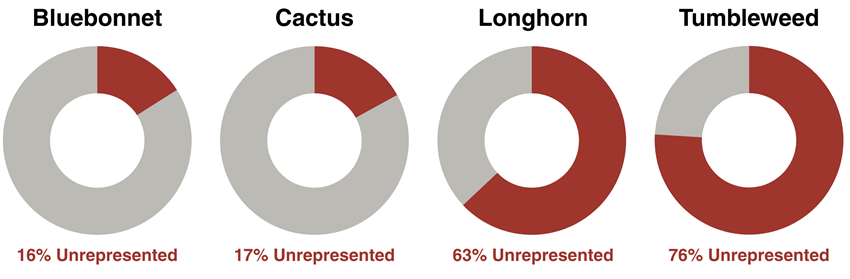
In most (76) Tumbleweed misdemeanor cases, the magistration forms did not even ask the presiding JP to record whether a person wanted to apply for counsel. Among the 50 cases in which the magistration form asked that question, there were only nine cases in which a JP answered it. While three forms indicated that an accused person wanted to apply for counsel, researchers did not find any completed applications for appointed counsel. On the day of their arraignment, accused people in 76% (96) of studied cases still had no attorney, the highest rate in any county studied.
Data Legend
1: Requested Counsel? The Deason Center reviewed each magistration form and recorded (1) whether the form asked if the accused person wanted to apply for appointed counsel, and (2) if so, second, whether, and how, the JP answered that question.
2: Application at Magistration? Researchers recorded whether each case file included an application-for-counsel form dated on the day of magistration. If there was no application, or if the application post-dated the magistration, researchers coded the case as ‘no’. Researchers did not find any applications for counsel in this county.
3: Request Granted? Researchers did not find any applications for counsel. Therefore, they did not code any requests as granted or denied.
4: Represented at Arraignment? Researchers documented whether court records indicated that, on or before the day of their arraignment, the defendant had an attorney. Researchers further coded whether that lawyer was court-appointed or retained. In five instances, researchers coded lawyers as ‘Type Unknown’ because they could not determine whether they were court-appointed or retained. (Court records only indicated whether a defendant had counsel, not whether that lawyer attended the arraignment.)
About the Tumbleweed Data
Center researchers collected records on 496 Tumbleweed County misdemeanor cases that were closed between January 1, 2016, and March 7, 2023.
Researchers eliminated 368 cases from the diagram for which they were unable to locate magistration records. Researchers removed two more cases in which application and appointment procedures differed substantially from those described above.
Magistrations for the 126 cases depicted in the diagram occurred between August 10, 2018, and November 6, 2021.