Bluebonnet County
 Applications for Appointed Counsel
Under the Bluebonnet County indigent defense plan, special magistrate judges presided over magistration, which took place at the county jail. During magistration, they were responsible for asking arrested people whether they wanted to apply for appointed counsel and documenting their answers on the county’s magistration form. Magistrate judges and court staff provided paper applications to people who requested them. People who completed their applications during magistration submitted them to court staff.
Bluebonnet magistrate judges did not have the authority to rule on applications for appointed counsel. Instead, Bluebonnet magistration staff were responsible for scanning applications and emailing them to the Indigent Defense Coordinator (IDC).
After magistration, people also could apply for counsel by going to the Bluebonnet IDC’s office, which was located in the county courthouse. If unrepresented people appeared for arraignment, the presiding county court judge often asked if they wanted to apply for appointed counsel. If they did, the judge sent them to the IDC’s office to complete an application.
Decisions about Appointment of Counsel
Pursuant to the Bluebonnet indigent defense plan, the IDC reviewed applications for counsel and appointed counsel for people whose financial circumstances clearly satisfied the county’s eligibility standards. Sometimes, the IDC concluded that a person who did not meet the county’s financial criteria still needed appointed counsel representation. The IDC forwarded those applications to a Bluebonnet County Court judge. Those judges had power to appoint counsel “in the interests of justice,” notwithstanding a person’s financial circumstances.
Key Findings
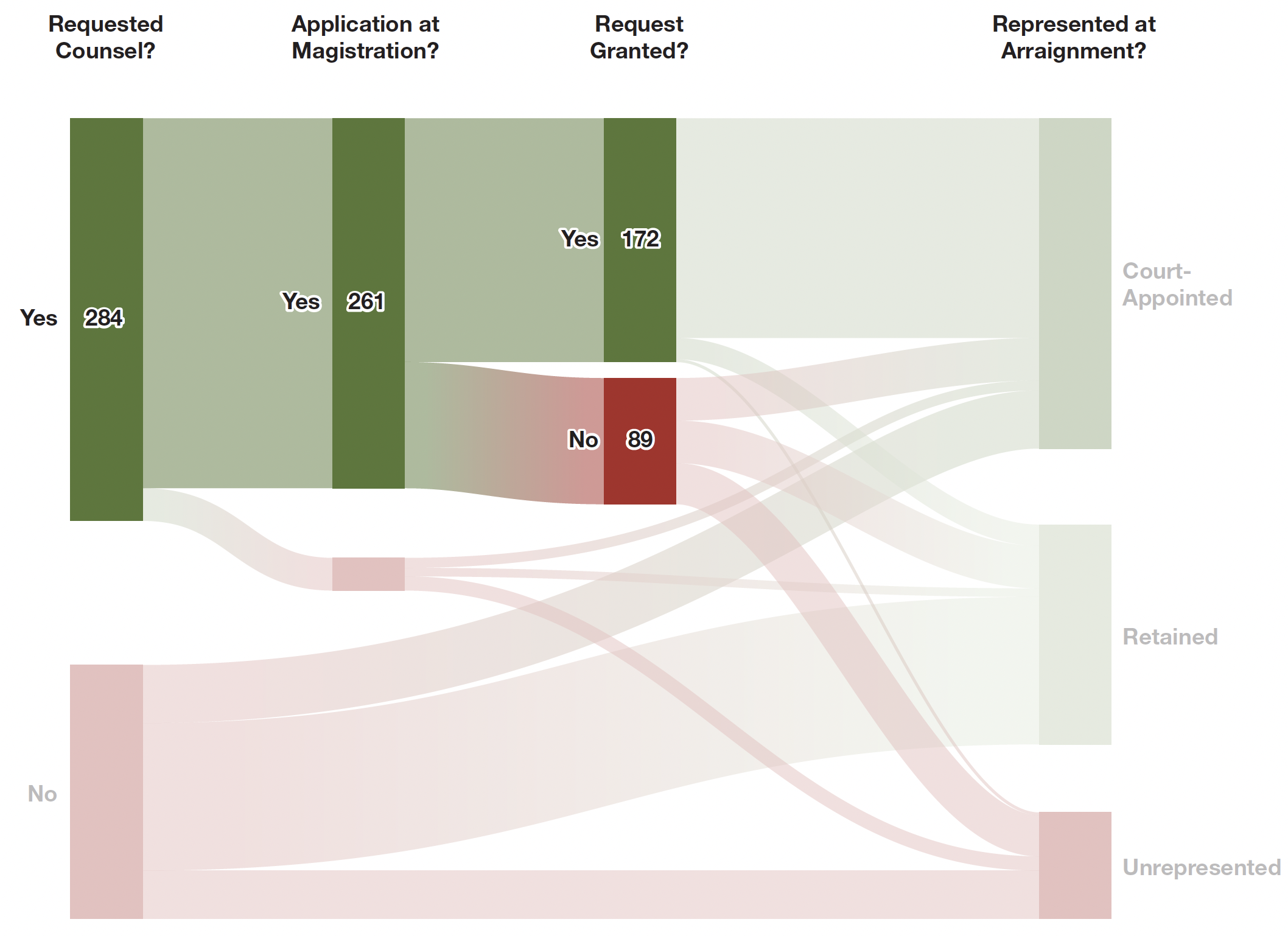
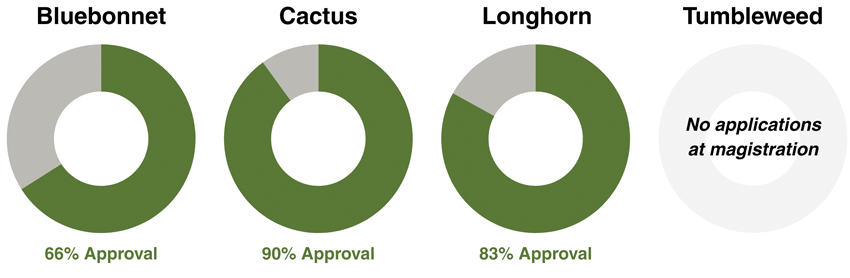
Bluebonnet County received day-of-magistration applications for counsel in 56% (261 of 463) of the studied cases. County officials rejected applications for counsel in 34% (89) of those cases and appointed counsel in 66% (172) of those cases—the highest day-of-magistration denial rate of any county in the study.
Data Legend
Column 1: Requested Counsel? The Deason Center reviewed each magistration form and recorded whether the form indicated that the arrested person wanted to apply for appointed counsel.
Column 2: Application at Magistration? Researchers recorded whether each case file included an application-for-counsel form dated on the day of magistration. If there was no application, or if an application post-dated the magistration, researchers coded the case as ‘no’. (Researchers did not find any applications that pre-dated a person’s magistration.)
Column 3: Request Granted? If a file included a day-of-magistration application for appointed counsel, researchers recorded whether officials granted or denied the request. This column does not depict outcomes of applications that post-dated a person’s magistration.
Column 4: Represented at Arraignment? Researchers documented whether court records indicated that, on or before the day of arraignment, the defendant had an attorney. Researchers further coded whether that lawyer was court-appointed or retained. (Court records only indicated whether a defendant had counsel, not whether that lawyer attended the arraignment.)
About the Bluebonnet Data
Deason Center researchers downloaded and reviewed files for 938 Bluebonnet County misdemeanor cases that closed between April 1, 2023, and June 20, 2023.
To construct the diagram above, researchers excluded 290 cases in which the Bluebonnet application and decision procedures substantively differed from those described. Researchers also excluded 143 of the remaining cases because they were missing magistration records and eliminated a further 42 cases in which the magistration forms lacked critical data needed for analysis, such as the date of magistration.
Magistrations for the 463 cases depicted in the diagram occurred between February 4, 2020, and April 2, 2023.