“Equal Justice Under Law”: Justice Ketanji Brown Jackson Brings a Message of Service, Independence and Possibility to SMU

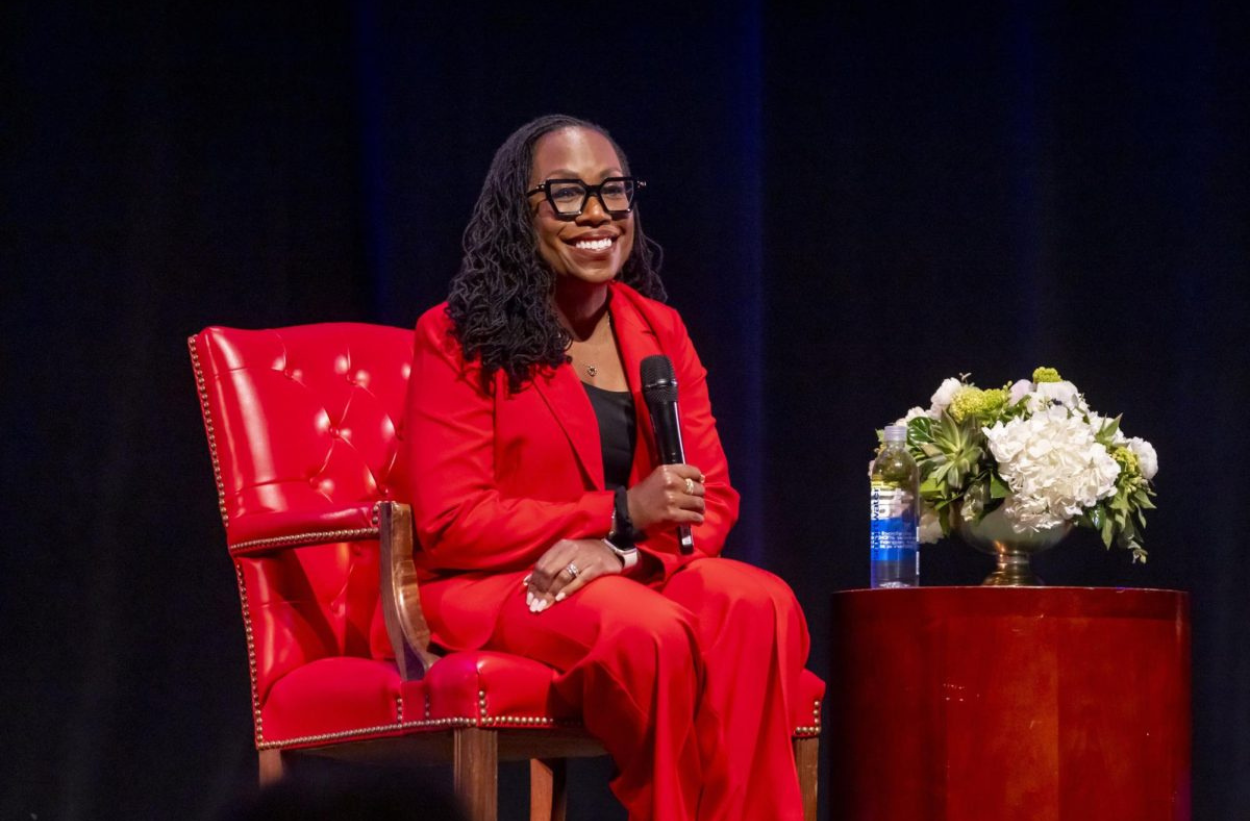
Over the next hour, Jackson offered a candid conversation about family, sacrifice, public service and the enduring importance of judicial independence in American democracy.
Moderated by SMU student Rylan Rob, the discussion moved fluidly between stories of Jackson’s childhood in Miami, her years at Harvard, her marriage and family life, the intensity of the Supreme Court nomination process and the deeper meaning behind her bestselling memoir, Lovely One (Random House, 2024).
Throughout the forum, Jackson returned repeatedly to a central idea: no achievement is accomplished alone.
“I wrote a memoir right before starting my journey on the Supreme Court because I thought it was a moment when I could reflect on the people and circumstances most responsible for the success that I had achieved,” she told the audience. “No one arrives at the highest heights on their own.”
That message resonated deeply with the students gathered inside the forum, many of whom are navigating the early stages of careers in law, business and public service.
Jackson’s own story is inseparable from the larger arc of American history. Born in Washington, D.C., in 1970, she came of age during a period of profound social change. Her parents, both public school teachers, had grown up in the segregated South before moving north in search of greater opportunity.
“My parents grew up in Miami, Florida, in a time of racial segregation,” Jackson said. “They understood what it meant to be limited in their own life prospects.”
Those experiences shaped the way they raised their daughter. Jackson recalled how her mother taught her to read at an early age and how her father instilled pride in African American history and achievement. More importantly, she said, they taught her to believe that she belonged in any room she entered.
“I think one of the kindest things they did was really teach me that I could do anything I wanted to do,” she said.
That confidence would prove foundational.
Jackson’s mother encouraged her at a young age to participate in poetry recitations and public speaking competitions at the Miami-Dade County Youth Fair. One performance in particular — reciting Margaret Walker’s poem For My People as a seven-year-old — gave her early insight into the power of language and public presence.
“I think it was really what got me interested in public speaking,” Jackson said.
The skills she developed there eventually carried her through debate competitions, Harvard classrooms and, ultimately, Supreme Court confirmation hearings watched by millions of Americans.
Jackson’s path to the Supreme Court included public service, private practice, judicial clerkships and years on the federal bench.
After graduating magna cum laude from Harvard University and earning her law degree from Harvard Law School, she clerked for three federal judges, including Supreme Court Justice Stephen Breyer — the very justice she would eventually replace. Her career included private practice, service on the U.S. Sentencing Commission and work as a federal public defender before appointments to the U.S. District Court and the U.S. Court of Appeals for the D.C. Circuit.
That broad professional background, she explained, shaped the way she understands both the law and the people affected by it.
One of the forum’s most compelling moments came when Jackson described working at the Neighborhood Defender Service in Harlem before law school. Growing up in suburban Miami, she said, she had never fully witnessed the ways poverty and the justice system intersected until that experience.
She described defendants accused of relatively minor offenses who faced impossible choices: plead guilty immediately and regain freedom, or insist on maintaining their innocence and remain jailed for months awaiting trial.
“The pressure that put on people was extraordinary,” Jackson said. “It had to do more with poverty than with justice.”
That experience changed her understanding of the legal system and ultimately guided her into public defense work.
“It was one of the things that really pointed me toward criminal law,” she said.
For SMU students considering careers in litigation or public service, Jackson offered an enthusiastic endorsement of judicial clerkships, calling them among the most valuable experiences a young lawyer can pursue.
“You’re behind the scenes getting a real sense of how judges think,” she explained. “As a litigator, your job is to persuade a judge.”
Her reflections on clerking revealed another side of Supreme Court life that those on the outside looking in rarely see: its traditions, collegiality and surprising formalities.
Jackson admitted she was stunned to discover the extent of the Court’s rituals after joining the bench in 2022.
“Before we go out to the bench or before conference, we shake every other justice’s hand,” she said. “It’s like a ritual.”
She also described the structured nature of private conferences among the justices, where each member speaks in order of seniority — leaving Jackson, as the junior justice, to speak last.
Jackson emphasized that disagreement among justices remains professional and grounded in the work of the institution.
“We are very learned people and professional colleagues,” she said. “None of us take it personally.”
Some of her warmest memories from joining the Court involved the welcoming traditions among justices themselves. Justice Amy Coney Barrett, knowing Jackson’s love of musical theater, organized a Hamilton-themed celebration complete with Broadway songs and a sign reading “The Room Where It Happens.”
“I put it in my chambers,” she said.
The conversation also turned deeply personal when Jackson spoke about her husband, Dr. Patrick Jackson, and their nearly 30-year marriage.
The couple met at Harvard in a class called “The Changing Concept of Race in America,” though their courtship initially included a moment worthy of a romantic comedy. Jackson recalled her confusion when Patrick spoke to her enthusiastically one day and ignored her entirely the next — until she learned he had an identical twin brother.
Their story illustrated the partnership and sacrifices necessary when both participants are working at the top of their field. At different stages, each partner adjusted career ambitions to support the other’s professional opportunities and their family’s needs. Jackson credited that flexibility and mutual understanding as essential to their success.
“We would throttle back for each other,” she said.
Perhaps the forum’s most riveting moment came when Jackson recounted the final days before President Joe Biden announced her nomination to the Supreme Court.
For weeks, she said, she endured a grueling and secretive vetting process involving endless paperwork, interviews and media speculation. As Biden’s self-imposed announcement deadline approached, Jackson became convinced she would not be selected.
Then, on a Thursday evening, her phone rang.
Calls from the White House appear with blocked numbers, she explained. When she answered, it was the president himself.
“I literally fell to my knees,” Jackson said.
By the next morning, U.S. Marshals had arrived to provide security. Her life, almost overnight, had changed forever.
“They said, ‘Ma’am, we’re going to need to take your keys,’” she recalled with a laugh. “I didn’t drive for six months.”
Amid the extraordinary attention and pressure surrounding the nomination, Jackson said her greatest concern centered on her family and the scrutiny they would face.
Both daughters, she said, immediately supported the opportunity.
“They were just thrilled,” Jackson said.
As the forum drew to a close, Rob asked Jackson what she most wished Americans understood about the judiciary.
Her answer carried the gravitas of someone keenly aware of the institution she now serves.
“The judicial branch is different,” she said.
Federal judges, she explained, serve under lifetime appointments and constitutional protections designed to preserve impartiality and independence.
“You want that body to be doing the work of resolving issues in a fair and just manner,” Jackson said. “Equal justice under law is a key tenet to freedom in our society.”
She warned that attacks on judicial independence ultimately threaten the broader constitutional system itself.
“I wish people really focused on that,” she said, “and stood up in some ways for the judiciary when judges are being attacked and undermined.”
By the end of the forum, Jackson had shared deeply personal reflections about family, sacrifice, public service and the responsibilities of the judiciary in American democracy.
The law, she reminded the audience, shapes the rights, opportunities and daily lives of ordinary people.
And in the life story she shared at SMU, students saw not only a Supreme Court justice, but also a daughter, mother, mentor and public servant who still believes deeply in the promise of American institutions.
That belief, perhaps more than anything else, will be the lasting lesson she left behind.