In Texas in 2023, 15% of misdemeanor cases resolved without any counsel for the defense present. In counties under 50,000 population, the number was 50%.
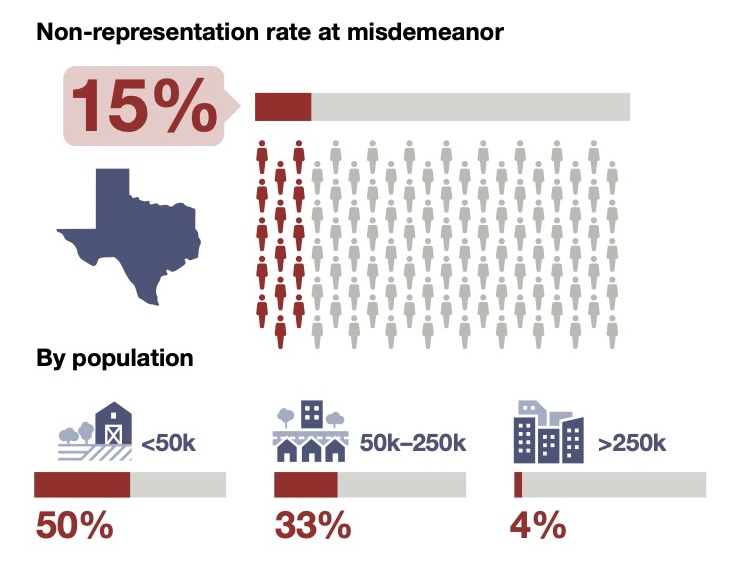

In a pioneering research study, the Deason Center reviewed more than 2,000 misdemeanor case files, interviewed court personnel, and observed court proceedings. Researchers found substantially different appointment procedures, different points at which people fell out of the process, and sharply different representation rates. The findings demonstrate why counties should examine their own systems to find the points of failure.

The Deason Center identifies five practical reforms to strengthen the right to counsel at misdemeanor magistration. These recommendations draw on constitutional principles, Texas law, administrative best practices, the Center’s research, and evidence from other jurisdictions.
This is a carousel with rotating cards. Use the previous and next buttons to navigate, and Enter to activate cards.
The Deason Center team gratefully acknowledges the invaluable assistance of dozens of Texas criminal justice officials and staff. To protect the anonymity of the counties where they work, the Center cannot publish the names of these extraordinary public servants. However, their contributions were essential to the project’s success. Without their commitment, the Center’s work would not have been possible.
The Center thanks Shelby Sirivore for her invaluable work collecting the data and preparing the visualizations featured on these pages.
This work is part of the Non-Representation Project and was supported by Arnold Ventures. The views expressed herein are the authors’ and may not reflect the opinions of Arnold Ventures.
