Step 4: Divide Annual Hours Needed by Annual Hours Available Per FTE to Determine FTEs Needed

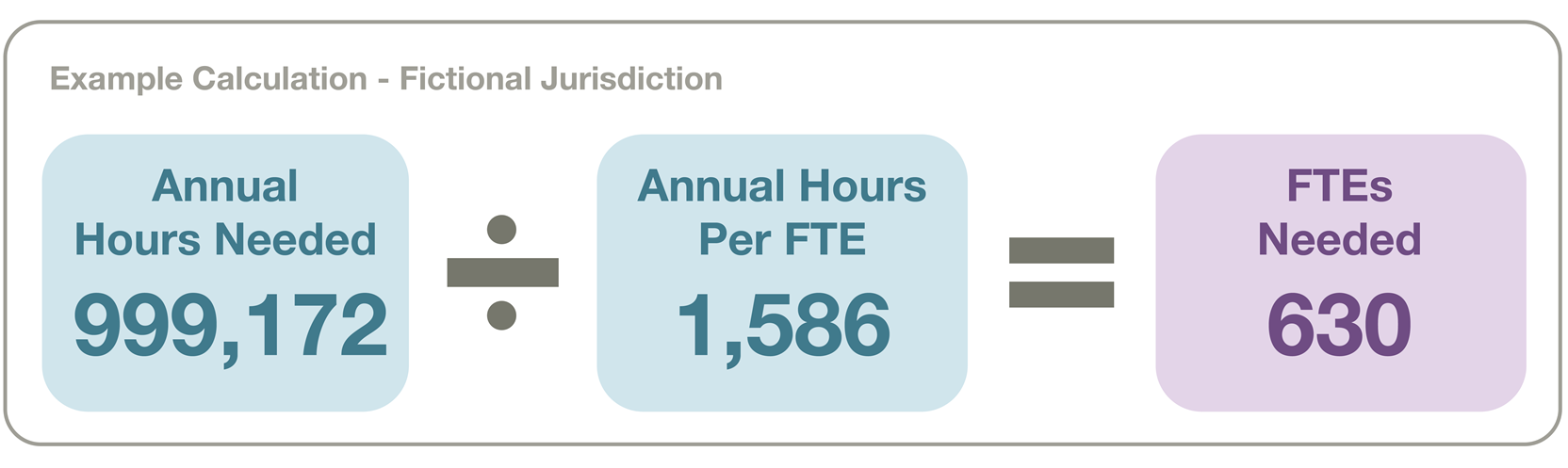
Next, you must determine how many full-time equivalent (FTE) attorneys are necessary to effectively represent the clients in the Projected Caseload. To do this, you will establish how many hours each FTE attorney can spend on case work ("Annual Hours Per FTE"). Then you will divide the Annual Hours Needed (Step 3) by the Annual Hours Per FTE. The result is the number of FTE attorneys needed for your Projected Caseload (“FTEs Needed").  

Determine Annual Hours Per FTE

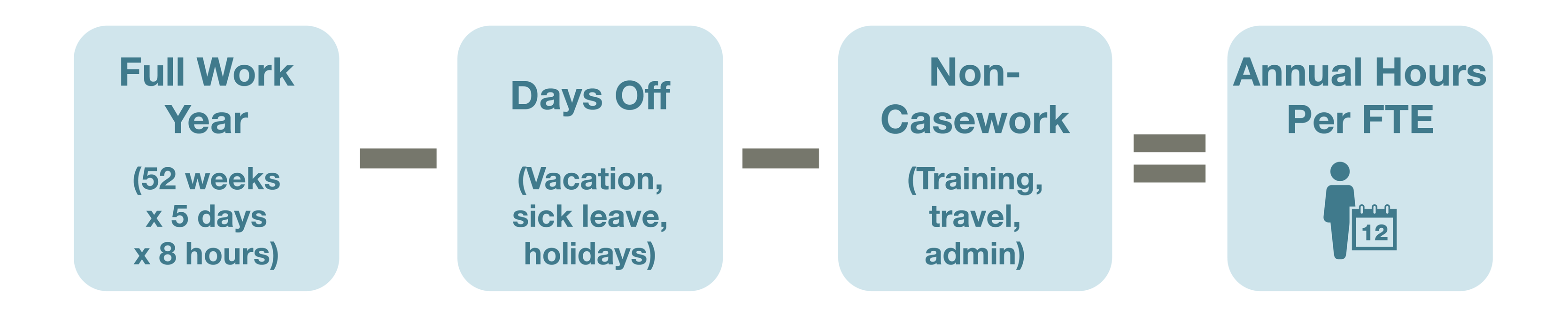
The NPDWS noted that each jurisdiction or system would need to decide “the amount of time an attorney providing public defense services would typically have available annually to handle case-related work.” NPDWS at 98We call this their Annual Hours Per FTE. This number can differ from year to year, provider to provider, and even attorney to attorney. However, most workload studies set a single default Annual Hours Per FTEGenerally public defender workload studies calculate the Annual Hours Per FTE by subtracting the time allotted for leave, travel, meetings, training, and administrative tasks.

The ABA public defender workload studies used 2,080 hours as the default Annual Hours Per FTE. 


Why do the ABA workload studies use 2,080 attorney hours per year?

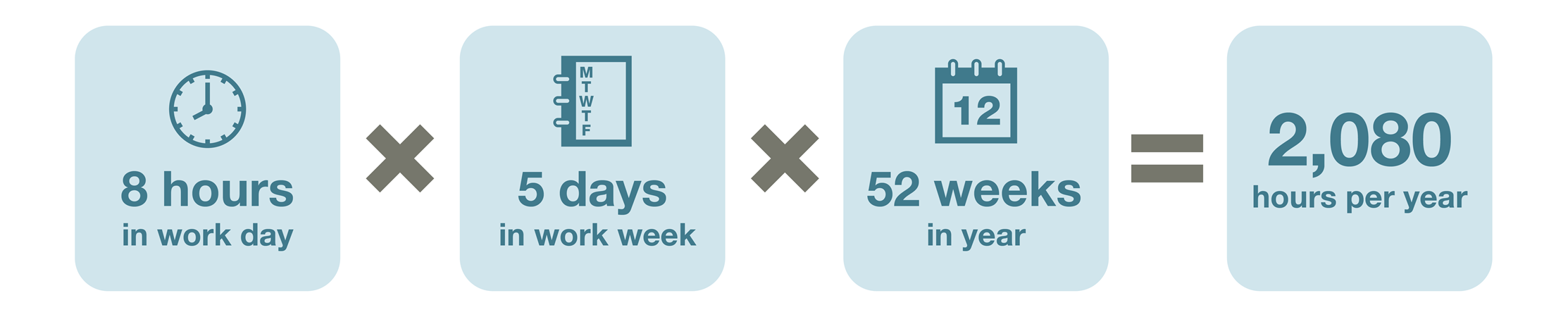
The ABA public defender workload studies assume that an attorney devotes eight hours per day, five days per week, 52 weeks per year to casework.
This assumption is unrealistic. It does not account for holidays, sick leave, or vacation. It also assumes that an attorney can spend all of their time working on client representation. It does not account for staff meetings, travel to the jail or court, administrative work, or training and continuing legal education (CLE). The ABA used 2,080 hours because it is conservative and exceeds the billable hours requirements of most large law firms. As a result, it is difficult to challenge.
The table below provides some examples of the Annual Hours Per FTE in various jurisdictions.

Real-World Examples: Annual Hours Per FTE


Jurisdiction

Available Hours Per Attorney FTE


North Carolina

(page 25)


1,320-1,375 hours


Colorado

(page 25)


1,269 hours


Washington State

(Standard 3J)


1,650 hours

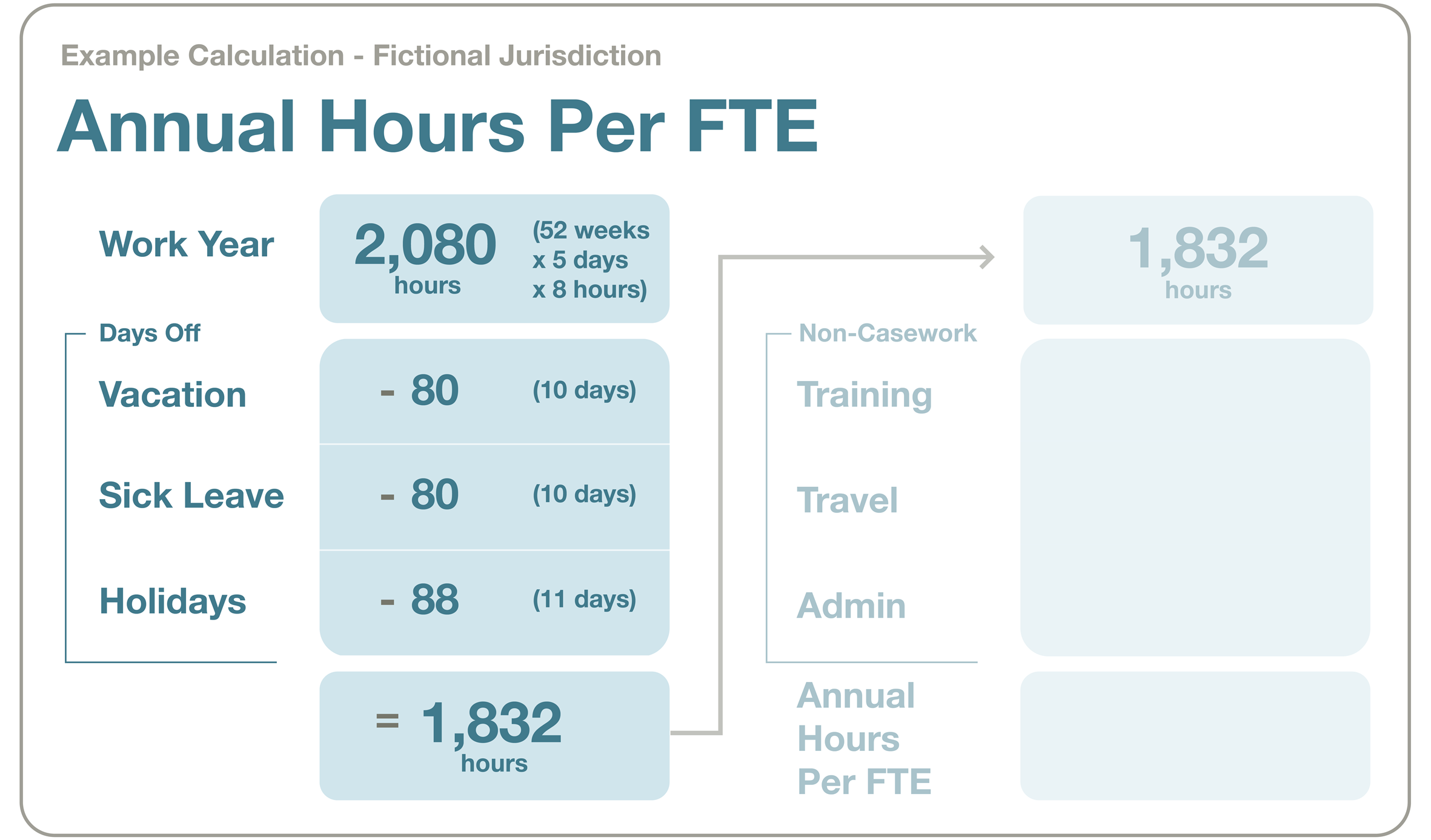
To calculate Annual Hours per FTE, you start with the total number of attorney hours available per year (typically 2,080: 8 hours per day x 5 days per week x 52 weeks per year) and then subtract the time allotted for various types of leave or other work (e.g., training and administrative tasks). This calculation is easiest in systems with full-time attorney employees.

Vacation, Sick Leave, and Holidays

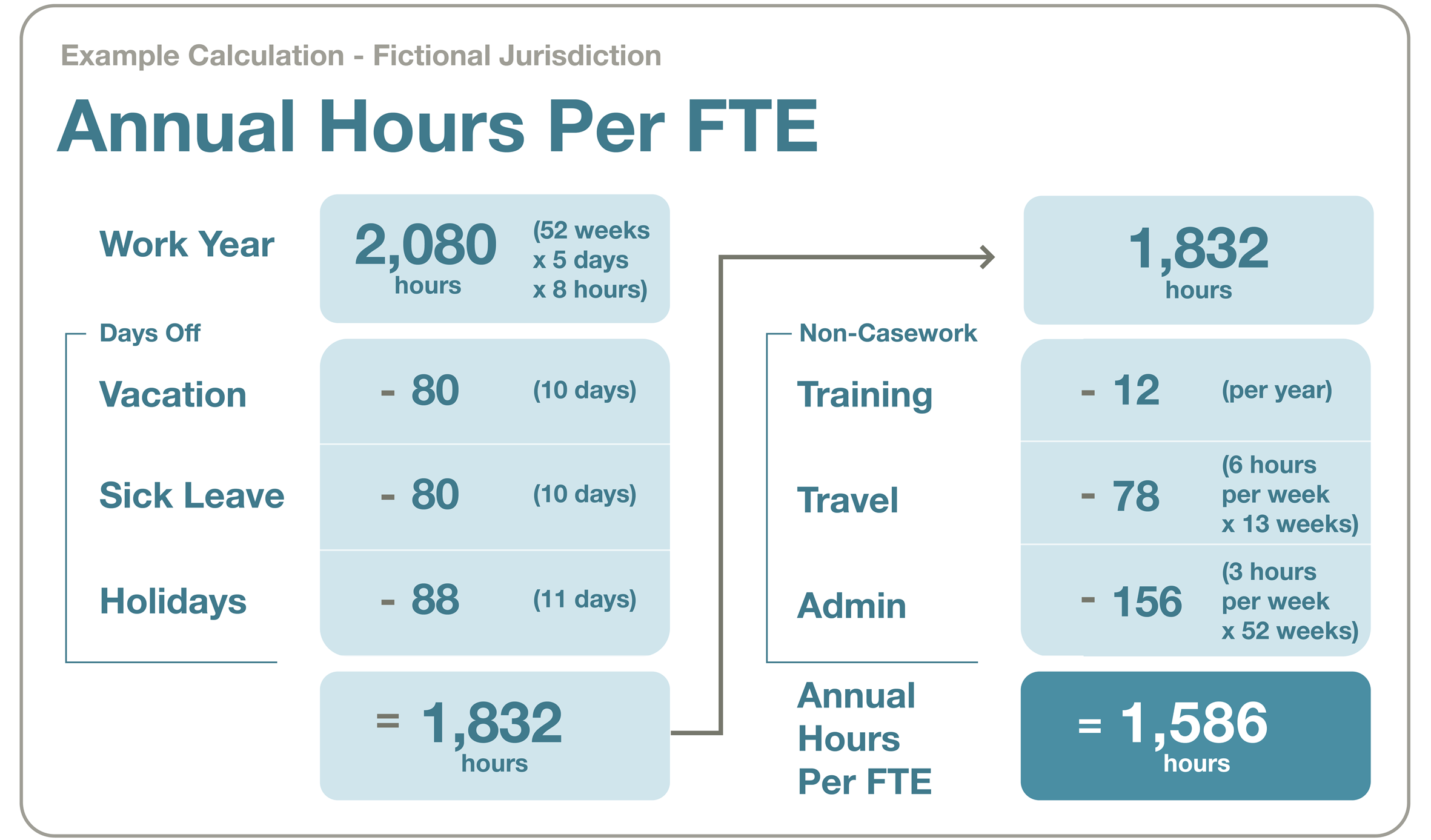
To calculate Annual Hours Per FTE, you first subtract the days allotted to an FTE attorney for vacation, sick leave, personal leave, etc. For example, in our Fictional Jurisdiction, attorneys receive 10 days of vacation, 10 days of sick leave, and 11 state holidays. The table below shows the reduction of Annual Hours Per FTE based on vacation, leave, and holidays.

Training, Administrative, and Other Non-Casework

In calculating Annual Hours Per FTE, you also subtract the time attorneys must spend on non-casework tasks, including training, administrative work, staff meetings, and travel. You can use available data to determine how much time to subtract, or you can estimate this time.

Training Time

Many jurisdictions require attorneys to attend continuing legal education (CLE) courses each year.  Providers may also have regular training requirements for their attorneys. Often they permit or even require their attorneys to attend training during the workday. In such cases, you must be subtract training time from the time available to work on cases. Below are two examples of training time calculations.

Example 1: In Jurisdiction A, the public defense provider sends half of their attorneys to a four-day training conference each year. The provider also offers in-house training over lunch one day each month. While attorneys can also request permission to attend other conferences or training courses, the provider does not track how often such requests are granted. Therefore, the provider conservatively accounts only for the conference (four days x 50% of attorneys), subtracting two days (16 hours) per year per attorney for training.

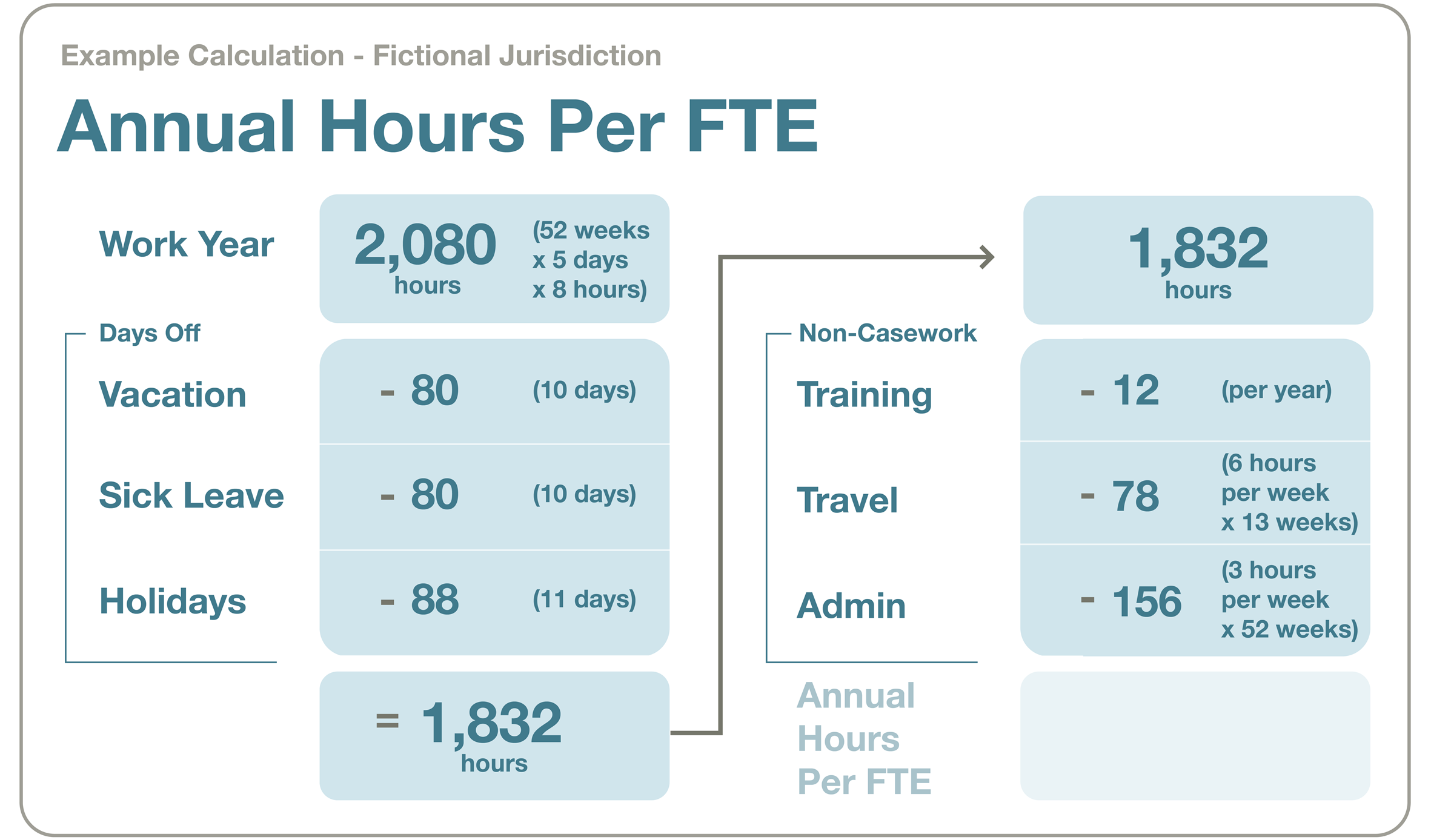
Example 2: Jurisdiction B requires all attorneys to take 12 hours of CLE per year. The provider allows attorneys to take work time to complete their CLEs. Jurisdiction B subtracts 12 hours for training per FTE per year.

Travel Time

The NPDWS standards do not include case related travel time because required travel time varies substantially by jurisdiction and provider. An attorney working in a rural regional office may need an enormous amount of time for travel, while an attorney working in a smaller urban jurisdiction may need very little. Additionally, travel time is often attributable to multiple cases. For example, when an attorney goes to a jail, they may visit several clients or visit one client to discuss multiple cases. For this reason, you should consider estimating and subtracting travel time when setting your Annual Hours Per FTE. Below are two examples of travel time calculations. 

Example 1: In Jurisdiction A, the public defense provider requires attorneys to track their travel time. From these data, the provider knows that, on average, each attorney spends 115 hours per year on travel time. The provider therefore subtracts 115 hours per attorney per year.

Example 2: In Jurisdiction B, the provider has a single office that covers three counties. The provider does not track travel time. Two counties require travel from the office and each holds court two days per week. Attorneys cover these courts on a rotating basis: each attorney covers one of these courts every four weeks. Attorneys spend roughly 6 hours on travel during their coverage weeks. The provider estimates that each attorney spends approximately 78 hours per year on travel (13 coverage weeks per year x 6 hours per coverage week = 78 hours per year). The provider therefore subtracts 78 hours per attorney per year.

Administrative Time

Administrative time includes all time devoted to work that cannot be attributed to a single case. Commonly administrative time includes staff meetings, supervisory meetings, and case review meetings. Below are two examples of administrative time calculations. 

Example 1: In Jurisdiction A, the provider is a small public defender office that meets weekly to review cases and discuss administrative matters. The provider estimates that this meeting lasts, on average, one and half hours each week. The provider therefore calculates that each attorney needs 78 hours (1.5 hours/week x 52 weeks) for administrative time.

Example 2: In Jurisdiction B, the public defender office has several divisions, each with their own meeting schedule. Some divisions meet for case review three days per week for one hour. Others hold one staff meeting and one case review meeting each week. The provider estimates that most divisions devote two hours to case review each week, and one hour to team or divisional meetings. Accordingly, the provider estimates that each attorney spends three hours per week, or 156 hours per year, doing administrative work.

The table below shows a calculation of non-casework time for the Fictional Jurisdiction using the scenarios from Jurisdiction B above.

How Do Judges Calculate Annual Hours Per FTE? 

Judicial workload studies use the same concept of annual hours available for casework, often described a “judge year value". Knowing how other justice system actors calculate their time available for casework can be helpful in advocacy. It also provides a comparative benchmark for your Annual Hours Per FTE. The table below provides some examples of judge year values from judicial workload studies.  

Real-World Examples: Judicial Workload Studies

Jurisdiction

Year Value


Virginia

(page 21)


1,175-1,290 hours

(70,506-77,427 minutes)


Texas

(page 12)


1,075-1,290 hours

(64,500-77,400 minutes)


Yuma County, AZ

(page 21)


1,347 hours

(80,811 minutes)

The table below shows the complete calculation of the Annual Hours Per Attorney FTE in Fictional Jurisdiction. 

Calculate FTEs Needed

With the above information, you are now ready to calculate the number of attorney FTEs needed to handle the Projected Caseload. To do this, you must divide the Annual Hours Needed by the Annual Hours Per FTE. 

The calculation of FTEs Needed for the Fictional Jurisdiction appears below.  

The calculation divides Annual Hours Needed (from Step 3) of 972,998 hours by Annual Hours Per FTE (above) of 1,586 hours per year. The result is that Fictional Jurisdiction needs at least 613.5 attorney FTEs to competently handle its Projected Caseload.

FAQs about Annual Hours Per FTE (Coming Soon)