There are several accepted ways of projecting future caseloads from historical caseloads. Step 2 presented the simplest method: using a recent year’s caseload as your Projected Caseload. More advanced projection methods attempt to both minimize the influence of any anomalies and account for trends that might impact the next year’s caseload. Popular advanced projection methods include: a multi-year average, an adjusted multi-year average, and a statistical model.

Advanced Methods: Projecting a Caseload
Multi-Year Average
A multi-year average is one projection strategy to address caseload anomalies. Using a multi-year average, instead of one year’s caseload data, reduces the influence of anomalies or one-time events, such as an unusually high or low number of murder cases in a year.
The table below shows five years of historical caseload data for Fictional Jurisdiction (2020-2024).
.png)
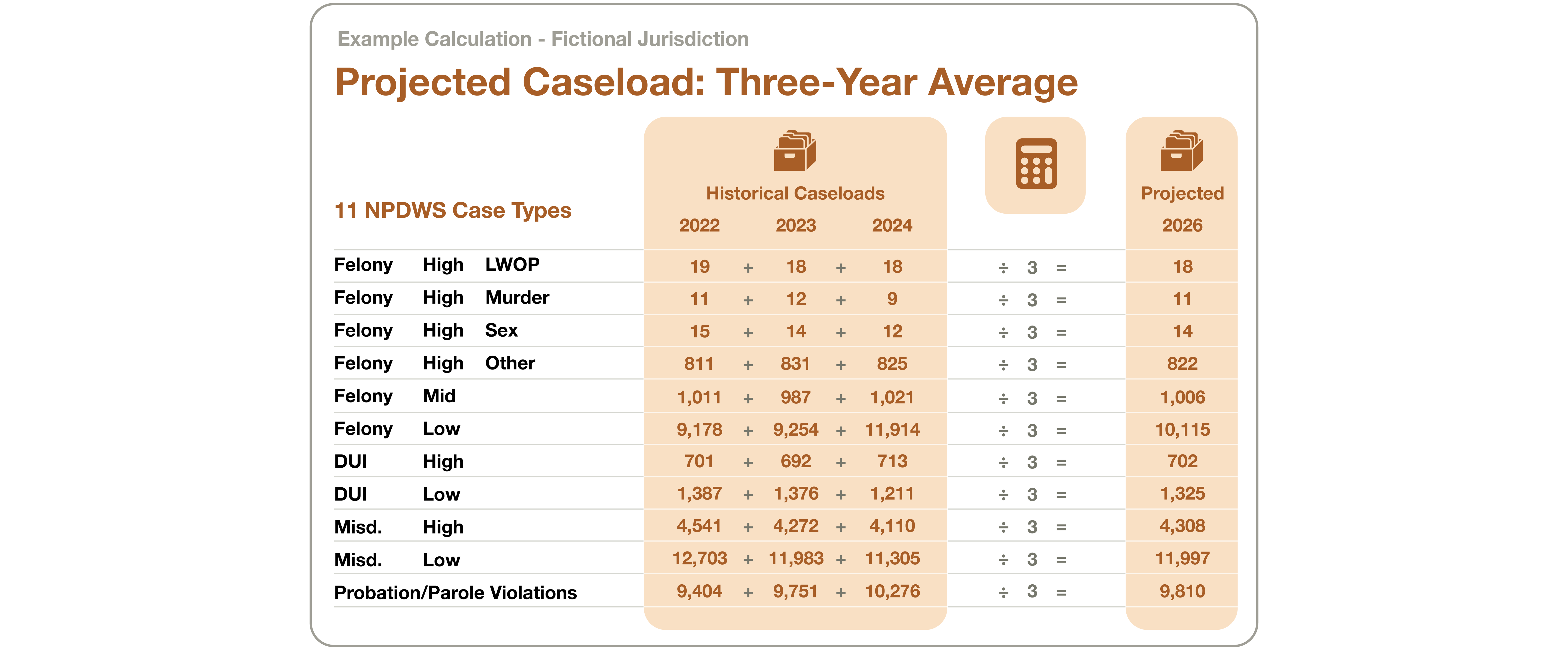
To use a multi-year average as the projection for next year, you simply average several past years' caseloads for each case type. In the example below, Fictional Jurisdiction used a three-year average to project its 2026 caseload, using its 2022, 2023, and 2024 caseloads.
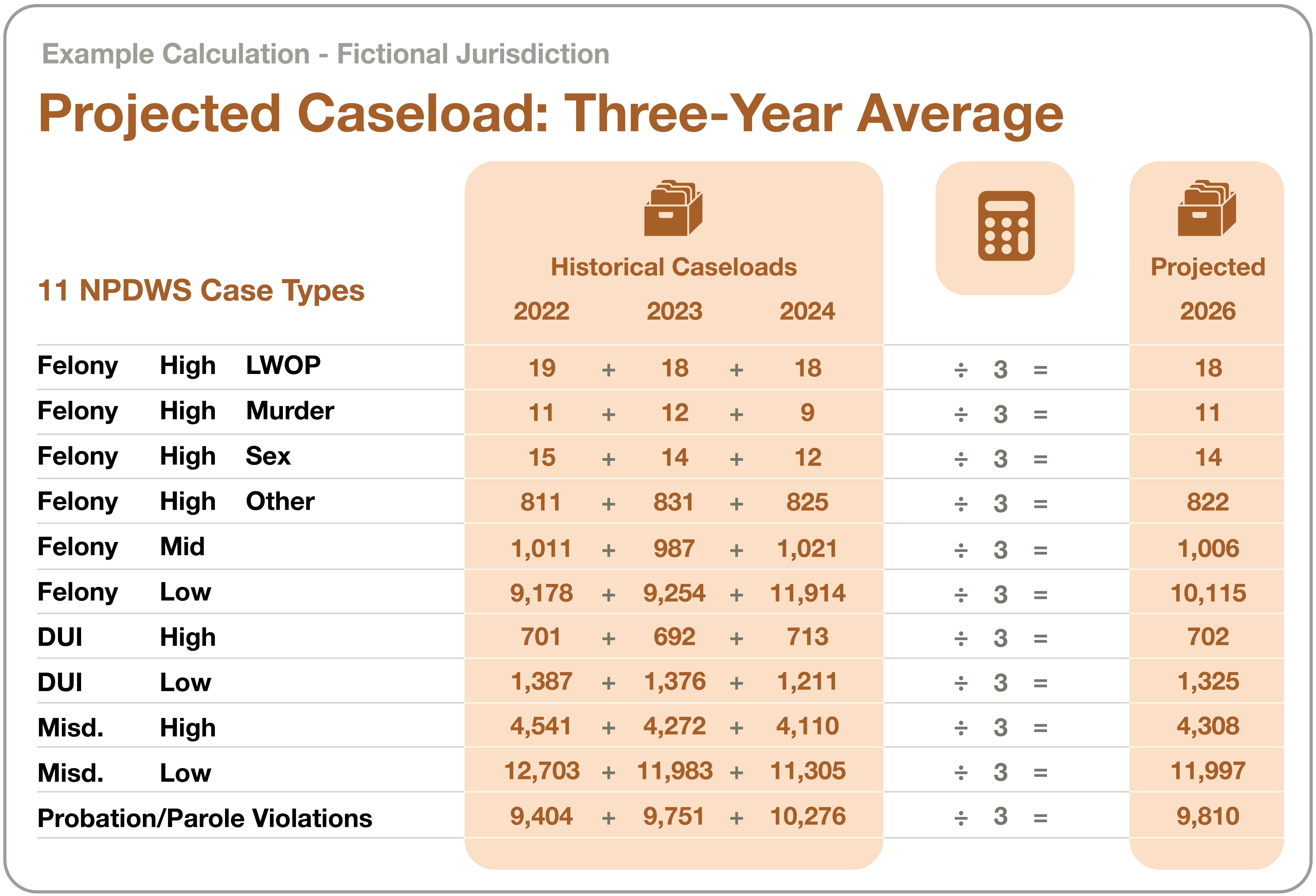
Note: Average caseload numbers are rounded to the nearest whole case.
.png?h=50&w=50&hash=DC6DB8BE0676AE4C07464301F9798D84) What is a Moving Multi-Year Average?
What is a Moving Multi-Year Average?
When a jurisdiction recalculates its multi-year average year after year, it is called a moving (or rolling) average. Each year, the jurisdiction adds the most recent year’s data to the average and drops the oldest year’s data from the average.
Above, Fictional Jurisdiction used a three-year average to generate a projected 2026 caseload, incorporating its 2022, 2023, and 2024 caseload data. If, in the following year, Fictional Jurisdiction used data from 2023, 2024 and 2025 to project its 2027 caseload (dropping the 2022 data and adding in 2025 data), Fictional Jurisdiction would be using a moving three-year average. Many state court systems use a moving three-year or five-year average to project their caseloads and calculate their staffing needs.
Above, Fictional Jurisdiction used a three-year average to generate a projected 2026 caseload, incorporating its 2022, 2023, and 2024 caseload data. If, in the following year, Fictional Jurisdiction used data from 2023, 2024 and 2025 to project its 2027 caseload (dropping the 2022 data and adding in 2025 data), Fictional Jurisdiction would be using a moving three-year average. Many state court systems use a moving three-year or five-year average to project their caseloads and calculate their staffing needs.
Adjusted Multi-Year Average
In some instances, you may have reliable information about legal or practice changes that have either impacted past caseloads or are likely to impact the next year’s caseload. In this situation, you might begin with the multi-year average and then adjust your caseload estimates to reflect those changes.
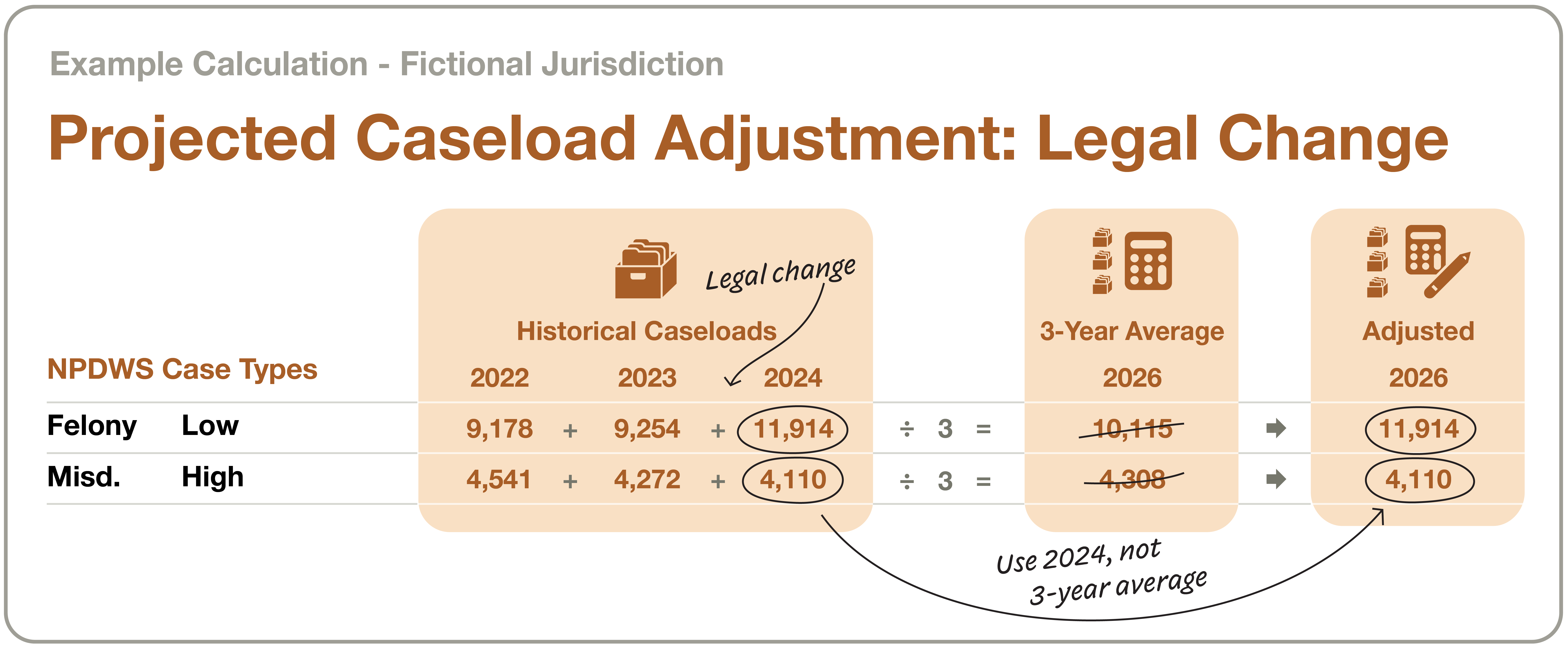
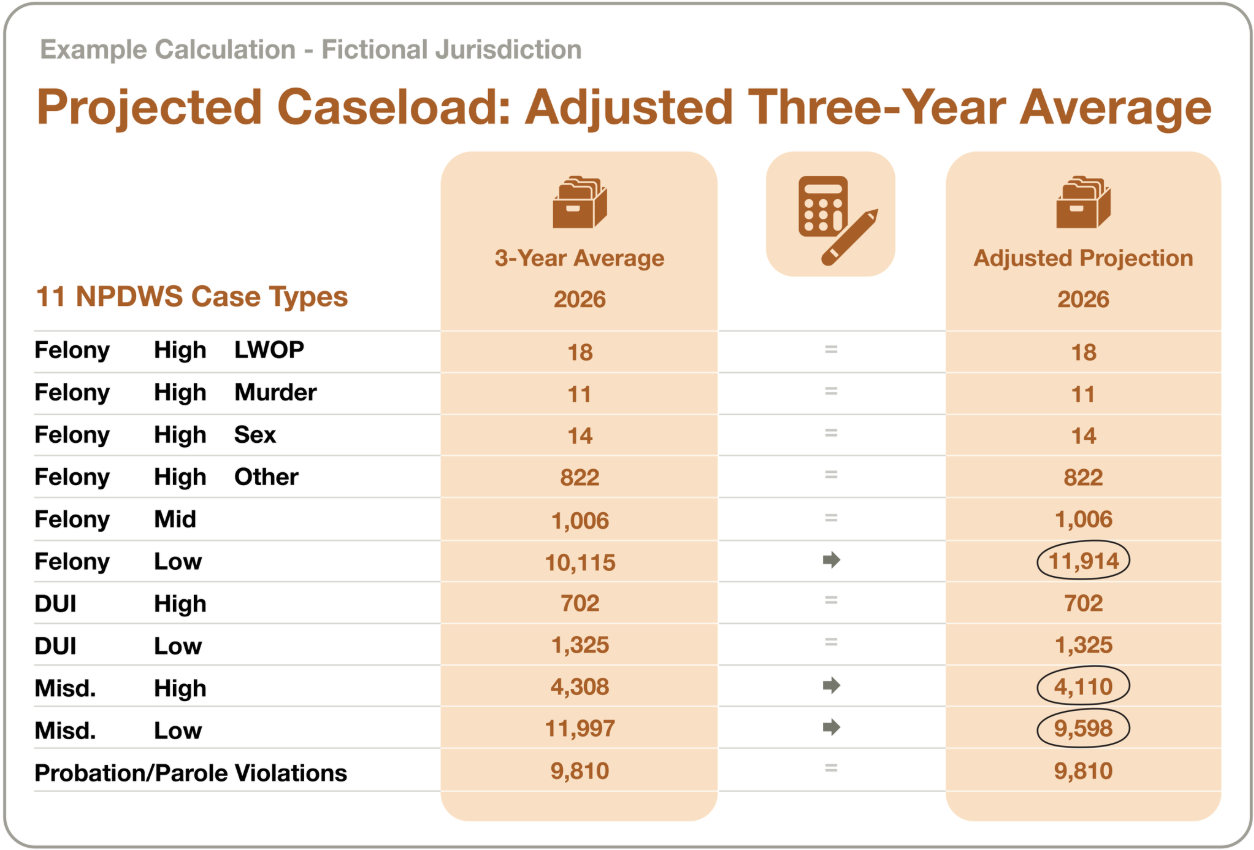
Assume Fictional Jurisdiction recently adopted two legal changes that are likely to impact caseloads. To account for these changes in its Projected Caseload, Fictional Jurisdiction begins with a three-year average (shown below) but then makes adjustments to account for these changes.
Adjustment 1: In 2023, Fictional Jurisdiction adopted a new sentencing scheme that recategorized some misdemeanors as felonies. The provider believes that this sentencing change accounts for an increase in 2024 Felony-Low cases and a decrease in 2024 Misdemeanor-High cases. Rather than using the three-year average for all case types, the provider therefore chose to use the 2024 Felony-Low (11,914 cases) and Misdemeanor-High (4,208 cases) caseloads as their 2026 Projected Caseload for these case types.
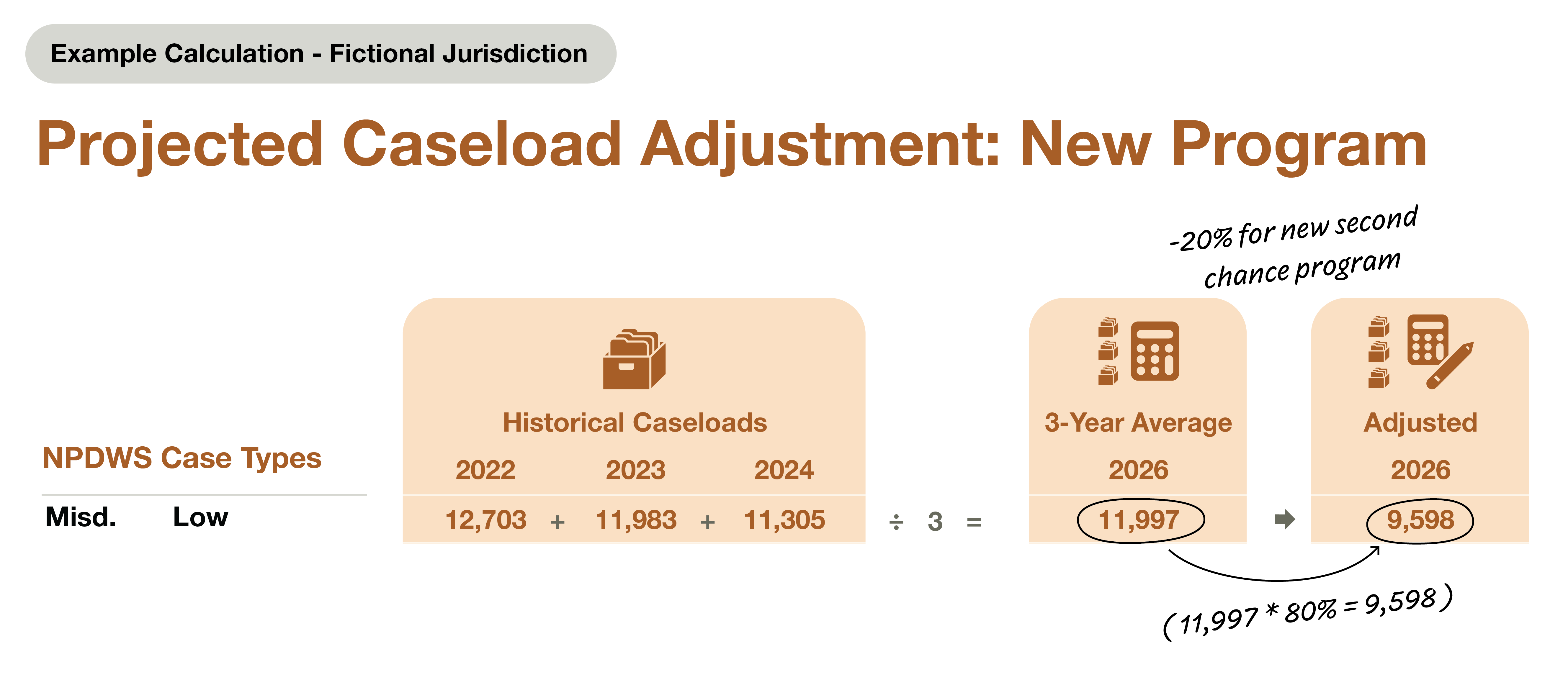
Adjustment 2: Fictional Jurisdiction recently announced a limited-scope second-chance misdemeanor program for people charged with petty offenses who have no prior criminal history. The court clerk automatically identifies eligible arrested people and defers their cases. Unless they are rearrested within six months of deferral, these people never appear in court. Based on past caseload data, the provider estimates that this will reduce their Misdemeanor-Low caseload by 20%. The provider estimates the projected 2026 Misdemeanor-Low caseload at 80% of the three-year average Misdemeanor-Low caseload or 9,598 cases.
The resulting adjusted three-year average caseload for Fictional Jurisdiction is shown below.
Statistical Models
Statistical models use trends and patterns in previous caseloads to predict future caseloads. They can also identify and exclude or address anomalies. Some models even take into account other data, such as crime statistics and arrest rates. Common statistical models for caseloads include Autoregressive Integrated Moving Average (ARIMA) and Holt-Winters forecasting. While statistical models may be more accurate than a multi-year average, they generally require significantly more data and deep technical expertise. Note: If you are interested in using a statistical model to project your caseload, please reach out to the Deason Center. Our researchers can offer advice or assistance.