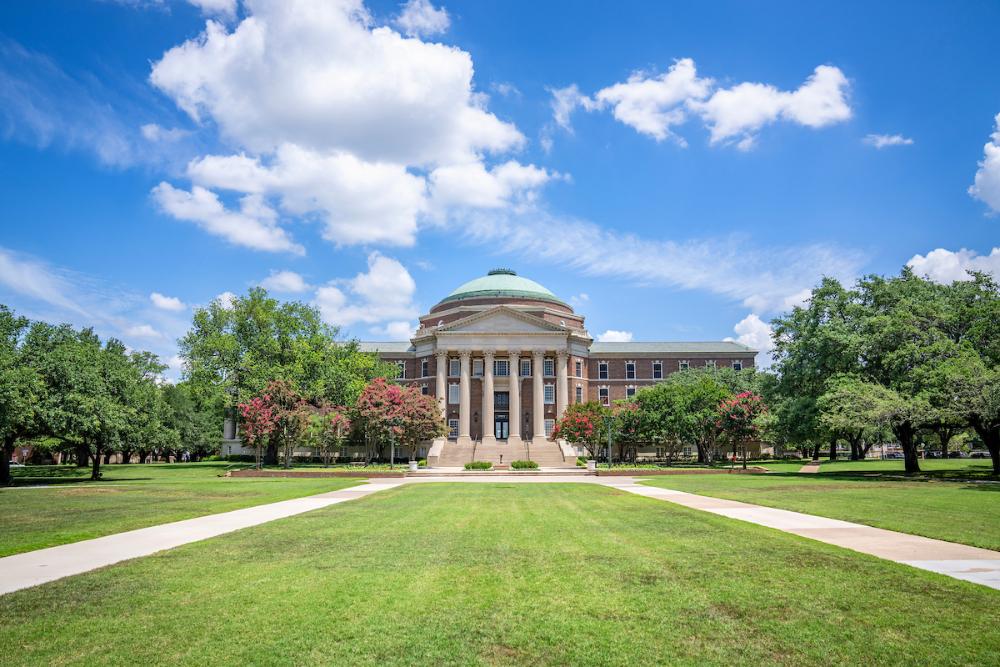
Dallas Hall, home to the M.S. in Data Science and Applied Statistics, is the oldest building on SMU campus.

Undergraduate programs

Earth sciences

B.A, B.S.

Minor

Overview

The Department of Earth Sciences at Southern Methodist University welcomes students eager to address pressing global challenges – from climate change, water and energy resources and environmental impacts to earthquakes, geohazards and Earth’s dynamic evolution. Through strengths in geophysics, geochemistry and Earth systems science, students engage real-world problems ranging from induced seismicity and subsurface resources to environmental monitoring and national security applications such as nuclear test verification.

SMU offers a Bachelor of Arts and Bachelor of Science in earth sciences and minors in earth sciences and environmental earth sciences. In each program, students learn through globally relevant coursework, enriching internships and immersive field experiences. Our state-of-the-art laboratories offer hands-on research opportunities with distinguished faculty. Notably, the department has been internationally recognized for its research in the areas of seismology, geothermal studies, remote sensing and paleoclimatology. 

Top 20%

Best National Universities

U.S. News & World Report (2026)

11:1

undergraduate student-to-faculty ratio

90+

undergraduate majors at Dedman College of Humanities and Sciences

Ready to apply?

Get started here.

Tuition and financial aid

2 out of 3 first-year students are awarded grants and/or scholarships with an average total of $38,598.

Tuition and costs

Explore the cost breakdown of tuition for undergraduate programs.

Financial aid

Find information on scholarships and financial support available at SMU.

Curriculum and learning

Featured courses

GEOL 1301

Earth Systems

A brief introduction to the interconnected systems that make up our planet.

GEOL 2306

Earth

History of rock, life and environment. Delves into the interdependent geological and biological history of Earth’s near-surface environments based upon physical laws and geological concepts.

GEOL 3243

Geology Field Studies

Two-week field trips to geologic locations inside or outside the U.S. Trips may include the Caribbean, Hawaii, Grand Canyon, Lake Superior, New Mexico or Colorado.

Outside the classroom

Student success

Students benefit from a modernized, industry-informed curriculum that reflects the breadth of earth sciences, as well as the vast research opportunities afforded here. From state-of-the-art laboratory facilities to immersive fieldwork, students leave the program ready to make significant contributions in the earth sciences.

Student stories

Cindy Yielding earned her earth science degree from SMU and credits the university with her success.

Cindy Yielding ’82

“The program has strengthened, evolved and grown to offer an even broader view of Earth and environmental sciences, and I certainly 12/10 recommend for all SMU students (at least consider taking a geology course!).”

Alexa Reyes is a member of the SMU Mustang Band as well as a student in the Department of Earth Sciences.

Alexandra Reyes ’27

“The Earth Sciences Department has given me more opportunities than I can count. The program has allowed me to pursue incredible research with supportive mentors while encouraging me to think critically and make connections across multiple disciplines.”

Faculty

The Earth Sciences faculty at SMU is internationally recognized for its work in the areas of seismology, geothermal studies and paleoclimatology, to name a few. Each faculty member specializes in multiple areas of research and takes an interdisciplinary approach to the curriculum, integrating chemistry, physics and environmental science to address topics like resource management and natural hazards.

Here, faculty fosters a collaborative culture in both academic and applied, industry-related projects. Research is supported by robust funding, particularly in areas like fluid-rock interactions, isotopic studies and volcanic processes.

Facilities

Students obtaining their master’s in earth sciences often use the Stable Isotope Laboratory.

Stable Isotope Laboratory

The laboratory supports activities ranging from surface water hydrology to evolution of the Earths mantle. Research emphasis includes paleoclimatology, global cycles, hydrology, fluid-rock interaction, and petrology.

Students pursuing a master’s in earth science at SMU use the teaching collection at the Shuler Museum.

Shuler Museum of Paleontology

Houses research and teaching collections of fossil vertebrates, invertebrates and plants. The museum fosters paleontological research and supports the preparation, curation and loan of fossils.

The SMU Materials Characterization Lab is an open research facility for those pursuing earth science degrees.

Materials Characterization Lab

An open-access research facility providing specialized equipment for high-resolution imaging and variable pressure and micro-structural analysis.

Request more info about this program

Request more info about the Bachelor of Science and Bachelor of Arts in earth sciences

Loading...

Frequently asked questions

An earth sciences degree offers a high return on investment through low unemployment rates and opportunities to work on critical environmental, climate, and natural resource issues. Graduates can pursue careers as diverse as environmental consultants, hydrologists, geochemists, geophysicists, or in roles within the energy sector or federal government agencies like the EPA. According to the Bureau of Labor Statistics, jobs in earth and environmental science are projected to grow by 3–6% between 2024–2034.  

An earth sciences degree from SMU prepares you for diverse careers in environmental consulting, energy, mining, and government agencies like the U.S. Geological Survey or NASA. Specific fields include environmental protection and consulting; natural resource management; air and water quality monitoring; geological hazards and geotechnical investigations; water and power-generation utilities; and meteorology, hydrology and oceanography. An earth sciences degree also provides excellent training for graduate programs.

It all depends on your career aspirations.

The Bachelor of Arts in earth sciences gives you a broad understanding of the earth sciences, allowing for interdisciplinary study. It allows for more flexibility in electives, making it an excellent choice for a double major – ideal if you are interested in environmental policy, environmental journalism, education, or law.

A Bachelor of Science in earth sciences, in comparison, is more appropriate if you want to go into technical geological work or pursue a graduate program in the sciences. It focuses heavily on specialized, technical skills and is more field-intensive than a Bachelor of Arts, making it better suited for careers in oil, gas and environmental consulting.  

One two-week field trip is required for either degree. These fieldwork trips earn two or three hours’ credit and have included locations in the Caribbean, Hawaii, the Grand Canyon, Lake Superior (in Canada), New Mexico or Colorado.

There are six research facilities and labs in the Earth Sciences Department at SMU.

  • The Stable Isotope Laboratory fosters the applications of light-stable isotopes of carbon, hydrogen, nitrogen and oxygen to problems in geology and archaeology.
  • The Shuler Museum of Paleontology is a research facility that is also home to teaching collections of fossil invertebrates, vertebrates and plants.
  • The SMU Geothermal Lab studies use of geothermal energy through ongoing research and projects such as the Geothermal Map of North America and the National Geothermal Data System.
  • The Paleobotany Lab supports the preparation and study of plant fossils.
  • The Radar Laboratory includes research on volcano monitoring, land subsidence and wetland mapping.
  • The Materials Characterization Lab houses electron microscopes, spectrometers, and equipment used for sample preparation and measurement, and the analysis of metals, rocks and soils. 

Earth science focuses more on geology, the Earth and its history, and geophysical composition. Study includes things such as plate tectonics, rocks, mineral resources and climate. Environmental science, on the other hand, is an interdisciplinary area of study that focuses on the effects of humans on the natural world. It incorporates biology, chemistry and geology to specifically address ecology, environmental policy and hazardous waste management. Earth science applications are in resource exploration, geological surveying or climate research. Environmental science leans more toward roles in sustainability, environmental consulting, impact assessment and pollution control.

Earth science is a very flexible, interdisciplinary applied science that integrates well with other fields. It attracts students with broad interests in geology, chemistry, biology, environmental science, archaeology, astronomy, oceanography, engineering, applied mathematics or physics. Combined majors are strongly encouraged! In addition to combinations with the above fields, many undergraduate earth science majors have double majors or minors in business – particularly finance, real estate or marketing – as well as economics, pre-law, computer science, archaeology, world languages, English, history, journalism and pre-med.

The highest paid managerial role in earth sciences is a natural sciences manager, with a median annual salary of $161,180 according to the U.S. Bureau of Labor Statistics. It is followed closely by geoscientists in the oil and gas and mining industries, who earn a median annual salary of $148,760. Top earners in this role may have salaries exceeding $178,880 a year.