[Blog] Frederick Aquino Reflects on Historic Visit to the Vatican

Frederick Aquino Reflects on Historic Visit to the Vatican
On Nov. 1, Frederick Aquino, Professor of Systematic Theology at Perkins School of Theology and 2000 Ph.D. graduate of Southern Methodist University’s Religious Studies program, sat during a Mass in St. Peter's Square in the Vatican as Pope Leo XIV formally declared Saint John Henry Newman a Doctor of the Church. For Aquino, who has spent three decades studying Newman’s philosophical and theological thought, the moment carried profound scholarly, spiritual and personal significance.
Aquino completed his doctorate at SMU under the mentorship of the late Dr. William J. Abraham, longtime professor at Perkins School of Theology. Aquino’s dissertation, “Communities of Informed Judgment: The Significance of John Henry Newman’s Notion of the Illative Sense for Issues in Theological Prolegomena,” laid the foundation for a career deeply intertwined with Newman’s legacy.
What follows is a curated reflection, drawn from Aquino’s own words, on the meaning of Newman’s elevation, the experience of being in Rome for the announcement and how this milestone reaches back to his formation at SMU.
Connecting the Moment to SMU and the Mentorship of Dr. Billy Abraham
For Aquino, the event marked the culmination of a path that began decades earlier in a Perkins classroom.
“When I was a doctoral student, I had questions about the relationship between faith and reason,” Aquino recounted. “So, I did a course with Billy Abraham on faith and reason in the Anglican tradition. I ended up writing a paper on faith and reason in Newman’s University Sermons, which I found compelling.”
That initial spark became a lifelong academic vocation where he would spend the next 30 years writing scholarly books and articles on Newman’s philosophical thought.
Aquino describes the Vatican recognition as a deeply personal moment of full-circle reflection.
Newman as Patron of the Pontifical Urbaniana University
Aquino points to Newman’s rich vision of education when explaining the significance of Newman being named Patron of the Pontifical Urbaniana University.
“Newman had much to offer on the aim of education, as presented in The Idea of a University,” Aquino said. “He saw the university as an environment for the cultivation of a connected view–learning to see how things fit together in light of one another and rendering a skillful application of this kind of understanding to a particular context.”
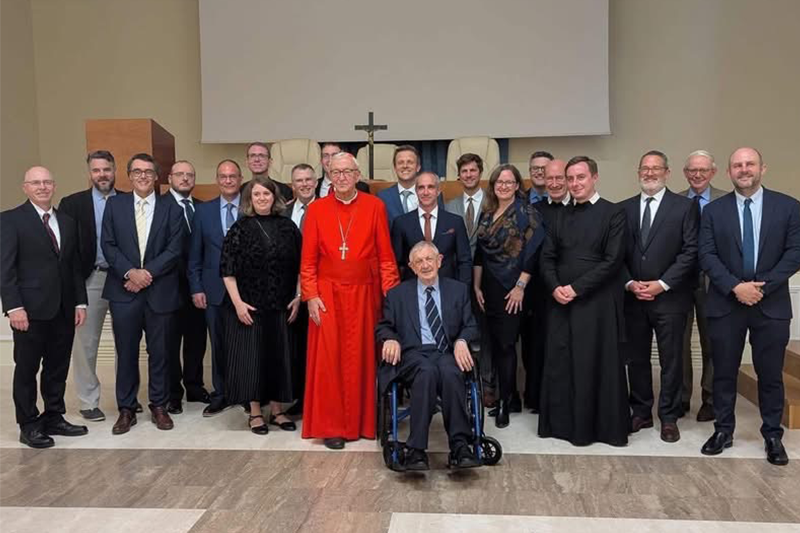
Aquino described this “connected view” as inherently communal—an environment where people learn to interpret situations with clarity and insight. He also shared his gratitude for the opportunity to lecture at the Pontifical Urbaniana University alongside Professors Vincenzo Buonomo, Luca Tuninetti, Pietro Angelo Muroni, and Monsignor Armando Matteo and witness the declaration of Newman as the patron saint of the university.
Faith and Reason: Newman’s Contribution for Today
Aquino believes Newman’s newly formalized status strengthens the relevance of his insights for the modern Church.
“I believe that Newman’s elevation as a Doctor of the Church lends more credence to his position on the dialogue between faith and reason… Part of Newman’s appeal was his ability to expand the intellectual horizons of his time and open up new constructive possibilities.”
“He identified the shortcomings of fideism and hard rationalism while seeking to carve out an alternative vision of faith and reason. He also recognized the importance of critically examining the grounds of faith while also emphasizing the extent to which our evaluations of faith, whether religious or not, are shaped by antecedent assumptions.”
A Moving Experience in Rome
Reflecting on sites in Rome, Aquino recounts that nothing compared to the ceremony itself.
“By far the most meaningful experience I had was at the Vatican during the ceremony,” he said. “Plenty of memories surfaced on that day.”
He recalled the first time he read Newman as an SMU doctoral student—never imagining he would one day contribute to the positio document on Newman.
“As someone of Italian heritage, my mother and father were very proud… It was an opportunity to participate in my own cultural heritage that was left behind when my ancestors immigrated to the United States,” Aquino shared. “I felt peaceful, grateful, and honored to be present and participate in a shared human history.”
The visit is already shaping Aquino’s teaching vision.
“Given the recent interest from students at Perkins School of Theology and encouragement by faculty at the university at large, I foresee offering a course on the thought of John Henry Newman in the near future,” he said.
Aquino has recently published two collections of essays — Newman’s Grammar of Assent: A Critical Guide and Newman and Contemporary Philosophy — and is also co-writing a book on Newman and the rationality of religious belief.
Upcoming scholarly projects, Aquino notes, will explore Newman’s grounding in both Anglican and Catholic traditions through rigorous and appreciative ecumenical scholarship.