Faculty research: Susanne Scholz explores spiritual and mental wellness through Bible and Yoga

In her course, Bible and Yoga, Susanne Scholz, professor of Old Testament at Perkins School of Theology at SMU, invites students to engage biblical texts through the combined practice of yoga and scripture reading.
Scholz has practiced Iyengar Yoga since 1991 and later developed the idea of bringing together biblical interpretation and physical posture practice. With the goal of fostering enthusiasm for biblical studies, the course invites students to read biblical texts while practicing a restorative form of yoga.
Reading the Bible through movement
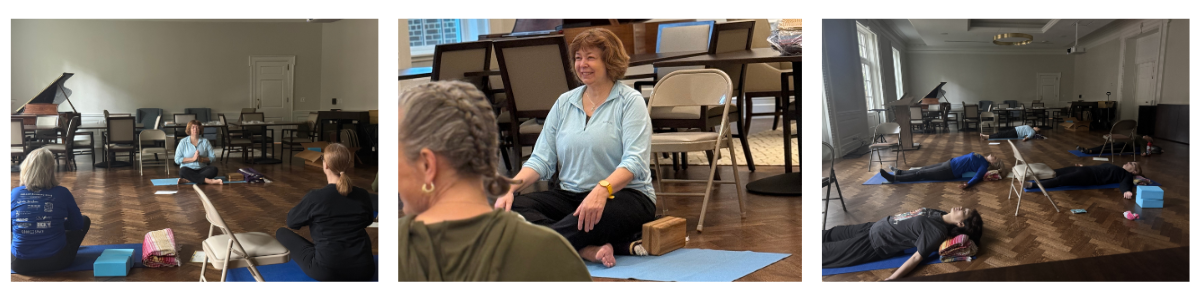
In her Bible and Yoga course, Scholz pairs readings from the Psalms with asanas, the physical postures commonly associated with yoga. As students hold restorative yoga poses, they rehearse together in call and response biblical verses to enter a meditative state of mind.
“As we hold the pose, we are speaking out loud a biblical word or verse in English or Hebrew,” Scholz explains. “Since students are busy with the physicality of the poses, they cannot really get attached to the words spoken.”
By the end of the process, Scholz observes, students hear familiar biblical phrases or verses in new ways. The combination of physical movement and biblical text creates mental-intellectual space for deeper theological reflection and innovative interpretive insights. By engaging both body and mind, students slow down and approach scripture with openness and attentiveness. Scholz describes this process as “materializing exegesis.”
Mental wellness and embodied spiritual practice
For Scholz, exploring new approaches to biblical texts is essential to keeping theological engagement vibrant and meaningful.
Scholz says engaging scripture in novel ways helps readers avoid “biblical clichés that prescribe rigid or stale theological beliefs.”
She also believes the process of “materializing” biblical interpretation appeals to people who feel disconnected from the Bible or their faith because this this physical approach invites practitioners to encounter biblical texts in spiritually nourishing ways.
Scholz sees a strong connection between embodied spiritual practice and mental wellness.
“When we become grounded in our bodies, we relax the mind and our emotional state of being. In the process, our mental wellness improves immediately,” Scholz suggests.
She believes embodied spiritual practice that is centered on mental stillness, inner reflection, and bodily awareness deepens emotional relaxation, spiritual formation, and biblical understanding.
Scholz’s earliest scholarly work in this area is the essay “Bible and Yoga: Toward an Esoteric Reading of the Bible,” published in 2005. In her teaching and writing on Bible and Yoga, she encourages an increased commitment to biblical exegesis, theological discourse, and physical awareness in Christian theological education.
In 2025, Scholz co-edited Contemporary Yoga and Sacred Texts (Routledge) with Belgian New Testament scholar Caroline Vander Stichele. The anthology examines how yoga communities engage texts they consider sacred or spiritually meaningful, and how those texts shape understandings of yoga's history, legitimacy and contemporary practice.