Faculty research: Navigating AI in the theological landscape

On April 14, the Center for Faith and Learning hosted a Faith and Artificial Intelligence panel, moderated by Perkins School of Theology Professor Robert Hunt.
The Center for Faith and Learning is an SMU program dedicated to exploring connections between religious convictions and academic and professional work. At Perkins School of Theology, faculty members such as Hunt are examining the implications of artificial intelligence as the technology rapidly evolves.
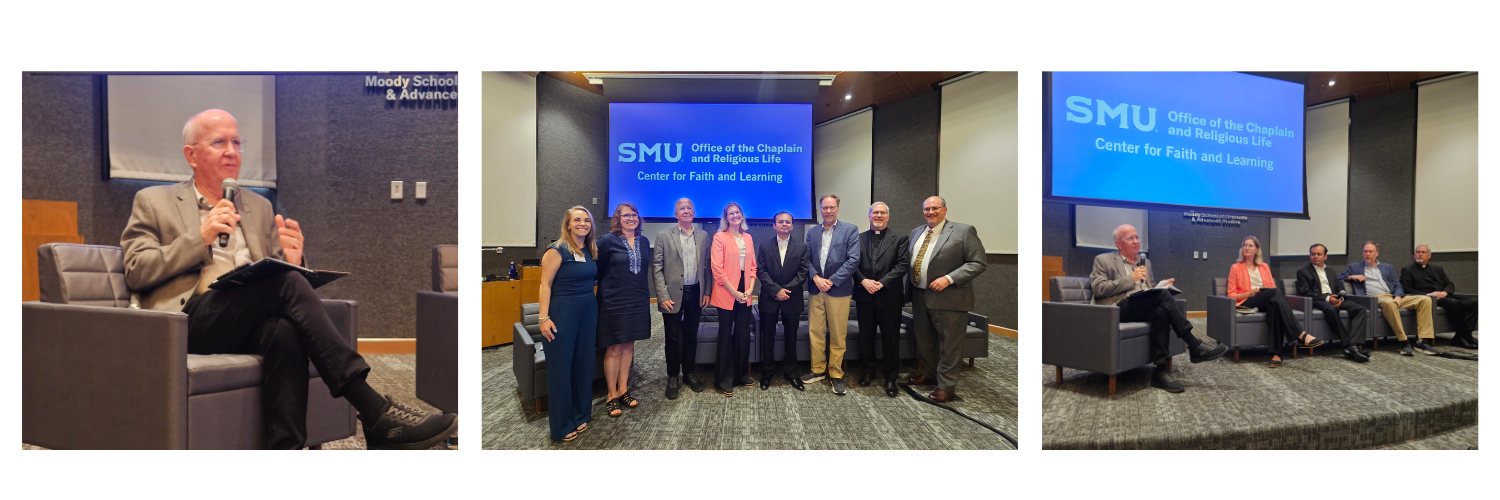
Leading the way: Professor Robert Hunt
After attending an SMU seminar on leadership in the Second Machine Age, Hunt recognized that AI was beginning to play a critical role in human self-understanding. As the technology has advanced, Hunt has focused increasingly on the meaning of intelligence, a concept traditionally understood as a human attribute.
Hunt, who holds a doctorate in philosophy, teaches a course on AI and ministry at Perkins that challenges students to critically evaluate this rapidly changing field.
“I’m encouraged that more faculty are recognizing that AI is shaping Christian faith and practice in the 21st century,” said Hunt. “What excites me even more is seeing how our students are taking the lead in critically engaging AI as a major social and cultural force and beginning to develop theological responses across multiple dimensions.”
When asked about the evolution of AI since he first engaged with the technology, Hunt identified five key considerations:
- AI is not just a technological tool; it also shapes the people who use it.
- There must be a clear distinction between human intelligence and what is called “intelligence” in AI, which may be, an unfamiliar or simulated form.
- Rediscovering what it means to be human in the wake of modernity is increasingly urgent.
- The AI age may require reexamining what it means to be human.
- AI will soon pose significant challenges to how we understand ourselves.
What role does theology play in AI?
Hunt compared today’s technological shifts to earlier periods such as the Enlightenment and the Industrial Revolution, noting that religious communities responded in different ways.
“Broadly speaking, there were two responses,” said Hunt. “Much of Protestant Christianity adapted to new technologies without fully recognizing how they shaped human self-understanding, while the Roman Catholic response was often more reactionary, even as change became unavoidable.”
“Because the central fact of Christianity is the incarnation, anything that influences our understanding of what it means to be human is inherently a theological issue,” said Hunt.
Framing AI through an educational lens
For students preparing for ministry or leadership, Hunt encourages curiosity and critical engagement with AI.
“Christian leaders and ministers, more generally, must take a posture of urgency toward understanding AI and how it is influencing them and their congregations,” said Hunt. “It is present in nearly every aspect of human life, even when it is not immediately visible.”
Hunt said he is encouraged by his students’ curiosity and engagement with the topic, which he believes bodes well for the future of the church.
Hunt’s most recent book, All Brain and No Soul?: Real Humanity in an AI Age, explores humanity’s historical engagement with technological change while examining where human connection remains today.